




A Wide-Angle View of Video Surveillance
Video cameras on school buses always seemed like an unnecessary expense to Monica Coburn — until she became the transportation manager of a school dis...

Video cameras on school buses always seemed like an unnecessary expense to Monica Coburn — until she became the transportation manager of a school district using them.
“Now I see they are to protect the bus driver and the district, as well as the kids,” says Coburn, who works for Bartholomew Consolidated School Corporation in Columbus, Ind. She says the district has video cameras on 111 of its 118 buses.
In converting to the pro-surveillance crowd, Coburn has joined a significant majority of her school transportation peers. These days, few districts or contractors question the usefulness of video surveillance on school buses. Not only are cameras useful for behavior management, they can also help with driver training and enforcement of stop-arm violations.
But let’s first look at the surveillance equipment itself, how school bus operators can determine the right system for their operations and how and when the equipment should be deployed.
Digital vs. analog
The introduction of digital recording devices has sparked interest among many school bus fleets, but traditional analog systems that use VHS tapes remain popular due to their simplicity and lower cost.
A variety of factors must be weighed when determining the best system for a particular bus operation. Operators must consider the intended use of the recording unit, how willing they are to learn new technology and the amount of funding they have to work with.
In the coming years, digital systems will be available that are capable of recording activity in all rows, including the driver’s seat. Coburn says she hopes newer technology will eliminate some of the complications the district has experienced with the current system.
“So many times we try to look at a recording, only to find the tape ejected or that it didn’t tape correctly,” says Coburn. “VHS tapes are just not as reliable and are poor quality.”
Denny Ftout, transportation supervisor for Harrison County Schools in Clarksburg, W.Va., agrees that digital cameras would be ideal but considers the analog models to be better than nothing in a financially-strapped district.
Adding a camera that records outside the bus and installing a microphone for the rear seats are improvements Ftout says would be beneficial. “Soundproof ceilings work great, but they prevent audio recording,” he says.
The fleet’s 96 buses are all equipped with video cameras that are viewed randomly for incidents. Ftout has tried using empty camera boxes in the past but found them to be less effective than boxes fitted with operating cameras.
The belief is that if students and drivers know they are definitely being recorded, they may be more likely to modify their behavior, but even this is not guaranteed.
“Cameras seem to act as a deterrent at first, but after about a month [the students] don’t really care,” says Ftout.
Special-needs buses
Video surveillance has proved most effective in the Vista (Calif.) Unified School District when used on special-needs buses, according to Marta Munson, bus driver supervisor.
Munson first requested a surveillance camera when she was a driver on a special-needs route and needed a way to show counselors and parents how students behaved.
What Munson found, however, was that the students were less influenced by the presence of a camera than she thought they would be.
Use of video surveillance on the district’s regular-education buses is limited to select buses when a need arises. Because the district only transports students in kindergarten through fifth grade, the primary purpose of the cameras is to aid in driver training.
“We try to use the cameras in a positive way,” Munson says. “We do a lot of training on passenger management with the help of video recordings.”
{+PAGEBREAK+} Privacy considerations
Legal questions regarding students’ privacy rights have arisen as video surveillance continues to become more commonplace on school buses. Districts have a variety of policies addressing who can view tapes, what actions can be taken as a result of video recordings and how much of a tape can be viewed.
The Avon Community School Corporation in Indiana follows a strict procedure when it comes to accessing recordings. Drivers must file a request and, if approved, the department has two designated video rooms where a tape can be watched with an administrator.
The rights of parents are not always clear when tapes involve multiple students. Recordings from a surveillance camera can become part of a student’s record, which can only be viewed by the student’s parents and school administrators, under federal law.
“We are very careful when dealing with parents who want to view a tape,” says Kym Robinson, Avon’s director of transportation. Parents must sign a form that says they understand and agree not to violate the Family Educational Rights and Privacy Act (FERPA).
FERPA requires written permission from a parent or eligible student to release or discuss any information from a student’s education record with another parent. To abide by FERPA, some districts make an effort to block the image of other students seen in a recording or show only specific segments of footage.
Ed Cook, a trainer at Chandler (Ariz.) Unified School District, says parents are occasionally allowed to view an incident, but uninvolved students are hidden. He adds that information from surveillance cameras is not used to discipline students, but instead is for improving school bus safety.
Surveillance systems are currently installed in 70 of the district’s 130 buses. Every bus has a camera box and flashing LED light, but cameras are rotated based on need.
Brenda Watson, transportation director for Watson’s Inc., a school bus contractor in Hermitage, Pa., expresses similar concerns about confidentiality issues.
“The problem I have is that these tapes are supposed to be so private, but then they end up all over the news when something happens,” Watson says. She adds that recordings from surveillance cameras are only shown to parents in extreme circumstances.
At Cypress-Fairbanks Independent School District in Houston, parents and all others not employed by the district are strictly prohibited from viewing surveillance footage.
“We do everything we can internally,” says Rick Terrell, transportation director. “Administrators can relay what they saw to parents, and drivers can view tapes with a supervisor, but our policy for parents [viewing tapes] is ‘no.’”
Warren, Ohio-based Community Bus Services Inc. had not pursued video surveillance until a customer recently requested it. This prompted the company to conduct extensive research on the options available, says Paul Hickson, vice president of operations.
“We quickly ruled out videotape systems and began looking at DVRs [digital video recorders],” Hickson says. “But a little research left us with more questions than answers. Apparently, digital technology is not widely used in the school bus industry.”
After getting the needed answers, Community Bus Services decided on four-camera systems with a single audio track and 50 hours of recording time. Hickson says he wanted a system capable of wireless downloads, but was willing to do without until downloading speeds become faster.
Proven usefulness
Duval County Public Schools in Jacksonville, Fla., experienced firsthand the benefits of video surveillance during a beating on a bus in February. A security camera recorded several students pummeling a 12-year-old boy, and the subsequent actions taken by the driver.
The incident prompted the district to pledge to install cameras and recorders on all 1,000 of the district’s buses, of which only 10 percent are equipped now. But the self-imposed fall 2004 deadline will not be met due to a lack of clear policy procedures.
The school board must still decide what type of cameras to purchase, how to discipline students for actions caught on tape and how to finance the purchase. David Solomon, director of transportation, says a camera committee was formed to research the options available on surveillance systems and to talk with other districts about their experiences.
“We’re looking at digital for the running time and because it’s easier to store and retrieve information,” says Solomon. “But cameras are really just a tool. You have to have policy and procedure in place for them to be effective.”
Ask for a tutorial
Avon’s Robinson is familiar with the research involved in selecting features that will enhance a transportation department’s operations. She says it’s easy to spend too much for options that aren’t effectively utilized.
When transitioning from analog to digital technology, Robinson says it’s important to learn the product and take advantage of its full capabilities.
“You do need to prepare and train for digital,” says Robinson. “You’re making an investment, and it’s a good investment, but you should use it correctly. It’s not quite as easy as just popping in a tape and going.”
Robinson recommends meeting with the manufacturer of a surveillance system to have features explained and demonstrated. Keeping abreast of constantly changing technology can be difficult, but using the manufacturer as a resource for information can make the process easier.
Analog technology is certainly not a thing of the past yet. Christine Wiig, sales manager of the school bus division for Radio Engineering Industries Inc. in Omaha, Neb., says analog systems will remain popular with districts that want a recording device but don’t need to go too high-tech and for those on a tight budget.
“I have a conversation with my customers to find out what they are trying to accomplish with cameras,” says Wiig. “It’s important that people understand the two systems because the newer and flashier [digital] systems may not be better for everyone.”
Sumas, Wash.-based Gatekeeper Systems recognizes analog’s continuing importance in the market and has made improvements to its system that address the common complaint of unreliability. Chris Akiyama, Gatekeeper’s vice president of sales, says analog units include more shock reduction to minimize camera movement in a mobile environment and a voltage regulating system to prevent lapses in power.
As long as budgets are limited, analog will remain an acceptable, economic choice for customers. School districts and contractors who are really interested in digital but can’t stretch funds that far can consider analog systems that are able to convert to digital by removing the VCR and replacing it with a DVR.
{+PAGEBREAK+} Cost concerns
Even with the continuing popularity of analog, digital technology is still the trend of the future. Its longer recording time, ability to search for specific events and greater reliability due to fewer moving parts make it a more efficient, time-saving system.
Still, the cost, at least twice that of an analog recording device, is a major factor.
Safety Vision in Houston has attempted to address this concern by introducing a mid-range digital system with two-camera capability.
“We are developing a medium-priced unit for districts who want to use digital but don’t need or can’t afford a high-end system,” says Chris Beard, Safety Vision’s national sales manager for the school bus market.
Digital units can also present indirect costs, such as the employees required to operate and maintain the systems and the computers needed to view the recordings.
Seon Design in Coquitlam, British Columbia, found that the complexity of the system was holding back many districts in their transition from analog, says President Ian Radziejewski.
“Our digital system is more akin to a video-based system because that’s what’s familiar to people,” says Radziejewski. He adds that the advantages of digital technology are more diverse than just the ability to transfer information to a computer.
“It’s a big plus to not have to save information to videotapes,” he says. “You can also hook a monitor to the DVR without needing an entire computer.”
Steven Holmes, president of VerifEye Technologies in Markham, Ontario, says his company has also made a concerted effort to simplify digital systems. VerifEye, which only offers digital systems, has made the unit compatible with a simple, low-cost docking system to eliminate need for a computer.
Holmes says this setup addresses operators’ concerns about the investment required to support the digital recording system. “Most people in the school bus market don’t have tons of technological support, so we want to make it as simple and easy to use as possible,” he says.
Advanced features
Externally-mounted cameras are becoming more commonplace on buses with multiple-camera capabilities. School bus operators use this angle to record stop-arm violators and to verify where students are when an incident occurs.
Many transportation directors remain skeptical of a camera’s ability to clearly record a license plate or identify a vehicle. Brian Curliss, product line manager for Honeywell Video Systems in Surrey, British Columbia, says the technology is advanced enough to catch violators in surrounding passenger vehicles.
“Our external cameras can capture a license plate [on a car] going 30 mph from 30 feet away,” says Curliss. Recording activity outside of the bus is expected to increase as more districts transition to systems with more than one camera. Safety Vision’s Beard says 25 to 30 percent of multiple-camera systems purchased by customers are configured with an external camera.
The demand for wireless technology is also on the rise, says Curliss. Recorders with a built-in hard drive eliminate the need to move the drive between the bus and an office, reducing the risk of damage or loss. Wireless bridges are available and are compatible with current systems. “We’re in an information age,” Curliss says. “People continue to want more from their system beyond a recorded image of the passengers.”
Gatekeeper’s Akiyama says, “GPS and wireless technology are definitely on the radar screen and they will provide huge benefits in coming years.”
Mike Pietrowski, vice president of sales for Tiger Mirror Corp. in Clay Center, Ohio, says he agrees that wireless systems are on the horizon, but aren’t popular yet because of the high cost. His company has the technology, but won’t pursue adding it to surveillance products until usage rates become more reasonable.
Manufacturers predict that digital recording systems will give full diagnostic assessments of the bus at any given time. This will include data about the engine, stop arms, turn signals, braking speed, traveling speed and the exact location of the bus through GPS technology.
More Safety
FMCSA Names New Chief Safety Officer: What School Bus Operators Should Know
Steve Dowling is set to lead the federal agency's efforts to advance commercial motor vehicle safety and reduce crashes, fatalities, and injuries on the nation's roadways.
Read More →
New Study Finds School Zone Speed Safety Cameras Cut Speeding Violations 97%
A Florida university's research demonstrates that Verra Mobility's automated enforcement changes driver behavior and significantly improves school zone safety.
Read More →
What Changed in DOT’s New National Roadway Safety Strategy?
The federal agency's new plan shifts its focus to safer people, roads and vehicles, with a new three-pronged approach instead of five. One outlined action even addresses a key industry concern around illegal school bus passing.
Read More →
Are Autonomous Vehicles Ready to Safely Navigate School Bus Stops?
NHTSA is accelerating autonomous vehicle deployment through new safety standards and commercial approvals. See why school transportation leaders are watching.
Read More →
NFL Star Lomas Brown Kicks Off New Illegal School Bus Passing PSA
Just in time for the back-to-school season, the former Detroit Lions offensive tackle took time to record a video encouraging motorists to slow down around school buses.
Read More →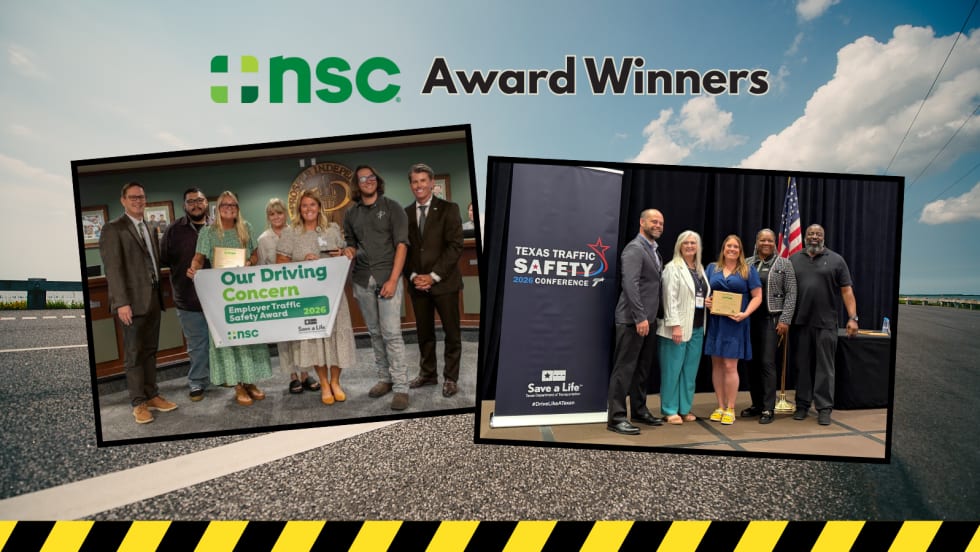
How Two Texas Districts Built Award-Winning Safety Programs
Learn how Prosper ISD and Rockwall ISD earned National Safety Council honors through hands-on training, safety culture, and strategies that reduced transportation incidents.
Read More →
NHTSA Releases 10-Year Review of Fatal School Bus Crashes
The latest federal analysis reinforces the safety of school buses while identifying where school-age pedestrians and other motorists remain most at risk.
Read More →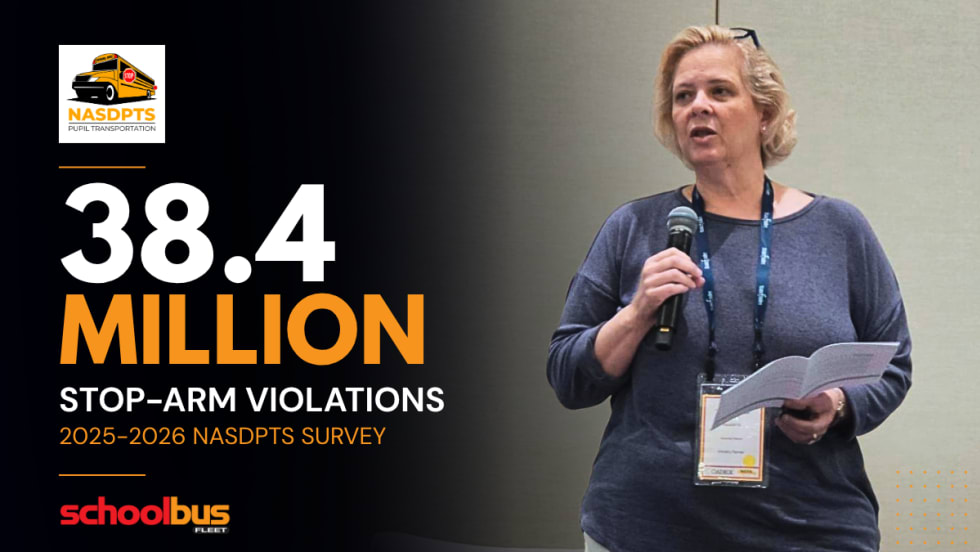
2026 NASDPTS Survey: Data Shows Further Reduction of Illegal Passing
New data is in! School bus stop-arm passings are down to 38.4 million violations per year, about a 2.3% decrease from last school year — but passings on the right side of the bus are higher than ever.
Read More →
Another School Bus Fatality Reported in Monsey, New York
A 7-year-old girl died after being struck by a school bus in Rockland County, New York while crossing the street. Here's what we know.
Read More →
NSTA Announces 2026 School Bus Driver International Safety Competition Winners
Drivers from across the U.S. and Canada showcased their safety and driving skills, with two defending champions successfully retaining their titles.
Read More →