




A Farmer Puts His Faith in Pupil Transportation
In a mountain-fringed Utah valley, Wayne Reese has used his administrative skills to guide pupil transportation for two local school districts – and managed to avoid staff layoffs during the COVID-19 pandemic. His accomplishments make him School Bus Fleet's Administrator of the Year.

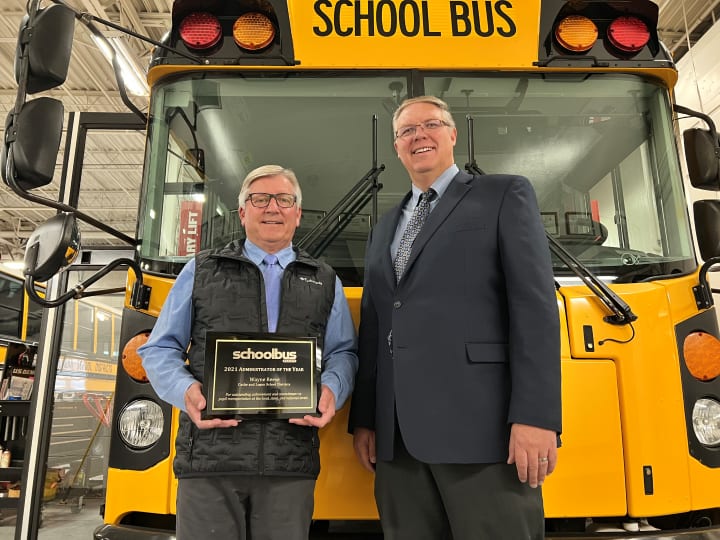
Wayne Reese, a dedicated student transportation leader since the 1990s, helped develop a public/private partnership for bus fueling and pioneered GPS technology adoption in his region. Reese, left, is shown with Jeff Barben of Logan School District, who nominated him for consideration as School Bus Fleet’s Administrator of the Year.
Photo courtesy of Wayne Reese
At first, Wayne Reese didn’t want to leave his full-time work on the family farm.
In 1985, he started driving a bus part-time to help a friend in the Cache County School District, but he’d grown up on that dairy farm in Benson, Utah, surrounded by Holstein cows, alfalfa, barley, sugar beets, and, eventually, field corn. Reese felt a strong commitment to those fields.
“My Dad always wanted a basketball team of children,” Reese recalls. “So, he and Mom had six children (five boys and one daughter). We grew up working side by side milking cows, hauling hay, moving sprinkler pipe, thinning, and hoeing sugar beets. And if a neighbor needed help, we were taught to go help them as well.”
One day, his boss asked Reese if he’d become a leader in the transportation department.
He couldn’t, he says, “unless I sold my dairy cows and could give the school district the time needed.”
“How much would I have to pay you to sell the cows and come work for me full-time?” his boss asked.
Reese gave him a number.
“Done.”
His boss retired a few years later and Reese took over the department in 1994.
In the years since then, Reese, now 65, has:
Established himself as the pupil transportation administrator of not just one, but two school districts – Cache County and Logan City. He’s responsible for the operation of 150 school buses, carrying more than 10,000 students to their classrooms each day.
Led the charge to get a grant from the state of Utah to get the National Guard to help remove leaking underground fuel tanks and to upgrade the bus fueling system.
Developed a public/private fueling partnership and a centralized fuel billing program.
Served as president of the Utah Association for Pupil Transportation.
Ensured that Cache and Logan became the first districts in the state of Utah to install GPS systems on all school buses.
Updated the state’s school bus driver instruction program.
Then, in 2020, the pandemic hit.
“We had one weekend to transition from in-school learning to virtual learning for the students in both districts,” Reese says. “In transportation, we had the weekend to find ways for our staff to continue to contribute to the missions of the school districts.”
He managed to keep his drivers and attendants on the job without layoffs and helped keep a connection between the students isolated at home and their schools.
For all these accomplishments, School Bus Fleet recognizes Wayne Reese as its 2021 Administrator of the Year.
Raised to Serve
For 25 years, Reese has served his ward in the Church of Jesus Christ of Latter-Day Saints in different capacities, including as a bishop (pastor) and stake president (leading a regional group of wards, consisting of 400-500 members). Between 1975 and 1977, he served a two-year mission for the church in Australia. These days, he plays organ on Sunday and piano when the under-12 children sing each week.
He balances that service with his dedication to manage the transportation needs of two school districts.
“Each of the school districts have their unique leadership styles and structures as they seek to address the varied education needs of their school community,” Reese says. “Each of those school communities have diverse population climates. Each school district has a separate school board made up of patrons who live and work within the boundaries of the school district and are elected by their neighbors to support what they feel is in the best interest of their children. Each of the school districts have varied taxing abilities to support the ‘missions’ of the school districts’ boards of education.
“Our challenge is to support the separate missions of each board of education, as well as supporting the implementation of those missions by the separate leadership teams.”
Teri Rhodes, president of the Cache School District Board of Education, praises Reese for his efficiency and strength of character.
“Not only is he efficient; he is kind – to students, parents, employees, and community members,” Rhodes said. “He listens patiently to concerned parents who call him, he responds quickly to problems that arise in the department, and, as a former bus driver himself, has been known to act as a substitute for drivers when we have a shortage. In our current societal landscape, where so many people seem to be trying to make themselves look better by attacking or belittling others, Wayne Reese’s compassion and kindness for others shines as a model for others to follow.”
Building a Partnership
Cache County, in northern Utah, borders Idaho.
“It’s known for great cheese, blue ribbon beef, and our Utah State University Aggies,” Reese says.
The area’s about 1,164 square miles, with about half that representing a valley floor fringed by mountains. The districts keep operating costs down by housing school buses throughout the valley – some at remote compounds and many at drivers’ homes.
“As we were removing leaking underground fuel tanks, we knew we needed a more environmentally sustainable method of providing fuel to our school buses, while also realizing our buses are housed in many locations throughout the valley,” he says. “This reduces cost by having the bus close to (the driver’s) daily bus route.”
Reese worked with state officials to add more fueling sites through a private/public partnership that helped keep fuel costs stable.
The state installed a fueling site at one of the bus compounds in the south end of the valley. Reese worked with privately owned stations elsewhere in the valley to join a state network of fuel sites.
“It involved getting the private sites to agree to ‘cost above fuel rack prices’ so we could count on stable pricing,” he says.
Making Tech Believers
Another challenge faced by school transportation leaders is occasional disagreements about the facts of a situation between parents or students and a bus driver.
“A patron says the bus didn’t stop at the bus stop, or it was early or late,” Reese says. “A school principal said the bus was late or early into the school.”
The supervisor meets with the driver, who reports they were on time and did stop, as scheduled.
Who’s telling the truth?
“The GPS system provided a neutral source of information that wasn’t subject to opinion or statements,” Reese says.
Shortly after the district installed the GPS system on school buses in 2004, the superintendent walked into Reese’s office. He’d heard there’d been a fatal school bus collision on the freeway, just over the mountain from the valley, where the district sometimes sent field trips and activity buses.
“When I looked up the location of our buses and could demonstrate to him it wasn’t one of our school buses, he said, ‘I am a believer,’” Reese says. “With the assistance of our transportation IT computer programmer, we now use the GPS for all the things we purchased it for, plus payroll, state reports, bus service needs, and more.”
“More” includes a new phone app that’s now being tested, which allows parents to see how close their child’s bus is to their bus stop and at what time the bus arrives safely at school.
“We plan to begin with one school and eventually add all schools in the valley to the program,” Reese says. “We have more than 5,000 separate school bus stops in the valley, so this will be a significant challenge and opportunity.”
The districts also are transitioning GPS systems to operator tablets that the drivers can use to record all their inspection and communication needs.
“We also plan to have the bus route saved on the tablet, so when a substitute fills in on that route, they will have route turn-by-turn directions to assist them in safely covering the route,” he says.
Pandemic Perseverance and Driver Shortages
Not long after the COVID-19 pandemic struck in the spring of 2020, Reese worked with his team to organize lunch routes so that bus drivers and attendants could visit schools, pick up lunches, and then distribute them at the regular school bus stops.
“This gave our students a physical connection to their school as they came to the bus to receive the free lunches,” Reese says. “We had principals and other school staff riding the bus from the school so they could connect with their students. Homework was delivered and received on these lunch buses.
“The heart-warming stories of students riding four-wheelers pulling wagons to obtain lunches for a neighborhood that had rallied to support the families whose parents were still required to work and not at home filled our drivers with compassion and joy in this service.”
That good news aside, his valley districts haven’t been entirely immune from the nationwide school bus driver shortage.
“Our valley has one of the lowest unemployment rates in the state of Utah and in the nation,” Reese says. “This is the first year since I have been here that we didn’t have a permanent driver for every route at the start of the school year.”
That means trainer/coaches, office workers, and shop staff have put themselves behind the wheel to help.
“We have increased our advertising and our new driver incentive program for new hires,” he says. “Our trainers have been working overtime to train new drivers as well as drive bus routes. We still do not have a permanent driver on every route, but we have been able to make sure every route has been covered every school day so far.”
Family Adventures
Reese and his wife, Kathy, have been married for 42 years.
She got her license to drive a bus when he started so that, if he had to deal with a farm emergency, she could drive for him. She has now driven full-time for 27 years.
They too managed to have enough children for a Utah State Aggies starting lineup – one son and four daughters. Now they’ve got 10 grandchildren too. Kathy has driven most of those grandchildren to school.
Wayne Reese enjoys traveling with the family.
They own utility terrain vehicles (UTVs), which they ride into the mountains to see wild animals, flowers, and the colors of fall. They go rock crawling in Moab near Canyonlands National Park and in Sand Hollow, not far from the Arizona border.
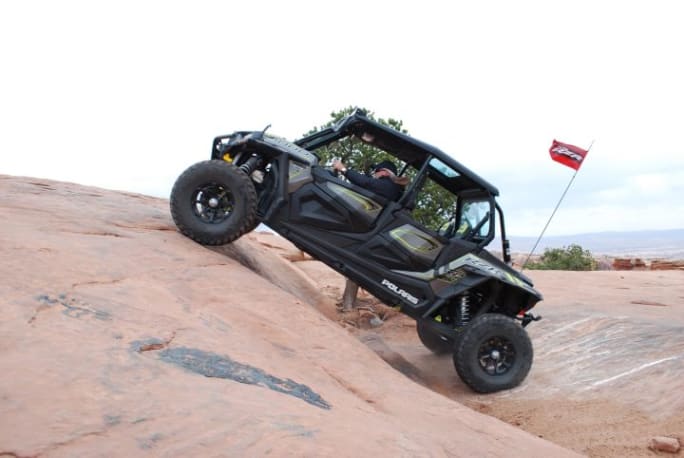
In his spare time, Reese likes to ride utility terrain vehicles (UTVs) into nearby mountains. He also enjoys rock crawling in Utah’s Moab and Sand Hollow.
Photo courtesy of Wayne Reese
The year Reese turned 60, he flew to San Francisco with his son and sons-in-law, where they rode Harley Davidson motorcycles up the coast through the redwoods, into Oregon, and through Napa Valley on the way back to San Francisco.
“It was such a great week,” he says.
Valued Dependability
Frank Schofield, the superintendent for the Logan City School District, considers pupil transportation an essential service that allows the school day to move forward. Without it, he notes, thousands of students would miss academic instruction, social and emotional support from teachers and peers, and sometimes basic nutrition.
“Wayne manages the transportation services for two school districts, and ensures the busing system addresses the unique needs of each community,” Schofield says. “Wayne is dependable, kind, and honest in his interactions with patrons and staff, and promotes a positive, customer-service based environment in the transportation departments.
“Whether he is monitoring weather and road conditions before sunrise, advising districts on the effect that school boundary alignment will have on transportation services, or ensuring all drivers are adequately trained, Wayne consistently directs the transportation efficiently and with a positive attitude. I am grateful for the opportunity to work with him and benefit from his years of experience.”
When it comes to business, Reese’s guiding principle is that no company can cut its way to success: “You succeed by out-innovating the competition.”
And when it comes to customer service?
“When a customer asks you to do something, don’t let what you cannot do keep you from doing what you can do,” he says. “Just because you may not be able to do everything the customer wants you to do, if you find something you can do for them, they are likely to remember that and return.”
He considers the continued safety of the children carried on his districts’ school buses the most critical goal, each and every day.
“I feel my most important achievements as a school bus fleet administrator is the same as our bus drivers – that no child is seriously harmed as they travel between their homes and their classrooms,” Reese says. “Though we are human and not without error, I am grateful for the safe way in which our drivers care for their students’ safety. As our valley continues to increase in population, the traffic becomes more congested and more difficult for our buses to safely navigate. I am grateful we have not had any student fatalities or serious injuries, and I pray we never do.”
More Management

How to Build a Better Driver Training Program
Ready to boost up your school bus instructor training? Here’s how to pick the right talent and improve recruitment, retention, and safety.
Read More →
CALSTART and Forth Combine to Form Catalyst Mobility
The new name represents a renewed vision for the nonprofit focused on advancing clean, equitable, and affordable transportation solutions that move people and goods.
Read More →
What Makes a Great School Bus Driver Trainer?
Choosing the right school bus driver trainer takes more than experience. Learn six keys to selecting and developing trainers and evaluating program effectiveness.
Read More →

School Bus Contractors Expand Through New Deals, Acquisitions & Partnerships
STA's Canadian division acquires Ontario-based G&L Stevenson Transport while Durham School Services adds a new district contract in California, First Student adds a New Jersey contract, and Minnesota Coaches acquires Halo Transportation.
Read More →
Logan Bus Company Rolls Out AI Phone System for NYC School Bus Families
A summer pilot found that AI agents could handle most routine calls, freeing up time for customer service staff to focus on emergencies and complex family concerns.
Read More →
From Intent to Impact: What I Learned About Leadership from TAPT
A Texas transportation supervisor shares lessons on self-awareness, accountability, managing stress and building trust — and why investing in leadership development matters at every stage of your career.
Read More →
NAPT Names 2026 Award Recipients, Hall of Fame Inductee
Who earned national recognition for their work in student transportation? This year, NAPT named five recipients of its 2026 awards for service, safety, and leadership, plus its newest Hall of Famer.
Read More →
2026 State of Student Transportation Report
Driver shortages. Rising costs. Growing safety expectations. More data, but not enough time to act on it. The 2026 State of Student Transportation Report reveals what transportation leaders say is putting the most pressure on their operations—and where they’re investing next. See how your priorities compare.
Read More →
How to De-Escalate an Angry Person: 5 Steps for Handling Workplace Conflict
What makes emotions run high, and how should you handle an angry colleague or parent? Follow these steps for staying calm, listening, showing empathy, and resolving conflict.
Read More →
What Readiness Looks Like This School Year
Learn about the challenges shaping the 2026–2027 school year, from persistent driver shortages and budget pressure to technology and readiness gaps. See how school districts are responding and adapting in Zonar’s 2026 Back-to-School Readiness Report.
Read More →