




8 Ways to Improve Your Tire Program
Improving the efficiency of your tire management program can return significant savings. Here are some basic, but often overlooked, strategies to ensure that your tire program is rolling smoothly.
Tires are a major expense for any school bus fleet. Only fuel and oil take a bigger chunk out of the budget for vehicle upkeep. So it makes sense that fleet managers would closely track and scrutinize tire performance and ensure that money is not being wasted due to tires that are poorly inflated, mismatched, misaligned or ignored. But the reality is that many fleets waste thousands of dollars each year because they overlook fundamental tire inspection and maintenance procedures. There are no well-guarded secrets to operating a safe, cost-effective tire program. The following eight tips will not change anyone’s perspective on tire management, but they should help to remind and inform fleet managers of essential strategies that could save them money and improve the safety of their school buses.
1. Pressure points
Let’s start with the obvious. Proper inflation of tires is critical to their performance and longevity. Although many fleet managers say they check tire pressures on, say, a weekly basis, they probably don’t. It’s an easy task to skip, both by drivers and by mechanics. But it’s important not to skip this relatively simple procedure. As you know, underinflated tires wear faster and reduce fuel mileage. That means that you’ll have to replace the tires — and fuel the vehicle — more often. According to The Maintenance Council, 10 percent underinflation will shorten tread life by 9 to 16 percent. That amounts to wasting $15 of tread on a $150 tire. You’ll also be robbed of fuel economy with an underinflated tire. With the recent surge in fuel prices, many school bus operators are searching for new efficiencies: Proper tire inflation is a slam dunk. John Alder, director of support services at Hallsville (Texas) Independent School District, offers the following key information about tire inflation.
Maintain the proper inflation pressure for the maximum anticipated load. Inflation guides are provided in the tire manufacturers’ specification handbook.
Check tires at every fueling with an accurate gauge. Have a master gauge that that is used only to correct the shop use gauges on a weekly basis.
Post inflation pressures on individual vehicles. If the pressure varies more than 10 pound per square inch, mostly likely something is wrong with the tire. Find out what is happening.
If the pressure is 10 pounds per square inch (psi) low, the tire is flat and needs to repaired or replaced. If the tire is 10 pounds psi too high, someone is not checking and/or inflating the tires properly.
2. Pick your tires wisely
A bargain price does not guarantee a happy customer. A good tire program begins with a good tire, even if that tire is more expensive than a competitor’s brand. “Purchase quality not price,” says Alder. “This is especially true in purchase decisions on recap tires.” “Don’t be afraid to try a different brand of tire, but always buy the best tire you can afford,” adds Brad Barker, head mechanic at Park City (Utah) School District. “Always buy at least the ply rating that is specified on the bus spec data plate. Never cut corners or try to save a buck when safety is involved.” Wayne Johnston, transportation director at the School District of Springfield Township in Oreland, Pa., says he tracked the durability of tires built by different manufacturers and discovered that one brand obtained twice the mileage of the other. In the long run, the $40 savings on the cheaper tire was an illusion because it needed to be replaced so much sooner. “You should track your tires closely if you really want to know how they’re performing,” Johnston says. “The upfront cost comparison can be misleading.”
3. Educating drivers
The key to an effective tire program is regular inspection and maintenance. It can be a major plus for your program if your drivers are conscientious about checking tire pressures. That’s a tough sell, however. Many drivers are reluctant to check tire pressures with a gauge and would rather thump them with a club. But that isn’t an accurate method of gauging tire pressure. So what’s the answer? Educate your drivers about the importance of maintaining proper air pressure in the tires. “During our 'back in the saddle' in-service training, we had the company that does our re-caps provide training for our drivers,” says Bill Bair, transportation director at Colorado Springs (Colo.) School District No. 11. “They learned about the importance of air pressure on tire life and the potential hazards of ‘zipper rip’ on radial tires. The training also opened their eyes about maintaining proper air pressure in the tires on their personal cars. It’s also important to encourage drivers to report problems with their tires. “When drivers take a curb shot or rub the curb, it damages the sidewall of the tire,” says Ben Cole, fleet maintenance manager in Colorado Springs. “It’s important for drivers to report any curb shots to their mechanics.” Cole says conscientious drivers can add 5,000 to 10,000 miles of wear on a tire.
4. The proper match
Proper matching of dual tires is critical. Ideally, they should be matched by brand and model. Another key consideration is whether the tire and its mate have compatible diameters. According to Alder, an 11R22.5 tire should not have a mismatch of more than 0.2 inches, with the larger tire on the outside. Improperly matched duals can lead to uneven wear and early failure. The larger tire, especially if there is a dramatic difference in diameters, will take the brunt of the load, causing it to wear prematurely. Though it shifts some of its load to its mate, the smaller tire also pays for the mismatch because it’s being dragged along by the larger one. This can cause rapid and irregular wear. Calipers can be used to measure diameters of tires on the vehicle, and a wall-mounted tire meter can be used to measure free-standing tires. It’s also important that air pressures of dual tires be matched.
5. Reduce exposure
Casings should be stored indoors or under a tarp to reduce any exposure to the elements. “Tire stored outside are deteriorating without being used,” says Barker. In Barker’s case, he says standardizing his fleet has helped to track tires and reduce inventory. “I try to keep two full sets on hand and mounted on wheels,” he says. “My tire vendor buys casings from me when my inventory gets higher than three sets.” Another sound strategy is to keep the casings clean and to avoid using water or petroleum products on tires. “Always use bead lubricants when mounting and dismounting tires,” Alder says. It’s also important to keep patching materials dry, clean and cool, advises Alder. “Use only one brand of tire repair products,” he adds. “It is best to use what your recapper uses.” 6.
Don’t tread lightly
Regular inspection of the tread can identify wear problems before they turn nasty. “If wear is uneven and tread depth starts to get down to 4/32 of an inch, it’s time to pull them,” says Cole. “This is where the mechanic or the garage helper comes in.” Tires should also be inspected for nail punctures and damage to the sidewalls.
7. Find a good capper
If you choose to use recaps on your buses (and not all districts do), make sure that you find a retreader who provides a quality product and good service at a reasonable price. Alder suggests that you visit the retread shop before sending in tires. “If it’s dirty, go somewhere else,” he advises. “And ask questions about everything you see.” Competition and consolidation have narrowed the field in the retread industry. Only the most reputable, professional outfits are in business these days, so you don’t have to worry about shoddy workmanship. But you still should track failures and mileage performance for each new retread product. Don’t be shy about testing new retreaders if you’re not satisfied with the performance of your existing supplier. And you shouldn’t forget about service requirements. Does the dealer pick up and deliver? Provide mounting and dismounting? How about 24-hour road service? And what kind of turnaround time do they promise? You’ll also want to ensure that they can meet your limit specifications.
8. Consider outsourcing
Should you handle tire repair and service in your shop or outsource the service to a professional tire shop? Depends on who you ask. Barker in Park City says he prefers to handle most of his tire chores himself and is happy with the results. “I like doing my own tires, so I can control the quality of the work,” he says. “You don’t know what the other guy is doing until you have a failure.” Barker says there are few essential components to an in-house tire program. “If you are going to do all of your own tire dismounting, repairs and mounting, you need to have your mechanics trained, have some special equipment and be able to lift 75 to 100 pounds,” he says, adding that basic tire tools are relatively inexpensive at less than $1,000. On the other side of the aisle, Bill Bowman, supervisor of vehicle maintenance for Indianapolis Public Schools, says he’s saved a bundle of money since switching to a contracted tire service. About 10 years ago, he says, the cost of having a two-man tire maintenance crew was approximately $60,000 per year. Each worker handled an eight-hour shift, giving the department 16 hours of coverage per day. “I can get the same service 24 hours a day, seven days a week, 365 days a year for $20,000,” he says. “It’s been a substantial cost savings to us.” Under the contract, the vendor performs tire repairs, mounting and dismounting and emergency road service, Bowman says. Buses with an en-route tire problem can expect service from the vendor within 45 minutes. In addition, once a quarter, the company sends over technicians to check the air pressure in all 303 buses in the fleet. “It’s worked out real well us,” Bowman says.
More Maintenance
The essential guide to school bus maintenance and student safety
Reactive maintenance puts students at risk of breakdowns, delays and roadside emergencies. This guide gives transportation directors a data-driven framework to predict failures, extend bus lifespans and improve fleet reliability across every route.
Read More →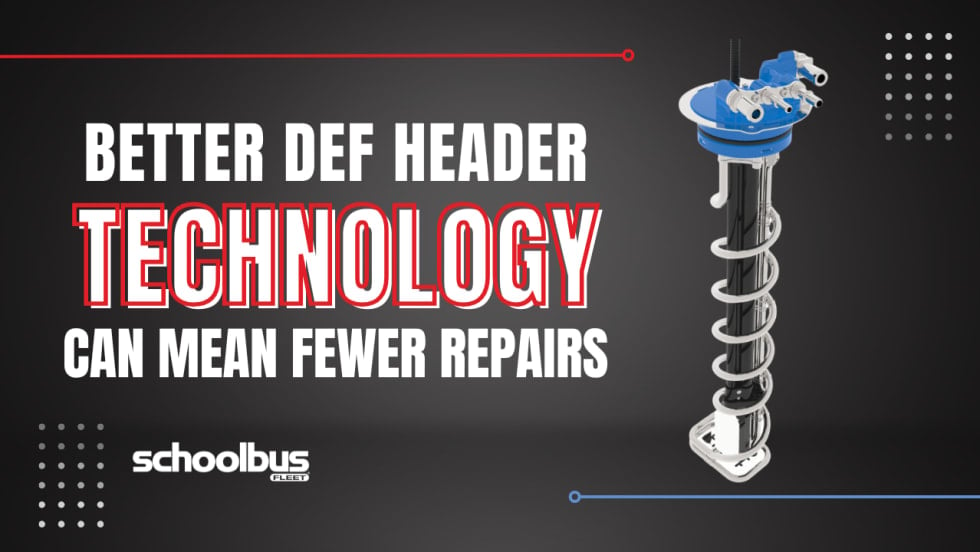
The Evolution of DEF Header Technology: What School Bus Operations Should Know at Replacement Time
See what school bus fleets should consider when replacing DEF headers to improve reliability, reduce repeat repairs, and control maintenance costs.
Read More →
Kerry Brothers Grows Michigan School Bus Repair Network
The acquisition of Downriver Truck and Bus expands Kerry Brothers’ school bus maintenance footprint across southeast Michigan, adding repair capacity, diagnostic resources, and state inspection support.
Read More →
Noregon Introduces CAN Bus Diagnostic Tool, Expands JPRO Features
CAN Mentor and the latest JPRO update aim to simplify vehicle network diagnostics and improve repair efficiency for technicians of all experience levels.
Read More →
Cummins on Smarter, Simpler Engine Innovation
Cummins discusses its first-ever gasoline engine for school buses, EPA 2027, and why bus fleets still want durable, simpler internal combustion options.
Read More →
Report: 72% of Diesel School Buses Now Use Advanced Low-Emission Engines
New data shows advanced low-emission diesel technology continues expanding across school bus fleets, even as electric bus adoption gains momentum.
Read More →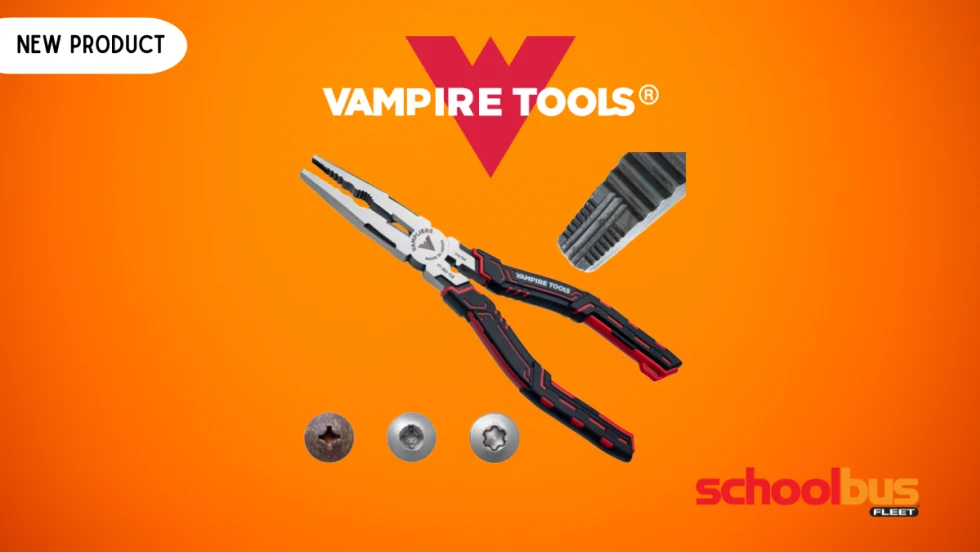
Vampire Tools' CAIMAN 7.5-Inch Multi-Purpose Screw Extractor Long-Nose Pliers with Crimper
Vampire Tools introduced the VAMPLIERS Caiman 7.5-inch multi-purpose pliers, combining screw extraction, cutting, crimping, and gripping functions into a single tool designed for fleet maintenance professionals.
Read More →
How Advanced Diagnostics Helps Bus Fleets Stay Ahead of Repairs
Chat with Noregon’s Kevin Smallhorn at ACT Expo about bus diagnostic tools, telematics integration, CNG maintenance support, and strategies to help reduce downtime and improve uptime.
Read More →
How School Bus Fleets are Getting Ahead of Breakdowns
Don’t let bus downtime wear you down. Here’s how bus operators are shifting from manual processes to AI-powered, data-driven maintenance systems for improved reliability and safety.
Read More →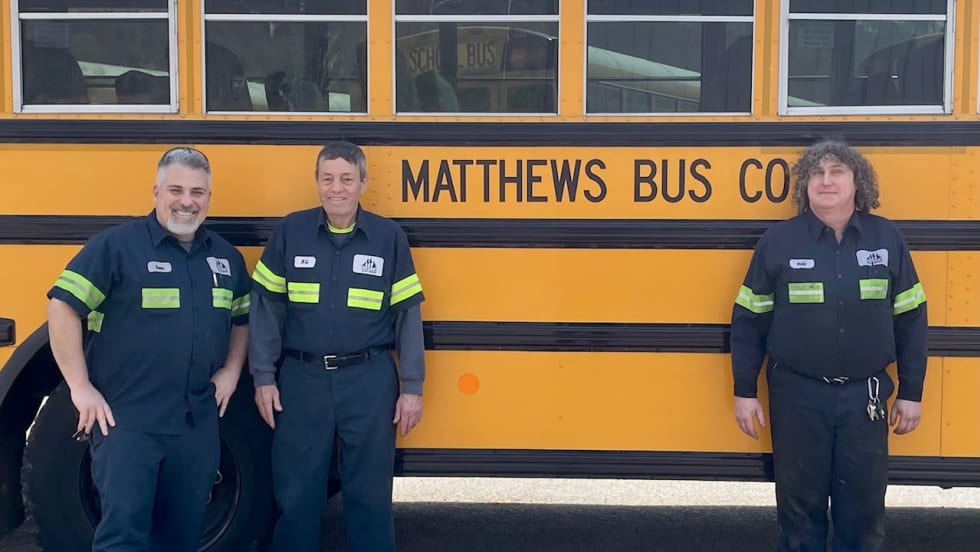
Pennsylvania School Bus Maintenance Team Praised for Dedication to Safety
Matthews Bus Company’s West Jefferson received a letter of commendation from the Pennsylvania State Police for their fleet inspections.
Read More →