




75 Great Ways to Improve Your Operation (Part II)
Even if you've got a top school bus operation, you've likely got room for improvement. Here are more than six dozen of the best tips, tricks, and techniques any outfit can employ.
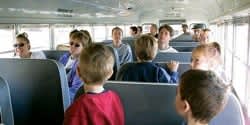
As part of the First Ride program in Calgary, Alberta, parents and kindergartners ride the bus together before school begins. They also view a PowerPoint presentation and video on bus safety.
Even if yours is one of the top school bus operations in the county, you've likely got room for improvement. Maybe you need to cut even more costs to accommodate a deteriorating budget, or the kids on that one route just won't behave. Here are more than six dozen of the best tips, tricks, and techniques any outfit can employ.
16. Explain diesel fumes to parents
Over the past few years, several diesel exhaust studies have created fears about the possible hazards of school bus emissions. Here’s how you can address these issues with parents:
- Acknowledge their concerns. Yes, the news reports are frightening, but they don’t always tell the full story.
- Tell them what you have done to reduce emissions. If you’ve limited idling time or bought new buses recently, you’ve contributed to reduced emissions.
- Tell them that removing children from the bus won’t eliminate their exposure to diesel exhaust. One study found that children who walked to school were exposed to higher particulate levels than children who rode the school bus.
17. Join the crowd — at an association
If you don’t belong to a local, state or national association, you’re not taking advantage of a valuable resource. Associations not only provide members with a sense of belonging, they also provide a great opportunity to network (which can lead to a better job!) and to exchange information about regulatory changes, equipment, training, policies and procedures and just about anything else that you can think of. In addition, many associations provide updates through newsletters and some offer deals on group insurance and other related benefits.
For information about local and state associations, check with other school transportation professionals in your area or grab a copy of SBF’s 2004 Fact Book and peruse the Industry Associations section. There are also a couple of national associations that might meet your needs. The National Association for Pupil Transportation (www.napt.org) mainly serves school district operations but also includes contractor members, while the National School Transportation Association (www.yellowbuses.org) focuses exclusively on the contractor community.
18. Improve communication on special needs
The importance of providing safe, efficient transportation to all eligible students, including those with special needs, is obvious to those in pupil transportation.Critical to meeting this challenge, however, is the knowledge base of the transportation providers, especially when dealing with special-needs passengers. Last year, the Office of Special Education Programs (OSEP) in the U.S. Department of Education issued a memorandum about the need for “meaningful and effective communication” between state special-education officials and local school districts on the subject of transporting students with disabilities. When necessary, transportation providers should be involved in a student’s Individualized Educational Program (IEP). Access & Mobility, a guide on transporting students with disabilities published by the California Association of School Transportation Officials, describes the IEP process this way: “This is an opportunity for transportation personnel in concert with special-education professionals and parents to develop the best strategy for delivery of effective services.”
19. ‘First Ride’ makes a big difference
In 2000, Southland Transportation in Calgary, Alberta, was among several contractors that helped to set up a school bus orientation and training program for children entering kindergarten and their parents.The program, branded “First Ride,” has been a great success since its inception, says Southland Transportation’s June Read. “It highlights the important role parents play to ensure that their children are in safe hands — not only on the bus but also on the journey between bus stop and home,” she says. Here’s how it works: A phone number and reservation system is set up for each of the participating school boards. After agreeing on a First Ride date, school locations are set up, with the transportation managers providing the necessary audio-visual equipment, support staff and volunteers. A corporate sponsor provides juice and snacks for attendees and volunteers, as well as a goodie bag and handout for each child. Meanwhile, Alberta’s provincial government safety agency hands out materials such as reflective arm bands. The educational component includes a 20-minute PowerPoint presentation on bus safety and the showing of a Winnie the Pooh school bus safety video. These presentations are followed by a “first ride” on a school bus. The program concludes with the distribution of safety handouts.
20. Learn to handle angry people
Here are some tips on how to deal with an upset worker:- Accept the person’s mindset. You don’t have to agree with it, but understand that the person needs to vent.
- Ask open-ended questions. Invite the person to give long-winded answers so that he knows you’re listening.
- Propose a trade-off. Make concessions, but ask for something in return.
21. Ready for the unthinkable?
Follow the lead of Department of Defense Dependents Schools, which are required to have annual anti-terrorism training. Before the school year starts, experts are brought in to meet with staff members on a variety of topics. This information is then passed to bus drivers and other transportation department personnel.
Additionally, if you don’t already have an emergency manual for non-natural disasters, consider developing one. Use training programs, local emergency response teams and feedback from other operations to help collate the material. Bomb threats, for example, are realistic threats to a school bus, whether terrorist related or not. Having procedures to prepare everyone for emergencies should cover most terrorist acts and a slew of other dilemmas.
22. Partner for a healthier environment
Participating in the Environmental Protection Agency’s (EPA) Clean School Bus USA program, Dale Krapf, president of Krapf Bus Companies in Exton, Pa., is not only transporting children safely but keeping an eye on the environment.The pilot program involves retrofitting existing Krapf school buses with emission reduction technology. Krapf implemented the program upon learning about the EPA’s initiative, which is designed to help communities across the nation reduce pollution from school buses. The technology used to retrofit Krapf’s buses is the same as the technology that will be used to meet the 2007 EPA requirements for all new diesel school buses.
Krapf is one of the first private school bus fleets to start such a program. “I take what we do very seriously and personally,” he says. “I feel a responsibility to help keep the air free of pollutants.” Working with school districts near its home base in Exton, Pa., Krapf Bus is retrofitting school buses with emission control technology. “We are working with some very progressive school districts who understand the benefits and value of clean diesel technology,” Krapf says. During the first phase of the program, Krapf has retrofitted four buses in the Great Valley School District in Malvern, Pa.
The next phase will be the retrofit of 16 school buses in the West Chester (Pa.) Area School District. The technology being installed on Krapf school buses is manufactured by Johnson Matthey. The combination of its particulate filters, which use continuously regenerating technology, and ultra low sulfur diesel fuel can reduce emission pollutants by more than 90 percent. The filters will require maintenance every 60,000 to 100,000 miles of operation, but other than that are “fit-and-forget.” While Krapf acknowledges that retrofitting school buses can be costly for a school district or school bus contractor — the cost can vary from hundreds to thousands of dollars depending upon the retrofit technology — the cost of not doing it is greater in terms of health risks. “It’s important to us that the emissions that come from our buses are as clean as possible,” Krapf says. “That’s why we’re voluntarily retrofitting our school buses with Johnson Matthey technology.”
23. Do as I do and as I say
Kids are always watching adults for cues on how to behave. What will they learn from you?Have all personnel who come in contact with students commit this to memory. Children observe how you drive, speak, gesture and react to their behavior. They also notice when you forget to talk with them or forget their names. School transportation personnel, especially bus drivers, need to be good role models. This evokes similar behavior from their riders.
— Submitted by Gary Coller, bus driver at Gross School Bus Service in Wyomissing, Pa.
24. The fight against stupidity
School districts throughout North America are regimented by sets of rules that have taken shape over the years through superintendent mandates, school board policies and best practices. Unfortunately, many of these rules are outdated, unfair or just plain stupid. But no one ever made a rule saying they have to stay that way.Denver Public Schools implemented a “dumb rules” committee to review the district’s rulebook and examine questionable practices. Based on staff, parent and student complaints, the committee investigated each potentially silly rule and, if necessary, followed a set procedure for how to remove or alter it. The school system also created a Web page dedicated to the dumb rules task force, and interested parties have been encouraged to e-mail suggestions and concerns to staff members through the site. The program created a direct outlet for basic problems to receive administrative-level attention.
25. Get thee some software!
In these days of growing technology, there is a program for every need, especially for tracking and organizing vehicle maintenance. If your operation is large enough, software for trip scheduling and bus routing is also a must.By the way, you need a pretty powerful computer system (with printer) to handle most of the work, but the good thing is the hardware is usually less expensive than most of the software!
— Submitted by Neal Abramson, transportation director, Santa Monica-Malibu (Calif.) Unified School District
26. Top riders receive emergency training
For the past 10 years, we’ve had a “lead student training program” that has helped to improve behavior management and emergency preparedness. It works like this: Each driver chooses four students from each route to participate in a brief training program. As the supervisor, I load a bus with the chosen students and take them on a short field trip to teach them the following emergency actions:- Pulling the parking brake.
- Using the two-way radio.
- Evacuating other students.
- Using the fire extinguisher.
- How to locate and remove the first aid kit.
The drivers use this program to reward students who act responsibly, and it has become a much-coveted honor. But there’s a larger payoff: Should a driver become incapacitated, the bus and its occupants have a better chance of survival.
— Submitted by Dan O’Rork, transportation coordinator, Douglas County School District, Zephyr Cove, Nev.
27. Two birds with one stone
Want to do your part for a cleaner environment and at the same time increase revenues for your operation? Start a recycle program for your drivers by placing recycling bins in the lounge. Staff members are sure to empty plenty of cans and bottles during lunch and other breaks each day. Additionally, kids often leave a lot of recyclable material on buses, and with a fleet of buses, these will add up. Cash in returns, if possible, and put a portion of the money into operational improvements, gifts or special events for the staff.28. Calming strategy is an open book
Our school year starts in August. In September, I was assigned to take over a difficult middle school-high school bus.After working for four to five weeks unsuccessfully to get the students to ride safely, I came up with a new idea. On a particularly unsafe afternoon, I pulled the bus over to the side of the road and talked again about the “whys” for the seven bus safety rules. After pulling back on the road, the problem continued. So I pulled over again, put my feet on the “dog house,” leaned back in my seat, got out my paperback book and started reading.
The students began yelling, “I gotta get home,” “I have to go to work,” “I have to go to practice,” etc. I continued to read for a few moments, then I raised my hand until it got quiet. Then I said, “I get paid to 7 o’clock, so it doesn’t matter to me. When you decide to ride safely with your backs to the back of the seat, your bottoms on the bottom, feet out of the aisle and all body parts inside the bus, we will try again.”
For about 30 to 45 seconds, there was yelling and threats. As it became quieter and quieter, I continued to read my book. About two or three minutes later we started on route again. Things were fine for a day or two and then slowly began to return to an unsafe ride. Ten days later I had to pull over again and read my book for about three or four minutes. That was the last time I needed to pull over. Four months later we turned the route over to a regular driver.
— Submitted by Tom Jones, team leader/trainer, Leander (Texas) Independent School District
29. Mirror training clinics on the go
First Student uses mirror clinics at all of its locations. The traditional mirror clinic is painted on an asphalt or concrete surface at the exit of all First Student driveways.Well, here in Vermont we do not have asphalt or concrete in our bus lots. With the help of our safety trainer, Les Howe, we made a mirror clinic on a large sheet of polyethylene. This allows us to transport the mirror clinic to all of our locations. Our second portable mirror device is made with red, yellow and white plastic plates that are joined with twine. Storage is simple because the plates are piled one on top of the other and put into a carrying bag. This has allowed us to get every driver certified in mirror station training. — Submitted by Betsy Ward, contract manager, First Student Inc. in Woodstock, Vt.
30. Proper hiring tunes up staff morale
I have been involved mainly with maintenance but have had a hand in driver training, too. I also try to keep up on employee safety training and offer training routinely to mechanics.Some of my methods that are practiced in my district include the following:
- During the new employee hiring process, screen all applicants thoroughly. Perform rigorous background checks and hold first and second interviews to get the best employees.
- Explain orally and in writing the responsibilities and duties of a position before making a job offer. If they accept your terms before they’re hired, they usually will be good employees. Document that they understand their duties and have them sign their approval.
- On the maintenance side, have a specific written program for each bus. Some call it preventive maintenance. I call it pro-active maintenance. The difference is that proactive maintenance takes preventive maintenance one step further, which reduces maintenance frequency but improves overall maintenance.
- Get mechanics or the shop foreman involved with driver training. A driver who is more aware of the mechanical limitations of components is more attuned to problems when they develop.
- Have a good rapport with all employees. Openly discuss any issues that arise.
- Emphasize organization, neatness and cleanliness of vehicles and facility. Riders and parents alike respect a bus that is well maintained. All documentation needs to be organized in a neat filing system.
- Follow and practice safety in all areas. More work is accomplished, and morale is higher.
— Submitted by Brad Barker, shop supervisor, Park City (Utah) School District
More Management
How to Build a Better Driver Training Program
Ready to boost up your school bus instructor training? Here’s how to pick the right talent and improve recruitment, retention, and safety.
Read More →
CALSTART and Forth Combine to Form Catalyst Mobility
The new name represents a renewed vision for the nonprofit focused on advancing clean, equitable, and affordable transportation solutions that move people and goods.
Read More →
What Makes a Great School Bus Driver Trainer?
Choosing the right school bus driver trainer takes more than experience. Learn six keys to selecting and developing trainers and evaluating program effectiveness.
Read More →

School Bus Contractors Expand Through New Deals, Acquisitions & Partnerships
STA's Canadian division acquires Ontario-based G&L Stevenson Transport while Durham School Services adds a new district contract in California, First Student adds a New Jersey contract, and Minnesota Coaches acquires Halo Transportation.
Read More →
Logan Bus Company Rolls Out AI Phone System for NYC School Bus Families
A summer pilot found that AI agents could handle most routine calls, freeing up time for customer service staff to focus on emergencies and complex family concerns.
Read More →
From Intent to Impact: What I Learned About Leadership from TAPT
A Texas transportation supervisor shares lessons on self-awareness, accountability, managing stress and building trust — and why investing in leadership development matters at every stage of your career.
Read More →
NAPT Names 2026 Award Recipients, Hall of Fame Inductee
Who earned national recognition for their work in student transportation? This year, NAPT named five recipients of its 2026 awards for service, safety, and leadership, plus its newest Hall of Famer.
Read More →
2026 State of Student Transportation Report
Driver shortages. Rising costs. Growing safety expectations. More data, but not enough time to act on it. The 2026 State of Student Transportation Report reveals what transportation leaders say is putting the most pressure on their operations—and where they’re investing next. See how your priorities compare.
Read More →
How to De-Escalate an Angry Person: 5 Steps for Handling Workplace Conflict
What makes emotions run high, and how should you handle an angry colleague or parent? Follow these steps for staying calm, listening, showing empathy, and resolving conflict.
Read More →
What Readiness Looks Like This School Year
Learn about the challenges shaping the 2026–2027 school year, from persistent driver shortages and budget pressure to technology and readiness gaps. See how school districts are responding and adapting in Zonar’s 2026 Back-to-School Readiness Report.
Read More →