





ICYMI: SBF Trailblazers: Invigorating the School Transportation Industry
5 Questions: Zonar's Tim Ammon Talks About His Latest Journey
Ammon brings decades of experience to his new leadership role at Zonar, a smart-fleet management technology provider.
June 5, 2023
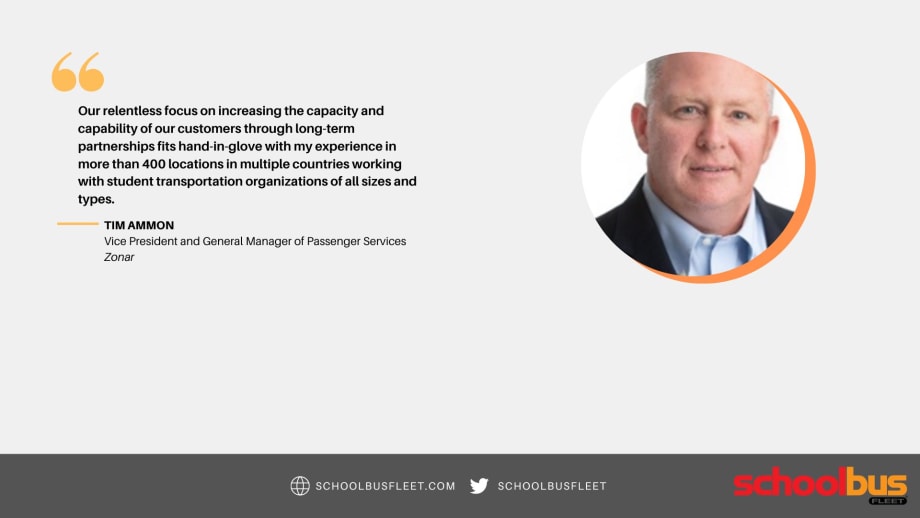
Image: Canva/Zonar
6 min to read
Tim Ammon’s no stranger to journeys, having hiked Mount Kilimanjaro and the Inca Trail before his daughter was born.
Now, the Massachusetts native has started a new voyage as Zonar’s vice president and general manager of passenger services, after stints at the Center for Effective School Operations (CESO), the STARTS Task Force coming out of the COVID-19 pandemic, and TransPar Group.
Ammon, who has lived in New Jersey for more than 20 years, also sits on the board of directors for an animal shelter and he participates in animal care and support activities. He and his wife also devote time to addressing food insecurity through local food banks.
“We now have a young daughter who occupies more than 100%, somehow, of our time and attention,” Ammon said. “But she is the best thing we do every day.”
In this interview with School Bus Fleet, Ammon talks about his involvement in the pupil transportation industry, how he came to Zonar, and what the future might hold.
1. What drew you to the world of student transportation?
What I have learned over time is that the mission of student transporters, which is to provide as much access to educational services as possible, is one of the noblest and most important services that we as a society can provide to children. I initially focused on the areas of fleet maintenance and management and gradually moved into all things student transportation over the course of a 25-year consulting career. Ultimately, I continue to be drawn to the uniqueness of the mission and the complexities of the challenges we face. Most people see student transportation as a one node problem (“Just pick my kid up!”), but when you look at the systems that are necessary to support the safe, reliable, and cost-effective delivery and return of millions of students every day, student transportation becomes one of the most interesting industries out there.
2. What philosophy tends to govern your approach to management?
Success comes from the power of teams made up of empowered individuals. The needs of school bus operations and organizations like ours that support them are multi-disciplinary and multi-faceted. Solving complex systems problems like these requires that we bring together the smartest, most thoughtful, most innovative thinkers and doers we can and give them the room needed to solve hard problems. As a leader, my job is to create that environment and then vigorously challenge my teams to go out and identify and address the biggest issues facing our customers. As a manager, I need to make sure that we have the systems and processes in place to define and implement the solutions we produce. Zonar’s 20-year history as a leader in innovation and a leader in supporting the school bus industry means that I am really fortunate to have a very strong foundation to execute these principles from.
3. What appealed to you about joining the team at Zonar?
I believe we are at an inflection point in the world of education that will have ripple effects that touch everyone who works in or around the field. The pandemic challenges and the demographic shifts occurring across the nation are going to disrupt what has been the normal course of business for the last 10 years. I believe the products and services that Zonar provides will place us right in the middle of helping solve the operational, financial, technical, and personnel challenges that student transporters are confronting as a result of these disruptions. The ability to build structured but flexible fleet management solutions that allow managers to respond in real time to changes in demand (for example, students who do or don’t show up as expected) and supply (such as drivers that are or are not available, changes in vehicle type, vehicles that are out of service for maintenance or may not have enough battery charge to complete a mission) will be the coin of the realm in the near future. At Zonar we are building the products and partnerships that will enable these capabilities for districts of all sizes.
4. How does your background with CESO, the STARTS Task Force, and TransPar Group serve as a foundation for his work at Zonar?
Zonar is all about understanding the needs of its customers and helping them find the right mix of products and services that will meet those needs. That consultative philosophy of matching the needs to the options is very similar to what I have done in my 20-plus year as a consultant. All of my previous work, with CESO, DSG, STA, STARTS, and TransPar was focused on listening to what our clients needed, assessing areas of strength and opportunities for improvement, and delivering solutions that offered both immediate and long-term value to the organization. At Zonar, we do this every day. Our relentless focus on increasing the capacity and capability of our customers through long-term partnerships fits hand-in-glove with my experience in more than 400 locations in multiple countries working with student transportation organizations of all sizes and types.
5. It may be difficult to forecast the next big changes coming to pupil transportation, but what areas are you watching for evolution? Vehicles? Equipment? AI like ChatGPT?
I talk often about the school transportation of tomorrow being built on a thousand yesterdays and the first one of those is today. In that context, school bus operations are going to be challenged on a huge number of fronts. The challenge of transportation past will continue to be mitigating the impact of driver availability. We will not solve the driver shortage, but we can do things to mitigate its impact and Zonar products can help with that. The challenges of transportation present are three-fold in my mind:
The first is that education and who is being educated will change because of the pandemic. Those changes came slowly at first but have since evolved quickly and we need to build transportation strategies that can respond to that.
The second is a looming technician shortage. Bus drivers are hard to come by, but technicians might be even more difficult. The challenge of maintaining dual powered (i.e., both ICE and alternative fueled) fleets will create a lot of pressure in maintenance services. Zonar has built solutions and technologies to address that now.
The last is the initial and sustaining impact of electrification. I am not sure we know how this is all going to end up shaking out, but it is clearly impossible to ignore $5-plus billion in spending in this marketplace. We are learning more about the requirements of building and sustaining electric fleets and Zonar has designed its technologies to support state of charge awareness and other useful information, but there is a lot more to learn and a relatively short time to learn it in.
The challenge of transportation future will be the continued integration of all the amazing tools and technologies being integrated into vehicles and operations. The alphabet soup of V2G, V2X, ACAS, AI, and the rest presents great opportunities but also substantial challenges. We have to recognize that most transportation operations want these tools but are often too busy with their primary job of ensuring student safety and service quality to fully take advantage of all the benefits. As a result, those of us who service the industry are going to have to find ways to integrate these tools and technologies into products such that they are available, affordable, and accessible to organizations of all types. This will be no small challenge, but Zonar thrives on big challenges so I am confident we can successfully meet the moment.
Subscribe to Our Newsletter
More Management

How to Build a Better Driver Training Program
Ready to boost up your school bus instructor training? Here’s how to pick the right talent and improve recruitment, retention, and safety.
Read More →
CALSTART and Forth Combine to Form Catalyst Mobility
The new name represents a renewed vision for the nonprofit focused on advancing clean, equitable, and affordable transportation solutions that move people and goods.
Read More →
What Makes a Great School Bus Driver Trainer?
Choosing the right school bus driver trainer takes more than experience. Learn six keys to selecting and developing trainers and evaluating program effectiveness.
Read More →

School Bus Contractors Expand Through New Deals, Acquisitions & Partnerships
STA's Canadian division acquires Ontario-based G&L Stevenson Transport while Durham School Services adds a new district contract in California, First Student adds a New Jersey contract, and Minnesota Coaches acquires Halo Transportation.
Read More →
Logan Bus Company Rolls Out AI Phone System for NYC School Bus Families
A summer pilot found that AI agents could handle most routine calls, freeing up time for customer service staff to focus on emergencies and complex family concerns.
Read More →
From Intent to Impact: What I Learned About Leadership from TAPT
A Texas transportation supervisor shares lessons on self-awareness, accountability, managing stress and building trust — and why investing in leadership development matters at every stage of your career.
Read More →
NAPT Names 2026 Award Recipients, Hall of Fame Inductee
Who earned national recognition for their work in student transportation? This year, NAPT named five recipients of its 2026 awards for service, safety, and leadership, plus its newest Hall of Famer.
Read More →
Sponsored•September 2, 2026
2026 State of Student Transportation Report
Driver shortages. Rising costs. Growing safety expectations. More data, but not enough time to act on it. The 2026 State of Student Transportation Report reveals what transportation leaders say is putting the most pressure on their operations—and where they’re investing next. See how your priorities compare.
Read More →
How to De-Escalate an Angry Person: 5 Steps for Handling Workplace Conflict
What makes emotions run high, and how should you handle an angry colleague or parent? Follow these steps for staying calm, listening, showing empathy, and resolving conflict.
Read More →
Sponsored•September 1, 2026
What Readiness Looks Like This School Year
Learn about the challenges shaping the 2026–2027 school year, from persistent driver shortages and budget pressure to technology and readiness gaps. See how school districts are responding and adapting in Zonar’s 2026 Back-to-School Readiness Report.
Read More →