




4 Critical Evacuation Preparedness Concerns
Evacuation preparedness is strikingly uneven in the pupil transportation industry. While some school districts and bus companies take evacuation ...
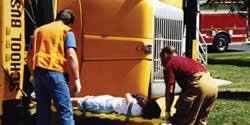
Evacuation preparedness is strikingly uneven in the pupil transportation industry.
While some school districts and bus companies take evacuation preparedness extremely seriously, conducting realistic and effective evacuation training for students and drivers and working closely with area emergency responders, others do little more than go through the motions.
The issue of evacuation readiness is best seen in broader context. Fatalities resulting from school bus fires and immersions are rare — thankfully so. Statistically speaking, other school bus safety concerns are clearly more pressing than evacuation preparedness. Protecting students during the loading and unloading process — the “moment of truth” — has rightfully been the industry’s primary training focus for a generation.
Furthermore, the additional emergency exits on school buses required since the Carrollton, Ky., and Alton, Texas, tragedies of the late 1980s may have lulled us into thinking we can safely move the evacuation issue down the safety priority list.
But emergency exits don’t equate to evacuation preparedness. Additional emergency exits by themselves don’t necessarily indicate a high, or even an adequate, level of preparedness. The potential for another disaster still exists. In fact, the constantly expanding population of children with special needs on buses and the increasing severity of those disabilities increase the danger that children won’t be able to be removed quickly enough in a bus fire or immersion.
We offer the following list of current evacuation preparedness concerns primarily to provoke discussion within our industry.
Concern #1
No one knows how many school bus fires take place. This a surprising gap considering the high stakes involved. There is no central reporting mechanism for school bus fires nationally, and unlike crashes, fires aren’t always carefully tracked even at the state level. Anecdotal news reports alone suggest the phrase sometimes tossed around when discussing this issue — “school bus fires are rare” — is not really accurate, even if you’re only looking at major incidents in which the bus was destroyed by fire.
{+PAGEBREAK+}
Concern #2
Students are poorly prepared for an emergency evacuation in many school districts. A practiced, detailed evacuation plan, in which students know exactly in which sequence to move toward the “best exit” for quickest egress in a particular scenario, is unusual today. It’s instructive to look back today at the excellent National Transportation Safety Board (NTSB) report on the Alton tragedy. The lack of emergency windows and hatches was, of course, pointed to as a major factor in the disaster. But the failure to train students in evacuation preparedness was also cited.
The failure to maintain better industry-wide student evacuation training is itself probably the result of a variety of factors. Many school districts are reluctant to provide adequate time for bus drills, and some school systems shamefully don’t conduct bus drills at all. An injury to a student that occurred years ago during a bus drill is a fairly common excuse for not conducting drills any more.
But even in school systems that allow drills, and provide adequate time, many bus drivers don’t really know how to conduct effective drills. Conducting effective drills isn’t easy; teaching 60 energetic children in the confines of a school bus is not for the faint-hearted. Surprisingly, many bus drivers were never really shown how to conduct a drill. Although the topic may have been broached during a classroom “basic” safety course, there was no chance to see a drill being conducted in real time, or to practice it. On a general level, we need to better prepare bus drivers about how to conduct drills. Some drivers — including (or possibly even especially) veterans — need one-on-one coaching from a trainer or peer mentoring to master the art of conducting truly effective drills. In our experience, bus drivers who’ve never really seen a good drill often tend to lecture kids instead of involving them, which is a recipe for a poor drill.
Drills on buses transporting children with challenging special needs, such as children who are medically fragile, often, ironically, get less attention than drills on typical bus routes. Because a drill itself could jeopardize a fragile child’s health and safety unless it is carefully supervised, getting “all the ducks in a row” for a realistic practice session can be very challenging. But in our opinion, the single most pressing evacuation worry facing our industry is evacuating children with special needs who are often transported on smaller, gasoline-powered vehicles with fewer emergency exits, further heightening the danger.
Another area that concerns us about drills is extracurricular trips. The NTSB has recently recommended that districts conduct drills at the beginning of all extracurricular trips; however, this is hardly standard practice in our industry at the present time. Passengers on extracurricular trips may not be regular bus riders and may be even less aware of evacuation procedures than other students. Drills are also sometimes important at the start of extracurricular trips to establish the authority of the bus driver; sports trips can be especially challenging when it comes to passengers (student athletes, and, sometimes, the coach!) following safety rules.
{+PAGEBREAK+}
Concern #3
Many bus drivers don’t “know their buses,” including the location and design of emergency exits, as well as they should. This can be easily tested in a variety of ways. For instance, ask your bus drivers exactly how many exits there are on their assigned buses. A true professional knows the answer at once, without having to close their eyes and count on their fingers. Or, in a classroom setting, ask your bus drivers to sketch in the location of all exits on a simple template of their bus. They should be able to position the exits accurately — i.e., at the appropriate row of seats. This can be a humbling but useful training exercise.
Of course, bus drivers who don’t open all their emergency exits every day, during the pre-trip inspection, are less likely to be able to quickly locate and open an exit in a real emergency.
The operation of exits is not as obvious as is sometimes assumed. Roof hatches can be especially problematic. Some dual-function roof hatches, combining ventilation with emergency egress, are surprisingly confusing to operate. A few years ago, we performed a simple test of this issue, asking several dozen experienced bus drivers, one at a time, to open a roof hatch as though an emergency situation required it for evacuation. To our shock and dismay, less than half the bus drivers could open the hatch all the way within a minute! If you think we’re exaggerating, try the test in your own operation. We hope you prove us wrong, but our experience is that unless a driver is opening the hatch every day during the pre-trip, opening it under emergency conditions should not be considered a given.
In our experience, many bus drivers are also poorly prepared about how to go out an emergency exit as safely as possible. How many of your drivers know how to most safely go out an emergency window, for instance (“feet first, face down”)? Do your drivers know the importance of “sitting and sliding” out the emergency door to avoid a personal injury?
Concern #4
Many communities are not adequately prepared for a major school bus emergency. This is not a new issue, but it’s an issue that we don’t seem to be making progress on. Community-wide school bus mass casualty incident drills are the exception, not the norm. Anyone who’s been involved can confirm that they take lots and lots of work to plan and execute — but what an incredible learning opportunity they provide.
School bus evacuation preparedness is a critical issue in achieving and maintaining the highest degree of safety and requires the highest degree of commitment from our transportation professionals. To what degree are you protecting the children riding your buses? “Never put a child on, until you know how to get them out.”
To download a PDF version of a one-page bus safety drill checklist and compliance form, visit www.schoolbusfleet.com and go to the Resources section (click on the Training link). The form was put together by the Pupil Transportation Safety Institute in Syracuse, N.Y. Its Website can be found at www.ptsi.org.
Jim Ellis is curriculum development specialist and Kathleen Furneaux is acting executive director of the Pupil Transportation Safety Institute in Syracuse, N.Y.
More Safety
2 Killed, Dozens Injured in Florida School Bus Crash
A multi-vehicle collision caused a Polk County school bus carrying 37 students to overturn on its way to Winter Haven High School.
Read More →
Illegal School Bus Passing Drops 24% in New York Districts
With fewer than 5% of citations involving repeat offenders, Westchester County officials said enforcement, education, and community partnerships are helping change driver behavior.
Read More →
School's Back. Here's What Happened to Traffic, Speeding & Distraction
What happens to traffic when school resumes? New data analysis examines changes in distracted driving, congestion, and speeding around schools.
Read More →
Geotab Expands Fleet Safety Tools With Video Coaching, Risk Insights
New safety and video capabilities aim to help fleet managers assess risk, support drivers, and take targeted action through video coaching, red-light violation detection, and more.
Read More →
How to Build a Better School Bus Driver Training Program
Is it time to strengthen your driver training? Here’s how to pick the right talent and improve recruitment, retention, and safety. This video is brought to you by IC Bus.
Read More →
Recent School Bus Accidents Leave 2 Dead, 2 Injured
Four school bus crashes in Florida, Illinois, and Georgia highlight risks in transportation lots, at bus stops, and during student loading and unloading.
Read More →
When Every Second Matters, Clarity Keeps Routes Moving
From routine delays to urgent incidents, strong communication practices help drivers, dispatchers, schools, and families respond with confidence.
Read More →
What Happens When a School Bus Catches Fire — and What Can Help
School bus fires are rare but can be devastating. Learn how advances in fire suppression and asset protection help fleets detect fires earlier, reduce damage, and improve safety.
Read More →
Geotab Launches Tool to Help Fleets Investigate Road Incidents
Geotab Investigations combines telematics data, video, documents, and other evidence to help fleets reconstruct incidents, resolve claims, and determine what happened.
Read More →
Texas Sixth Grader Wins 2026 National School Bus Safety Poster Contest
Sai Darshana Yekolu of Moseley Middle School in Prosper, Texas, was named the newest winner for her artwork, bringing the theme of “Safe Rides, Everyday Heroes” to life.
Read More →