





Don’t Miss: Making the School Bus Ride Easier for Students With Autism in 7 Steps
What’s Behind the Rise in Special Needs Transportation?
Autism, mental health, and social development: Special-needs transportation is changing. Here’s why — and what it means for pupil transporters.
January 22, 2025
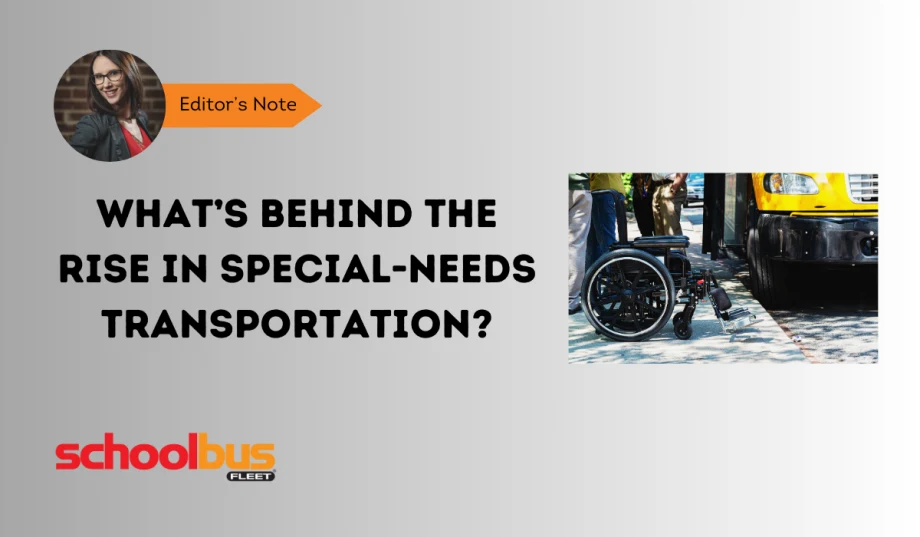
Several experts theorize that COVID isolation likely had a negative cognitive and social development impact on younger students, possibly leading to more behavioral issues on the bus today.
Photo: SBF/Canva
5 min to read
Back when society had just gotten over fear of Y2K, autism was not a diagnosis widely talked about. At the turn of the millennium, autism affected 1 in 150 children.
Twenty years later in 2020, it was 1 in 36 children, according to CDC data. That’s a 76% increase!
More Facts About Disabilities and Special Needs
Autism affects about 4x more boys than girls.
It affects 1 in 45 adults.
Autism prevalence is lower among white children than other racial and ethnic groups.
Autism Spectrum Disorder [ASD] prevalence in 8-year-old children is estimated at 2.8%.
In 2022-23, an all-time high of 7.5 million students aged 3-21 received special education and/or related services under the Individuals with Disabilities Education Act (IDEA) — the equivalent of 15% of all public-school students, and a rise of 3% in the past three school years.
Among students receiving special education and/or related services, the most common category of disability was specific learning disabilities, at 32% (a disorder that may…manifest itself in an imperfect ability to listen, think, speak, read, write, spell, or do mathematical calculations). This is followed by speech or language impairment (19%), other health impairment (15%), autism (13%), developmental delay (7%), intellectual disability (6%), emotional disturbance (4%), multiple disabilities (2%), and hearing impairment (1%).
Sources: CDC and NCES
Why is there an increase in autism? The national non-profit Autism Speaks says the change reflects an improvement in outreach, screening, and de-stigmatization of the diagnosis among minority communities.
Special-Needs Trends & The School Bus
It’ll be no surprise to anyone reading this that the school bus has also seen a rise in special needs passengers, including students with autism.
The number of students served under the Individuals with Disabilities Education Act (IDEA) has risen from about 6.4 million in 2012-13 to 7.5 million in 2022-23 — an increase of 17%. This growth represents about a 15% increase of all public school students, highlighting a broader trend in the need for special education support, Will McDermott, head of student services for First Student, added.
Anecdotally, every single transportation director I’ve spoken with has said the same: More and more students need more and more accommodation. In fact, some districts are now running more SPED buses than full-size routes.
“Students with special needs come with a lot more specialized and complex needs than ever before in my career,” said Susan Shutrump, a retired PT/OT supervisor and consultant.
Jenna Fromm of Palmer Bus Service said their van fleet now goes up every year more than their buses.
Penny Evert of Whitehall District Schools said her district has significantly more students who need fidget bags, story cards, and incentive programs to ride safely on the bus.
Rose Lee of Bonita Unified School District reports more parents requesting accommodations since COVID.
David Cantrell, deputy director of the Office of Special Education Programs at the Department of Education, spoke at November’s NASDPTS conference, and added: “Five years ago, this thing called COVID happened. Nationally, it exacerbated the behavioral and social emotional needs of all students, particularly those with disabilities. We’re seeing an increase in the number of children who are suspended from schools and the number of students who have acting out behavior to such a degree that they're being pulled from the regular education classroom. They have behavior intervention plans. When students were pulled from the brick and mortar setting for over a year, sometimes two or three years, we saw a regression in their skill.”
“This is probably one of the worst years we’ve had for behavior,” added Katrina Morris of West Shore ESD. Her advice for drivers? “Don’t look at the disability; look for the ability. That’s where you find the heart of these students.”
HopSkipDrive also reports more need for safe, individualized transportation. “Supplemental transportation is a needed addition to a school district’s toolkit for students with disabilities given they may not thrive on a school bus or may need additional transportation during the day,” said Emily Uhland, HopSkipDrive’s vice president, customer success. “When schools are using a multi-modal transportation system, they are able to support more needs.”
Shutrump added that aside from diagnosed autism, we’re also seeing a rise in students with mental health issues and behavioral challenges. These can stem from living in an environment where there are drug and alcohol addictions, a lack of institutions and community support around mental illness.
There is also credit to advanced medical technology that can treat individuals with complex conditions who would not have survived decades ago.
Alexandra Robinson of A. Robinson Consulting believes we have not yet learned how best to fully accommodate students with mental health issues, but that we have taken the first step: recognizing and increasing our awareness of what those issues are. “I think the accommodation comes with practice and experience,” she said.
Robinson adds that in some situations, a diagnosis and an IEP is the only path to transportation to and from school as awareness for services available increases. But, “Sometimes districts see special needs and immediately think special bus. Just because you have an increase in kids with disabilities doesn't mean those students have to go on a special bus.”
“It is not that we're testing more; it’s that we really have a lot more students with those disabilities,” Shutrump said. “And I think as a country, we haven’t done enough to support people in those disability areas.”
That’s why we’re excited to dedicate the February issue of SBF each year to special-needs transportation so we can dig into the trends, nuances, and complexities of it all.
For more resources, check out the U.S. Department of Education’s Mental Health page, their PDF on “Supporting Child and Student Social, Emotional, Behavioral, and Mental Health Needs,” their behavioral support resources, and read up on trauma-informed care.
Subscribe to Our Newsletter
More Blog Posts
5 Video Interviews That Stuck With Me
After more than 100 episodes of The Route, SBF’s editor looks back at the unforgettable conversations and the school transportation lessons that we won’t forget.
Read More →
Leading with Compassion & Curiosity
What if the story you're telling yourself isn't true? Learning about emotional intelligence can improve communication and culture in school transportation and beyond.
Read More →
Key Trends Shaping The Future of School Transportation: ACT Expo Analysis
What’s next for the school bus market? We walked the show floor in Vegas to find out. From AI and V2G to battery breakthroughs and cutting-edge software, here’s what stood out.
Read More →
Suffering from Imposter Syndrome? You’re Not the Only One
Tips on fearing less instead of being fearless, and a powerful lesson from a group activity inspired by the 2025 NAPT keynote.
Read More →
My Own Trailblazers (and Why We Need More Women in Leadership)
From family influences to industry leaders, SBF’s editor reflects on the women who shaped her path and why representation in school transportation leadership matters.
Read More →
18 Ways to Support Your Transportation Team Beyond Thank-You Notes
Love the Bus Month is about more than thank-you notes. Learn how supporting the entire transportation team builds trust, culture, and retention year-round.
Read More →
When Home Is the Headline: Finding Our Way Forward in Minneapolis [Op/Ed]
In this season of uncertainty, leadership means empathy, critical thinking, and showing up. Here, our editor’s personal reflection on what matters most when times are tough.
Read More →
Seventy Years on the Road Together
School Bus Fleet’s editor reflects on the magazine and the industry’s legacy, change, and what endures.
Read More →
Through Change and Choice: Key Insights from 2025 and the Road Ahead
The school bus industry navigated big changes in 2025. Here’s how we adapted, what the data reveals, and what lies ahead in 2026.
Read More →
The Hidden Risks on the Road
Even the best school bus drivers can’t prevent every danger. As technology races and tempers rise behind the wheel, transportation pros face new challenges beyond the driver’s control.
Read More →