




Previously: Annual NSTA Bus-In Produces Two Bill Introductions
From Steel to Semiconductors: How Tariff Policy May Impact School Transportation
Tariffs may feel far from the yellow bus, but they affect costs, supply chains, and technology in student transportation. Here’s what you need to know.
by Patrick Dean, NSTA President
September 18, 2025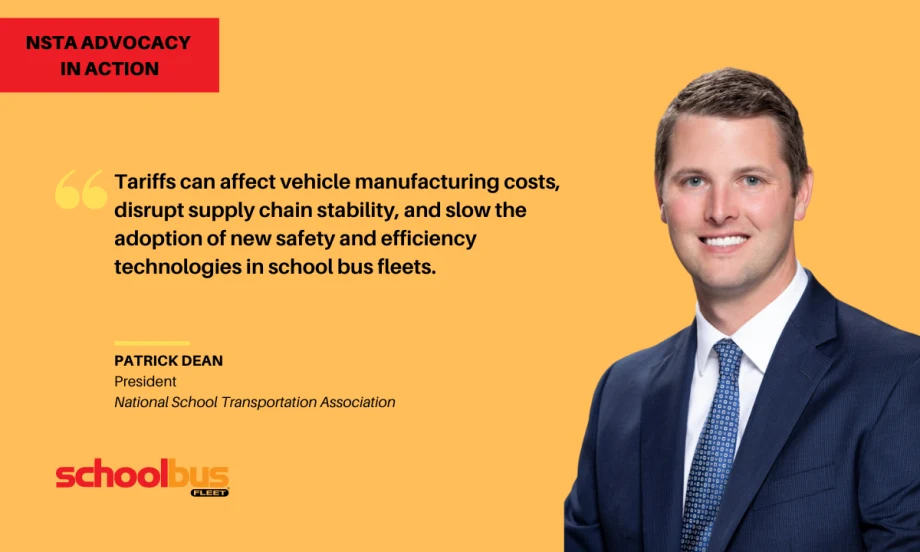
What do tariffs have to do with school buses? Everything.
Photo: NSTA/School Bus Fleet
5 min to read
In July, the 2025 NSTA Annual Meeting & Convention (AMC) brought together school transportation leaders, policymakers, and industry stakeholders from across the country to address the pressing issues impacting private school bus contractors and school transportation. This year’s keynote speaker, Casie Daugherty, managing director at Prime Policy Group, captivated the audience with an in-depth presentation titled “Trump, Tariffs, and Tea Leaves.”
With nearly 15 years of experience guiding clients through the complexities of trade and tax policy, Daugherty brought a rare blend of deep technical knowledge and strategic insight. Currently, she leads Prime Policy Group’s tax and trade practice, where she navigates matters ranging from tariff disputes and customs investigations to tax reform and compliance. Her background includes work on Section 232 and 301 tariff actions, anti-dumping and countervailing duty cases, and high-profile forced labor investigations.
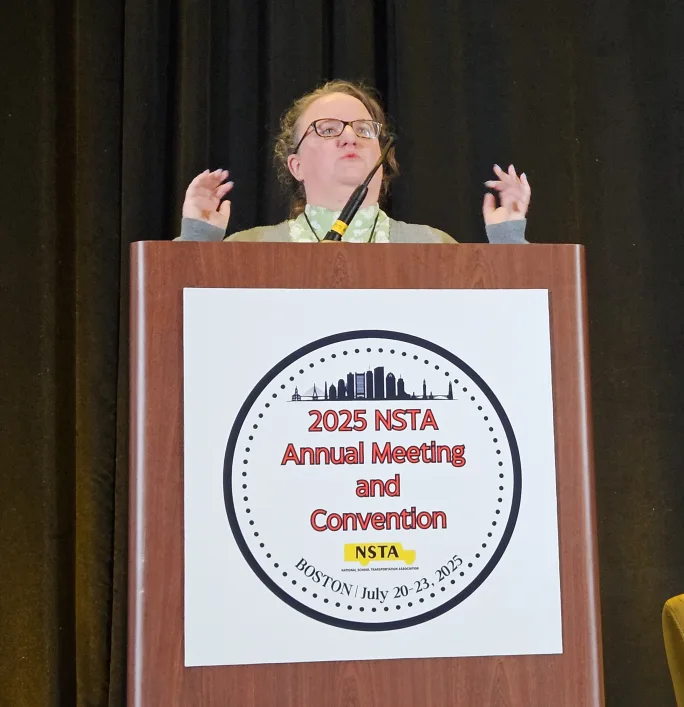
Casie Daugherty presents at NSTA's annual meeting last July.
Photo: Amanda Huggett
Daugherty began the session by outlining the legal framework that empowers the executive branch to implement tariffs. She traced the history from the Smoot-Hawley Tariff Act of 1930 through the Reciprocal Trade Agreements Act of 1934, the Trade Expansion Act of 1962, and the International Emergency Economic Powers Act of 1977, also known as IEEPA. In short, these laws provide broad and flexible authority for presidents to impose tariffs, often with minimal Congressional input. In recent years, presidential administrations have increasingly used these powers as an all-purpose policy lever, whether addressing national security, economic competition, or geopolitical disputes.
The heart of Daugherty’s presentation focused on the incoming wave of reciprocal tariffs, some of which took effect on August 1, 2025, but in a 7-to-4 ruling in late August, the U.S. Court of Appeals for the Federal Circuit said the president incorrectly used IEEPA to impose these charges on American trading partners. The import fees do, however, remain in effect while the court case continues. The U.S. Supreme Court indicated on September 9, 2025, that it will take up the case on a “fast track” basis, likely to occur in November.
These tariffs are noted to establish a baseline rate of 10%, with country-specific adjustments that can be significantly higher or lower depending on the outcome of trade negotiations. She illustrated how the rates for various trading partners are changing. Some nations, such as Brazil, will see sharp increases, jumping from 10% to 50%, while others, such as Vietnam, will see steep decreases, from 46% to 20%. Several countries, including Canada and the European Union, will face moderate increases, whereas China will experience one of the largest drops, from 34% to just 10%.
During her presentation, Daugherty posed several open questions that will determine the policy’s real-world impact. She asked whether all countries could face the August 1 deadline, or if those engaged in active negotiations will receive extensions. As we now know, these intense negotiations remain fluid.
Daugherty also raised the issue of whether exemptions under the U.S.-Mexico-Canada Agreement (USMCA) will remain in place, and if sector-specific carveouts under Section 232 investigations will be maintained. This was particularly in the interest of NSTA and its members, as bus manufacturing, parts supply, and specialty materials may experience shifts. The outcome could have significant positive or negative ripple effects on costs, timelines, and sourcing strategies.
Daugherty then examined the scope of Section 232 investigations, which assess whether imports threaten national security. These investigations already cover steel and aluminum, materials essential in bus frames and components. Now, they extend to industries including automobiles and auto parts, semiconductors and related manufacturing equipment, pharmaceuticals, critical minerals, commercial aircraft and jet engines, and unmanned aircraft systems. For school transportation stakeholders, this means closely monitoring investigations that may touch upstream suppliers or specialized technologies.
The recurring theme throughout Daugherty’s keynote was caution. She noted that retaliatory tariffs from U.S. trading partners remain a possibility, and that it is unclear whether restraint or swift retaliation can prove more advantageous for those countries. Stakeholders, she advised, should take an active role in advocacy, particularly for products under Section 232 and 301. Finally, she encouraged industry leaders not to wait for final tariff announcements before engaging in the policy process.
While tariff policy may seem far removed from the yellow bus world, Daugherty made the connections real to NSTA members. Tariffs can affect vehicle manufacturing costs, especially if steel, aluminum, and auto parts tariffs remain elevated. They can also disrupt supply chain stability, affecting how quickly parts can be sourced or replaced. In addition, tariffs on semiconductors or specialized equipment can slow the adoption of new safety and efficiency technologies in school bus fleets. In an era where private school bus contractors already face challenges in driver recruitment,fleet modernization, and funding, these added economic pressures make strategic planning even more critical. Daugherty wrapped up her presentation by urging NSTA members to stay informed, stay connected, and stay vocal as policy changes in Washington, D.C. often unfold rapidly.
This keynote was a reminder that while tariff policy may be crafted in distant political and economic circles, its effects can shape budgets, purchasing decisions, and ultimately, the services delivered to students. As her session concluded, attendees left with a deeper understanding of how trade policy is evolving and how they can prepare their operations for the months ahead. Daugherty’s knowledge offers the industry a clearer view of the trends and challenges shaping trade policy in 2025.
As of July, I am honored to assume the role of president of the National School Transportation Association (NSTA). I welcome the opportunity to engage with colleagues and stakeholders who share a commitment to advancing safe, reliable, and efficient student transportation. Those wishing to learn more about NSTA’s initiatives and the issues shaping the future of school transportation may contact me at president@yellowbuses.org.
Together, we can address the challenges ahead and work to ensure a stronger, safer future for student transportation. With NSTA, you never travel alone.
Subscribe to Our Newsletter
More Blog Posts

Student Transportation Leaders Gather at NSTA Annual Meeting & Convention
Patrick Dean recaps key moments from NSTA’s 2026 Annual Meeting & Convention, including advocacy efforts, AI discussions, OEM insights, and federal policy updates.
Read More →
School Bus Contractor Association Brings Key Policy Issues to FMCSA
Federal policy, CDL testing, insurance, and compliance were among the key topics as NSTA leaders met with FMCSA to advance priorities for school bus contractors.
Read More →
NSTA Engages School Boards on Outsourcing Student Transportation Services at COSSBA Conference
What benefits does using contracted providers bring to districts and students? That’s what NSTA shared at a recent conference for education leaders. Here are the highlights.
Read More →
NSTA Advances Legislative Priorities During 2026 Capitol Hill Bus-In
Members of the industry’s contractor’s association traveled to Washington, D.C. to advocate for two key initiatives during congressional meetings.
Read More →
NSTA Emphasizes School Transportation at the Midwest Commercial Vehicle Safety Summit
From NHTSA safety data to NCST standards and stop-arm passing prevention, NSTA reinforces the role of school buses in protecting students and improving traffic safety.
Read More →
NSTA Participates in National School Bus Safety Week Event with Pennsylvania Congressman
The industry's contractor association and Rep. Brian Fitzpatrick spotlight rising dangers from illegal school bus passings and outline new legislative efforts.
Read More →
Senate Introduction of Brake for Kids Act Marks School Bus Safety Milestone
The legislation seeks to launch a national awareness campaign reminding motorists to stop for school buses. With millions of violations each year, it’s time to make school bus safety a national priority.
Read More →
Building the Future of Student Transportation: Highlights from NSTA’s 2025 Annual Meeting and Convention
From drivers to contractor-member companies, NSTA’s 2025 Annual Meeting in Boston celebrated school bus excellence while spotlighting trends shaping student transportation.
Read More →
Inside the Process: School Bus Safety Subcommittee's Review of FMCSA Proposals
New FMCSA proposals could reshape school bus operations. Here’s how the national contractor’s association is responding to possible changes on railroad crossings and inspection and medical reports.
Read More →
Annual NSTA Bus-In Produces Two Bill Introductions
Association members hit the Hill in force — 65 people, 153 meetings, two bills, and a shared mission to advance student transportation safety.
Read More →