One night in West Virginia last year, a school bus caught fire in the middle of the night. Unattended, unnoticed, the blaze spread to two nearby buses and destroyed them as well. Lacking an automatic fire suppression system (AFSS) and telematics, disaster couldn’t be averted, says Jason Redman, school transportation director for neighboring Kanawha County: “If they had the AFSS and telematics, the system would have automatically alerted someone of a fire event before it could have escalated.”
School buses are a lifeline for millions of students, taking them safely between home and school. But, like any vehicle, buses are susceptible to fires, which can pose critical risks to the lives of children and drivers. The integration of advanced fire safety technologies, such as telematics and AFSS developed by companies like Kidde Technologies, helps improve the chances of preventing catastrophes.
Advanced Fire Detection and Suppression
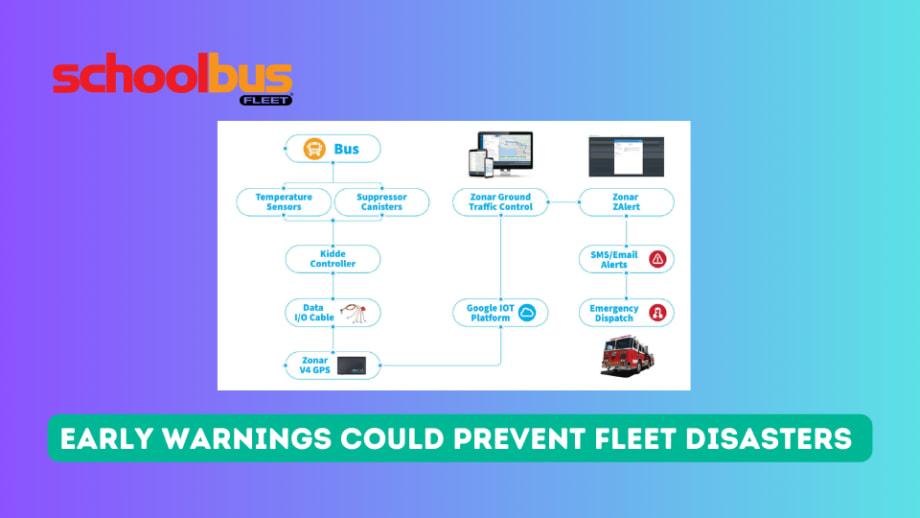
At the heart of Kidde's modern fire safety systems are linear heat detectors (LHD) installed in the engine and battery compartments of school buses. Tim Ammon of Zonar explains: "Each bus has detectors in the engine and battery box. One of these is called a linear heat detector (LHD). This detects heat along the entire length of a sensor cable, which is a twisted pair of wires that run in a circuit around the box. Should the temperature rise to 465 degrees, the coating around those two wires melts and the wires touch, creating an electrical short. This sends a signal to the fire alarm panel, and that’s the alert."
This early detection mechanism is crucial in identifying potential fires before they escalate.
Once a fire is detected, the suppression system activates automatically. "Two nozzles under the hood deploy the extinguisher and put out the fire," Ammon continues. This rapid response is essential in preventing small fires from becoming catastrophic incidents, thereby protecting the students and the bus.
Seamless Integration for Enhanced Safety
The integration between telematics systems and AFSS plays a pivotal role in ensuring swift and efficient fire response. This integration allows for real-time communication and automatic alerts to emergency services. "The system connects to our GPS unit, so when an event occurs, the GPS box triggers an alert, which can send emails and text messages to local emergency dispatch," says Ammon. This automated alert system ensures that emergency responders are notified immediately, even if the driver is focused on evacuating the students.
Redman, the West Virginia transportation director, elaborates on the benefits of this integration, particularly in rural areas: "If a fire event occurs in the presence of a driver, their priority would be to unload the students as quickly as possible. This means communicating to emergency personnel that a fire event is present several minutes after the initial fire is discovered. With these systems onboard, the task of notifying emergency services is taken off the driver and they can focus on unloading passengers and getting to safety."
This division of responsibilities allows for a more coordinated and effective emergency response.
Operational Efficiency and Cost Savings
Beyond safety, the integration of these technologies also enhances operational efficiency. School buses are significant investments for school districts, and the cost of replacing a burned bus can be substantial. Ammon points out, "From an operational efficiency standpoint, if a bus has burned, it could take up to 18 months to rebuild or the district can buy a used bus, which may be hard to come by given supply chain issues." Preventing fires not only saves lives but also preserves valuable assets and reduces financial strain on school districts.
In Kanawha County, all school buses equipped with wheelchair lifts have AFSS installed. Redman emphasizes the improvement in emergency response times.
"These systems are great on their own, but with the ability to identify a suppression event and communicate the bus’s real-time location with emergency services, their response time will greatly improve,” Redman says. “Any firefighter will tell you that every second counts."
Looking ahead, the industry is committed to advancing fire safety technologies for school buses. Ammon discusses potential innovations: "One thing we’re looking at is using data to provide some form of early warning so that drivers can shut down an engine before a fire occurs. For example, EV bus lithium-ion batteries emit hydrogen gas prior to a thermal runaway, which can lead to a fire. One possible solution would be to detect that off-gas and alert the driver before a fire occurs."