





Prioritizing Safety: Gaining Insights from School Transportation Officials
Safety Competitions Back on Track Post-Pandemic
In June, Kansas holds its annual conference and driving competition, while NSTA goes to Texas for the latest School Bus Driver International Safety Competition.
May 8, 2024
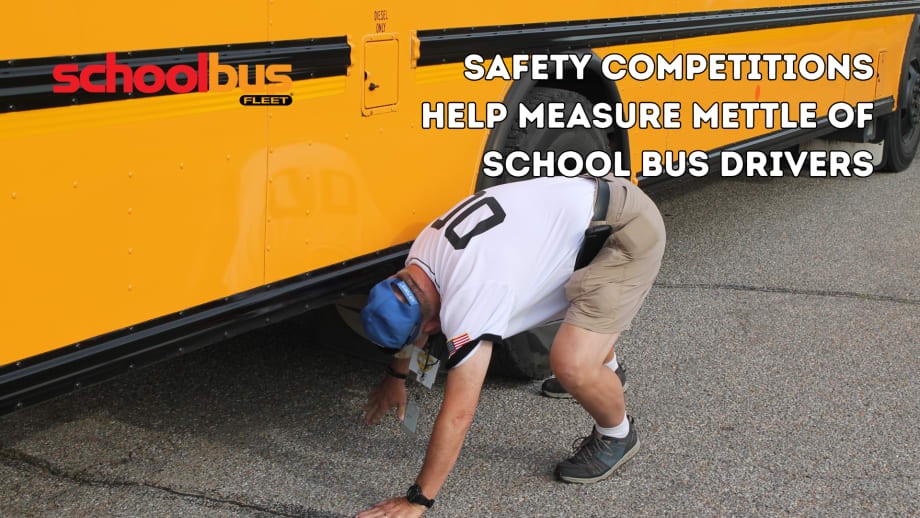
At the 2023 competition in Kansas, this judge is determining how well the driver performed the $100 spot test. Drivers who successfully cover a piece of tape the size of a $100 bill with their inside right dual wheel gets the cash.
Source: Kansas State Pupil Transportation Association/Canva
4 min to read
The COVID pandemic put the brakes on many state, regional, and national school bus safety competitions, but these events are making a comeback.
School Bus Competition in Kansas
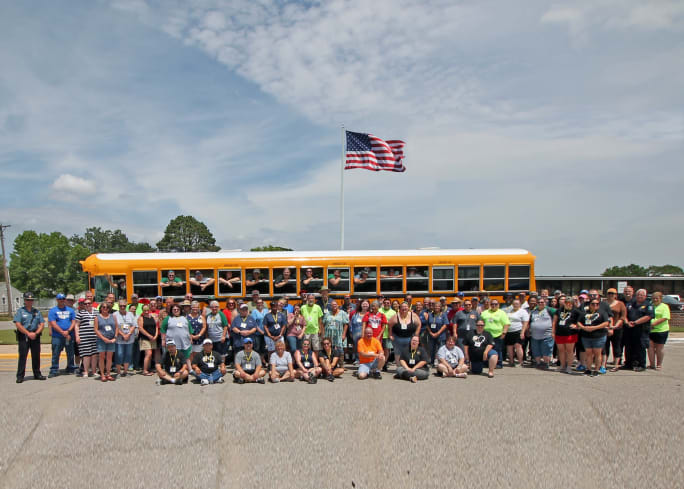
Participants in the KSPTA event in 2023.
Source: Kansas State Pupil Transportation Association
In Kansas, as an example, the state’s School Transportation Safety Conference and State Driving Competition comes to Wichita June 5-7. Early bird registration ends on May 10.
“School bus competitions are a fantastic way for drivers to understand ‘how’ they are driving when it comes to accurately maneuvering their bus,” said Melissa Ostermeyer, executive director of the Kansas State Pupil Transportation Association. “In addition, most school bus drivers are ‘out of sight and out of mind’ from the normal school day. School bus drivers are often not included in normal school district recognition programs/events/activities. Competitions give them a chance to be recognized.”
The Kansas competition is recommended so drivers can:
Learn the latest trends.
Improve training in general education and special education transportation.
Learn to produce better, more quantifiable results from the transportation team.
Improve transportation safety.
Decrease losses.
Events like this are great for transportation directors and supervisors, superintendents, fleet managers, mechanics, and technicians, driver trainers, and special education paraprofessionals. But, obviously, school bus drivers stand to gain the most from these activities.
“Competitions allow school bus drivers to not only hone their driving skills, but also to build camaraderie amongst school bus drivers in all school districts,” Ostermeyer said. “Competitions are an important training piece for every school bus driver, regardless of the number of years they have been driving a bus. This includes not only competing but judging. For example, if a school bus driver trainer judges a competition such as parallel park, and they watch 50, 60, 70 school bus drivers on a competition course do this, they have just added value to their training skills in seeing what a lot of school bus drivers do right or wrong.”
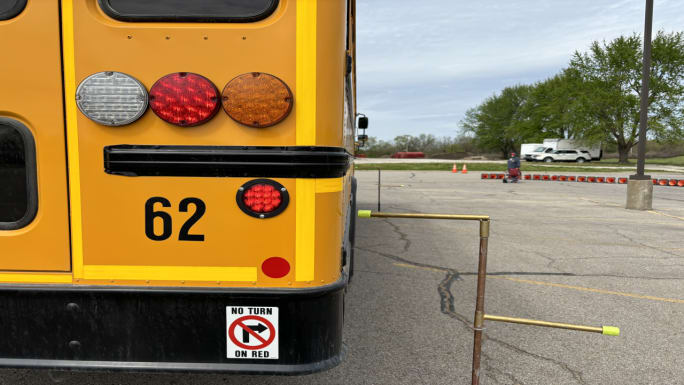
In the diminishing clearance event, drivers must proceed through an increasingly narrow lane.
Source: Kansas State Pupil Transportation Association
The International Safety Competition Returns
On June 29-30, the National School Transportation Association hosts the 2024 School Bus Driver International Safety Competition in Austin, Texas. Participants can earn a possible total of 725 points. Competition events include:
General knowledge written test.
Vehicle inspection written test.
Offset alley, in which a driver is evaluated on handling a bus through offset lanes with minimal hesitation and without touching barriers or flag tips.
Railroad grade crossing – right turn. This event evaluates a driver’s common sense, degree of care, and knowledge of laws, rules, and regulations when required to maneuver a school bus across railroad tracks at an intersection.
Straight line. This helps determine a driver’s ability to maneuver the right wheels of a school bus over a straight path of a given width.
Diminishing clearance. In this event, the driver must follow a straight line with gradually reduced clearances.
Back-up stall. The driver must back a school bus into a stall that’s the width of the bus plus two feet without touching the upright standards and without crossing over the stall limit lines.
Left turn. This evaluates a driver’s ability to properly prepare for and execute a left turn.
Parallel parking. This event gauges the driver’s knack for parking the bus parallel to a curb without touching barriers placed at both ends of the parking area, without touching the curb, and within 18 inches of the curb.
Curb-line student loading zone. Perhaps one of the most important skills is knowing how to manage the loading and unloading of students in the danger zone around the bus. This test measures the driver’s alertness to the loading of elementary school passengers and whether they remember proper use of directional signals, yellow warning lights, red flashing crossover lights, stop-arm deployment and proper mirror use.
Stop line. This event measures the contestant’s depth perception, ability to use crossover mirrors, and whether they bring the bus to a smooth, complete stop.
“The School Bus Driver International Safety Competition remains an iconic event, where drivers showcase their skills in operating a bus safely and efficiently,” said Curt Macysyn, NSTA’s executive director. “In an era where school bus drivers are at a premium, this event underscores the level of talent and professionalism it takes to be a school bus driver. Highlighting the many benefits of the yellow bus, as well as the abilities of school bus drivers serves as inspiration for individuals to choose the path of pupil transportation as a career.”
Is your state or region holding a safety competition? Tell us about it in the comments!
More Safety

How to Build a Better School Bus Driver Training Program
Is it time to strengthen your driver training? Here’s how to pick the right talent and improve recruitment, retention, and safety. This video is brought to you by IC Bus.
Read More →
Recent School Bus Accidents Leave 2 Dead, 2 Injured
Four school bus crashes in Florida, Illinois, and Georgia highlight risks in transportation lots, at bus stops, and during student loading and unloading.
Read More →
Sponsored•September 8, 2026
When Every Second Matters, Clarity Keeps Routes Moving
From routine delays to urgent incidents, strong communication practices help drivers, dispatchers, schools, and families respond with confidence.
Read More →

What Happens When a School Bus Catches Fire — and What Can Help
School bus fires are rare but can be devastating. Learn how advances in fire suppression and asset protection help fleets detect fires earlier, reduce damage, and improve safety.
Read More →
Geotab Launches Tool to Help Fleets Investigate Road Incidents
Geotab Investigations combines telematics data, video, documents, and other evidence to help fleets reconstruct incidents, resolve claims, and determine what happened.
Read More →
Texas Sixth Grader Wins 2026 National School Bus Safety Poster Contest
Sai Darshana Yekolu of Moseley Middle School in Prosper, Texas, was named the newest winner for her artwork, bringing the theme of “Safe Rides, Everyday Heroes” to life.
Read More →
Sponsored•August 27, 2026
Doing More With Less: How Transportation Directors Can Prioritize Safety Amid Budget Uncertainty
With diesel prices soaring and nearly one-third of transportation directors expecting budget cuts, maintaining student safety has never been more challenging. Download this guide to learn how leading districts are prioritizing risk, funding critical safety technology, and building stronger budget cases with data.
Read More →
Walton County Schools Adds Gatekeeper Stop-Arm Enforcement System
The Florida district will deploy Gatekeeper’s updated Student Protector technology, which now incorporates AI to improve video evidence.
Read More →
How To Build a More Secure School Bus Yard During and After Hours
As thefts and overnight security threats continue, school transportation leaders are combining stronger operational practices with AI-enabled surveillance to better protect buses, facilities, and staff.
Read More →
FMCSA Names New Chief Safety Officer: What School Bus Operators Should Know
Steve Dowling is set to lead the federal agency's efforts to advance commercial motor vehicle safety and reduce crashes, fatalities, and injuries on the nation's roadways.
Read More →