





Check Out: Late April Target for EPA Clean School Bus Rebate Program Kickoff
Nuvve, First Student, Lion Electric Join DOE V2X Collaborative
The U.S. Department of Energy's new memorandum of understanding seeks to explore and evaluate technical and economic feasibility for bidirectional charging infrastructure.
April 24, 2022
The U.S. Department of Energy's memorandum of understanding is set to expire in two years, but could be renewed by the signatories.
Image: U.S. Department of Energy
4 min to read
Nuvve Holding Corp., First Student, and Lion Electric are among the signatories on a memorandum of understanding for vehicle-to-everything (V2X) technology infrastructure announced by the U.S. Department of Energy.
The agreement combines resources from DOE, DOE national labs, state and local governments, utilities, and private entities to evaluate technical and economic feasibility to integrate bidirectional charging into the nation’s energy infrastructure – including cybersecurity advancements.
According to a news release, the International Energy Agency (IEA) estimates that 130 million electric vehicles – including school buses – will be on the road globally by 2030.
Power to the Grid
“As the number of EVs grows and especially as larger trucks and buses electrify with larger batteries, there will be opportunities to use those batteries to also support the grid,” the release stated.
Bidirectional plug-in electric vehicles (PEVs) could help the country’s energy security, resilience, economic vitality, and quality of life while supporting the electrical grid. The DOE indicated that a bidirectional EV fleet “could serve as both a sustainable mobility option as well as an energy storage asset that sends power back to everything from critical loads and homes to the grid. A bidirectional fleet could also create new revenue opportunities for EV owners or fleets.”
Dave Turk, deputy energy secretary, said: “The (memorandum of understanding)…represents a collaborative approach to researching and developing novel technologies that will help unify the clean energy and transportation sectors while getting more American consumers into electric vehicles. Integrating charging technology that powers vehicles and simultaneously pushes energy back into the electrical grid is a win-win for the future of clean transportation and our energy resilience overall.”
Attacking Technical Concerns
The DOE also announced it is taking on technical challenges and barriers to the integration of tens of millions of EVs with the electric grid, commonly referred to as Vehicle Grid Integration (VGI) through the EVs@scale lab consortium.
The consortium teams six DOE national laboratories to conduct research and development in the areas of smart-charge management, high-power charging and facilities, dynamic wireless charging, codes and standards, and cyber physical security.
“In addition to addressing the near-term challenges to VGI to benefit all EV stakeholders, the lab consortium will conduct high-risk, high-reward research on the EV charging and grid integration technologies the U.S. will need in the future,” according to the news release.
The collaboration is expected to accelerate and enable bidirectional PEV integration into the electrical grid by identifying and resolving barriers, accelerating commercialization and customer adoption, factoring in security by design, and improving coordination between the electric and automotive sectors through establishing cybersecure bidirectional charging station demonstrations, collecting and analyzing demonstration data, and preparing analyses to evaluate the business case for V2X.
Who’s Participating in the MOU?
Signatories in the V2X MOU include:
U.S. Department of Energy’s offices of Vehicle Technologies, Electricity, Technology Transitions, and Cybersecurity, Energy Security, and Emergency Response
The California Energy Commission
The California Public Utilities Commission
The City of Lancaster and City of Lancaster Community Choice Aggregator
The City of Los Angeles
Fermata Energy
First Student
Ford Motor Company
General Motors
International Brotherhood of Electrical Workers – Chapter 11
Lion Electric
Los Angeles Department of Water and Power
Lucid Group
National Electrical Contractors Association – Los Angeles
Nissan
Nuvve Holding Corp.
Pacific Gas and Electric Co.
Rhombus
Sacramento Municipal Utility District
San Diego Gas and Electric
Southern California Edison
Zeem Solutions
Bob Holycross, VP, chief sustainability, environment and safety officer, Ford Motor Company said, "As Ford leads the EV revolution, we’re excited to help our customers unlock the energy potential of their electric vehicles, whether it’s using their F-150 Lightning to power their home in an outage or their E-Transit to run their tools on the job site. We’re proud to be lending our expertise to this partnership and look forward to continuing the conversation with the Department of Energy, California Energy Commission, and others to accelerate the deployment of V2X technology."
"Nuvve is proud to be included in this collaboration with the Department of Energy and other partners to demonstrate the importance of intelligently electrifying vehicles as we transition to a decarbonized world," said Gregory Poilasne, chairman and CEO of Nuvve. "Since our founding, we have been focused on vehicle grid integration technology with a strong focus on bidirectional vehicle charging, and we look forward to showing how Nuvve’s intelligent energy management platform bridges the gap between the energy and transportation sectors."
Kevin L. Matthews, head of electrification for First Student said, "As the largest operator of school buses and leader in yellow bus electrification, we are proud to participate with the U.S. Department of Energy to accelerate the development of vehicle-to-everything (V2X) technologies. We are committed to working with utilities and other stakeholders to create a V2X solution that supports the utility grid and our operations. We believe that school buses are ideally suited to do just that."
The MOU is set to expire in two years, but could be renewed by written consent if the participants want to continue the collaboration.
More Alternative Fuels

CALSTART and Forth Combine to Form Catalyst Mobility
The new name represents a renewed vision for the nonprofit focused on advancing clean, equitable, and affordable transportation solutions that move people and goods.
Read More →
Alt-Fuel Moves: New Buses, Charging Hubs & Real-World EV Testing
Propane and electric school bus deployments continue to grow as districts add new vehicles, expand charging infrastructure, and gather more real-world operating data.
Read More →
Fewer Electric School Bus Models Reshape the U.S. Market
WRI’s latest buyer’s guide points to a consolidating electric school bus market, but fewer options may reflect a maturing industry rather than fewer meaningful choices for school bus operators.
Read More →
The Fuel Budget You Can Actually Predict: How Propane Autogas Keeps Money in the Classroom
Learn how propane autogas helps school districts manage fuel costs with predictable pricing, lower maintenance, and reduced emissions from former transportation director Joel Stutheit.
Read More →
Hendrickson, Driventic Introduce New Electric Powertrain for School Buses
ELECTRAAX, the electrified, lightweight drive axle offers integrated ePowertrain efficiency and modular flexibility for Class 6–7 school bus use.
Read More →
The Mobility House Joins PowerFlex in Fleet Electrification Deal
The acquisition combines intelligent charging software, bidirectional charging expertise, and fleet electrification services to support the growing adoption of electric school buses across North America.
Read More →
Alt-Fuel Moves: Electric School Bus Investments Hit the Road
See which districts across the U.S. are putting electric school buses into service, expanding charging infrastructure, and planning the next phase of fleet electrification.
Read More →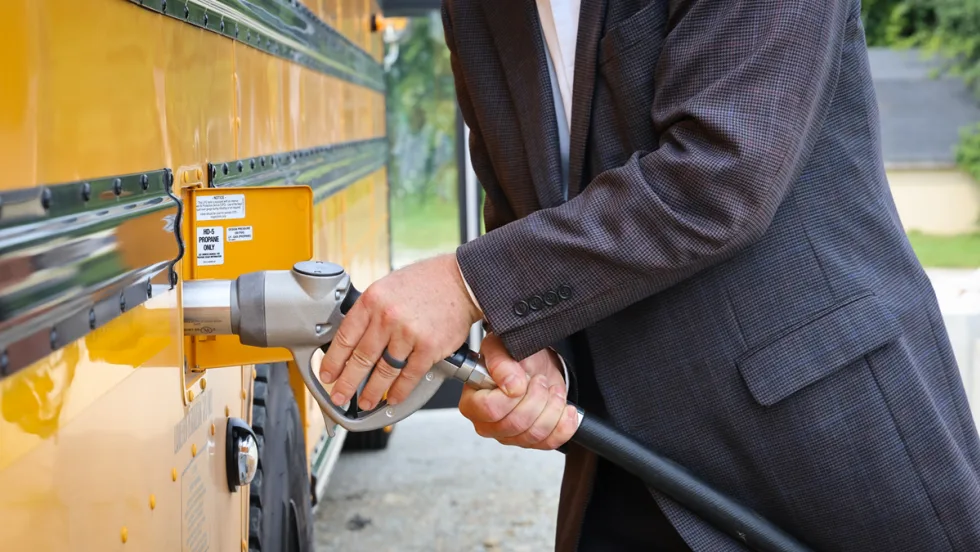
With Fuel Volatility Ahead, School Districts Turn to Propane
While diesel prices peaked above $5 this spring, districts with propane autogas-powered fleets paid under $2 per gallon, according to PERC.
Read More →
EPA Unveils Proposed Changes to 2027 Heavy-Duty Engine Rules
The federal agency has proposed changes to next year’s targets that would eliminate DEF derates, ease warranty requirements, and retain current NOx emissions standards.
Read More →
Alt-Fuel Moves: EV Charging & Infrastructure Projects Gain Momentum
The latest developments include new funding, charging infrastructure, utility investments, and fleet technologies designed to support the transition to electric school buses nationwide.
Read More →