




Virginia District Adds 3-Point Belts to New School Buses
Although the state doesn’t require them, Henrico County has begun equipping its new buses with lap-shoulder restraints. Director Josh Davis share details on the move, which began with a certain NHTSA leader's speech.

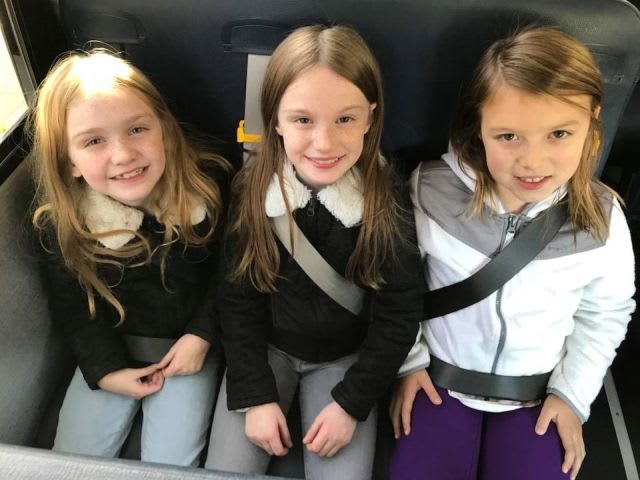
Starting last year, Henrico County Public Schools’ newly purchased buses have three-point seat belts for students.

Starting last year, Henrico County Public Schools’ newly purchased buses have three-point seat belts for students.
RICHMOND, Va. — When the head of the National Highway Traffic Safety Administration (NHTSA) told transportation officials gathered here in 2015 that all school buses should have three-point seat belts, the message hit close to home for Josh Davis.
As director of pupil transportation for Henrico County Public Schools, Davis oversees a large fleet of school buses that cover the county surrounding Richmond, where the industry’s fall conferences were held in 2015. NHTSA’s then-administrator, Mark Rosekind, raised eyebrows among conference attendees and made headlines in the mainstream media when he declared that “every child on every school bus should have a three-point seat belt.”
Among those in the audience was Davis, who was spurred by Rosekind’s statement to get more educated about the issue of seat belts on school buses.
“I said to myself, I need to do more research, because the question will inevitably come up from the superintendent, elected officials, or parents,” Davis recalled.
Reviewing the Research
Specifically, Davis pored over the National Transportation Safety Board’s (NTSB’s) analyses of occupant protection in school bus crashes. The investigative agency has found that lap-shoulder belts reduce flailing injuries and enhance protection for school bus passengers.
“I’m an engineer by trade in education, so I understand the type of modeling [NTSB] did,” said Davis, who has worked in pupil transportation for the past nine years.
His review of the research on school bus occupant protection led Davis to two key conclusions. For one: “Three-point belts do provide an extra layer of safety from some of the very rare crashes that can occur,” he said. Those would include side impacts and rollovers.
But the benefits of the belts aren’t limited to severe crashes, Davis determined. His second conclusion: “I believe that three-point belts will help [reduce] injuries in some of the lesser crashes.”
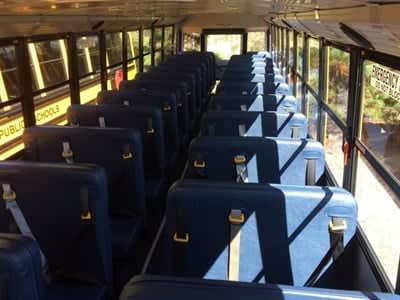
So far, Henrico County has acquired 24 new school buses since adding seat belts to its specs.
Seat Belt Spec
Davis presented his findings on the subject to Henrico County officials, who decided in spring 2017 to include a requirement for seat belts in the school district’s vehicle specifications.
So far, Henrico County Public Schools has purchased 24 new school buses with three-point seat belts. The buses are Thomas Built models, and the seats and belts are supplied by SynTec Seating Solutions.
Davis said that the three-point restraint systems added $9,200 to the cost of the district’s 77-passenger buses and $6,200 to the cost of 53-passenger models. The transportation director acknowledged that the premium for three-point belts meant buying 24 new buses instead of 26.
Henrico County Public Schools has a fleet of more than 600 school buses, so the phasing in of three-point belts could take 10 to 20 years, depending on future funding levels.
“The county is looking for some additional funds to accelerate bus replacement,” Davis said. “We’re hoping to buy 40 to 60 buses in each of the next few years.”
Belt Use Not Mandatory
Virginia doesn’t have school bus seat belt requirements on the books, so Henrico County made its own determination about whether to mandate that students buckle up on the belt-equipped buses. For now, the school district is leaving it voluntary — school bus drivers encourage their passengers to wear the three-point belts, but they don’t force the issue.
Davis said that in general, younger students are complying, but with older students, “it’s a mixed bag.” Meanwhile, the district is hoping that parents will support the seat belt initiative.
“Right now, we tell parents we are investing in this safety equipment for your students, and we hope that they will use it, but we’re not going to take them to the principal’s office” if they won’t buckle up, Davis said.
Confronting Concerns
Seat belts on school buses has long been a contentious issue in the industry. One of the most common concerns raised by some pupil transportation officials and drivers is that seat belts could impede the evacuation of students in an emergency, such as a school bus fire or water immersion. In fact, some drivers at Henrico County Public Schools share that fear.
“We had some drivers that declined a new bus because of the seat belts,” Davis said. “Some of them have that evacuation concern.”
For his part, Davis said he sees the enhanced crash protection of three-point belts outweighing the perceived risk of a hindered evacuation. He noted that while several states require lap belts or lap-shoulder belts on school buses, he has not been able to find any reports of incidents “where buckled up students failed to evacuate a bus and perished. This has not happened in the U.S., to my knowledge.”
Emphasis on Training
Henrico County Public Schools took delivery of its first buses with three-point belts last fall. The transportation department provided training on the seat belts for drivers and students, and families were invited to check out the new buses at a school one evening.
The district conducts emergency evacuation drills with students twice a year. Those drills will now begin with the students buckled up.
“I think that with bus evacuation drills and their daily riding habits, the kids will be very used to buckling and unbuckling,” Davis said. “Some special-needs [and pre-K] students might need some extra assistance. Those are the buses where we do have aides on board.”
Keeping a Close Watch
All of Henrico County Public Schools’ buses have surveillance systems on board, with up to six cameras each in newer buses. The surveillance footage could prove useful in analyzing the performance of the three-point belts in the event of a crash.
“We haven’t had any accidents yet where we were able to see the prevention of an injury — not that I want to have an accident,” Davis said.
Last summer, Davis gave a presentation about three-point belts at the Virginia Association for Pupil Transportation’s annual conference. While he shared his own experience, beginning with the effect of Rosekind’s message, Davis encouraged his counterparts at other districts to get educated on the seat belt issue — regardless of whether they’re for or against it.
“Be prepared to share facts when questions come up,” Davis advised. “As a director, you want to be informed.”
Watch Davis demonstrate the three-point belts on a new Henrico County school bus in the video below.
More Safety

How to Build a Better School Bus Driver Training Program
Is it time to strengthen your driver training? Here’s how to pick the right talent and improve recruitment, retention, and safety. This video is brought to you by IC Bus.
Read More →
Recent School Bus Accidents Leave 2 Dead, 2 Injured
Four school bus crashes in Florida, Illinois, and Georgia highlight risks in transportation lots, at bus stops, and during student loading and unloading.
Read More →
When Every Second Matters, Clarity Keeps Routes Moving
From routine delays to urgent incidents, strong communication practices help drivers, dispatchers, schools, and families respond with confidence.
Read More →

What Happens When a School Bus Catches Fire — and What Can Help
School bus fires are rare but can be devastating. Learn how advances in fire suppression and asset protection help fleets detect fires earlier, reduce damage, and improve safety.
Read More →
Geotab Launches Tool to Help Fleets Investigate Road Incidents
Geotab Investigations combines telematics data, video, documents, and other evidence to help fleets reconstruct incidents, resolve claims, and determine what happened.
Read More →
Texas Sixth Grader Wins 2026 National School Bus Safety Poster Contest
Sai Darshana Yekolu of Moseley Middle School in Prosper, Texas, was named the newest winner for her artwork, bringing the theme of “Safe Rides, Everyday Heroes” to life.
Read More →
Doing More With Less: How Transportation Directors Can Prioritize Safety Amid Budget Uncertainty
With diesel prices soaring and nearly one-third of transportation directors expecting budget cuts, maintaining student safety has never been more challenging. Download this guide to learn how leading districts are prioritizing risk, funding critical safety technology, and building stronger budget cases with data.
Read More →
Walton County Schools Adds Gatekeeper Stop-Arm Enforcement System
The Florida district will deploy Gatekeeper’s updated Student Protector technology, which now incorporates AI to improve video evidence.
Read More →
How To Build a More Secure School Bus Yard During and After Hours
As thefts and overnight security threats continue, school transportation leaders are combining stronger operational practices with AI-enabled surveillance to better protect buses, facilities, and staff.
Read More →
FMCSA Names New Chief Safety Officer: What School Bus Operators Should Know
Steve Dowling is set to lead the federal agency's efforts to advance commercial motor vehicle safety and reduce crashes, fatalities, and injuries on the nation's roadways.
Read More →