




Students Develop Flashing Sign for School Bus Stop Safety
The team of sixth grade students from Wake County (N.C.) Public School System create a flashing sign to alert students, bus drivers, and motorists when a school bus is approaching the bus stop.

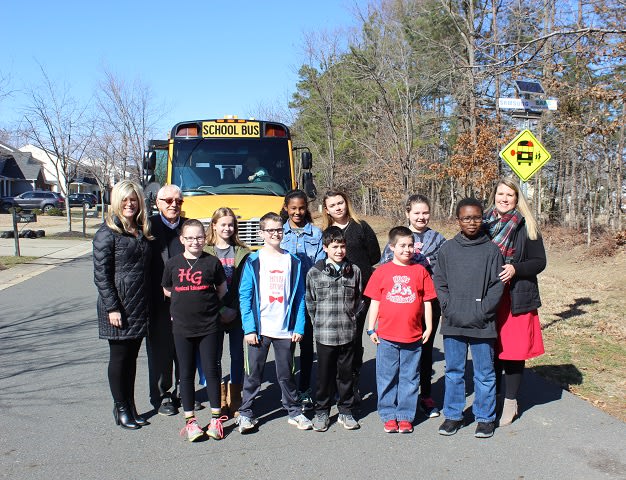
The team of students from Holly Grove Middle School developed flashing signs to improve school bus stop safety, and became one of 50 state finalists for the Samsung "Solve for Tomorrow" contest. Photo courtesy Wake County (N.C.) Public School System
The team of students from Holly Grove Middle School developed flashing signs to improve school bus stop safety, and became one of 50 state finalists for the Samsung "Solve for Tomorrow" contest. Photo courtesy Wake County (N.C.) Public School System
HOLLY SPRINGS, N.C. — A group of middle school students here received national recognition after developing a flashing sign to improve school bus stop safety.
The team of sixth graders from Holly Grove Middle School were recognized as one of 50 state finalists for Samsung's “Solve for Tomorrow,” a national contest designed to help students create change in their local communities by using skills in science, technology, engineering, and math (STEM).
The students developed a flashing sign with LED lights to alert students, bus drivers, and motorists when a school bus is within 300 feet of the bus stop. Their contest submission granted them $20,000 worth of technology for their school.
Debra Schelin, a sixth grade teacher for Holly Grove Middle School, told School Bus Fleet that she first encouraged her students to enter the contest after receiving an email from Samsung.
“Samsung sent out a national email that got my attention because [the contest] was centered around STEM,” Schelin said. “This contest gave my students the opportunity to identify and come up with a solution for a real-world issue they found important.”
The students said they began sharing their experiences with school bus safety during a classroom discussion, in which two of the students recalled an incident in which one of them was nearly struck by a vehicle while trying to board their school bus.
“We thought flashing lights on a sign at the school bus stop would help get the attention of motorists that often pass the bus stop arm,” the group of students told SBF. “We think flashing lights will be better than just a plain sign that motorists are often desensitized to.”
Before developing the idea for the flashing sign, the students’ initial plan was to create solar-powered cameras to be placed on stop arms as a way to capture motorists illegally passing stopped school buses. However, the students changed their idea after they discovered that Wake County Public School System had already installed about 20 stop-arm cameras on some of its buses.
Stephen Sposato, the director of transportation for Wake County Public School System, said that based on data collected last March, there are nearly 3,000 stop-arm violations each school day in North Carolina.
Sposato added that the safety of students is critical when entering and exiting the school bus and believes the advanced notification of the flashing sign will help better prepare motorists to be cautious and stop for buses.
When asked about the district's plans to install the “smart” sign, Sposato said the district hopes to see prototypes developed and pilot projects implemented. However, he noted, there is no exact time frame for installation.
On Friday, the team of students recorded a video to showcase their idea and included a mock-up of how the signs would work in a demonstration with a school bus, according to a post on the district’s Facebook page. The video will be their entry submission for the next round of the Samsung contest.
Ten national finalists will be selected to present their project to a panel of judges, and Samsung will announce three winners to receive $100,000 in classroom technology and supplies, according to the contest’s website.
Schelin said if the students are selected as one of the top three winners, the principal of Holly Grove Middle School will invite them to be a part of the committee that designates how the school will distribute the funds for the classroom technology and supplies.
More Safety
Geotab Expands Fleet Safety Tools With Video Coaching, Risk Insights
New safety and video capabilities aim to help fleet managers assess risk, support drivers, and take targeted action through video coaching, red-light violation detection, and more.
Read More →
How to Build a Better School Bus Driver Training Program
Is it time to strengthen your driver training? Here’s how to pick the right talent and improve recruitment, retention, and safety. This video is brought to you by IC Bus.
Read More →
Recent School Bus Accidents Leave 2 Dead, 2 Injured
Four school bus crashes in Florida, Illinois, and Georgia highlight risks in transportation lots, at bus stops, and during student loading and unloading.
Read More →

When Every Second Matters, Clarity Keeps Routes Moving
From routine delays to urgent incidents, strong communication practices help drivers, dispatchers, schools, and families respond with confidence.
Read More →
What Happens When a School Bus Catches Fire — and What Can Help
School bus fires are rare but can be devastating. Learn how advances in fire suppression and asset protection help fleets detect fires earlier, reduce damage, and improve safety.
Read More →
Geotab Launches Tool to Help Fleets Investigate Road Incidents
Geotab Investigations combines telematics data, video, documents, and other evidence to help fleets reconstruct incidents, resolve claims, and determine what happened.
Read More →
Texas Sixth Grader Wins 2026 National School Bus Safety Poster Contest
Sai Darshana Yekolu of Moseley Middle School in Prosper, Texas, was named the newest winner for her artwork, bringing the theme of “Safe Rides, Everyday Heroes” to life.
Read More →
Doing More With Less: How Transportation Directors Can Prioritize Safety Amid Budget Uncertainty
With diesel prices soaring and nearly one-third of transportation directors expecting budget cuts, maintaining student safety has never been more challenging. Download this guide to learn how leading districts are prioritizing risk, funding critical safety technology, and building stronger budget cases with data.
Read More →
Walton County Schools Adds Gatekeeper Stop-Arm Enforcement System
The Florida district will deploy Gatekeeper’s updated Student Protector technology, which now incorporates AI to improve video evidence.
Read More →
How To Build a More Secure School Bus Yard During and After Hours
As thefts and overnight security threats continue, school transportation leaders are combining stronger operational practices with AI-enabled surveillance to better protect buses, facilities, and staff.
Read More →