




Speaker Shares Impact of Boston Marathon Bombing
Jeff Bauman tells NAPT Summit attendees about how he lost both legs in the 2013 bombing but was able to give investigators a description of the suspect he had seen.

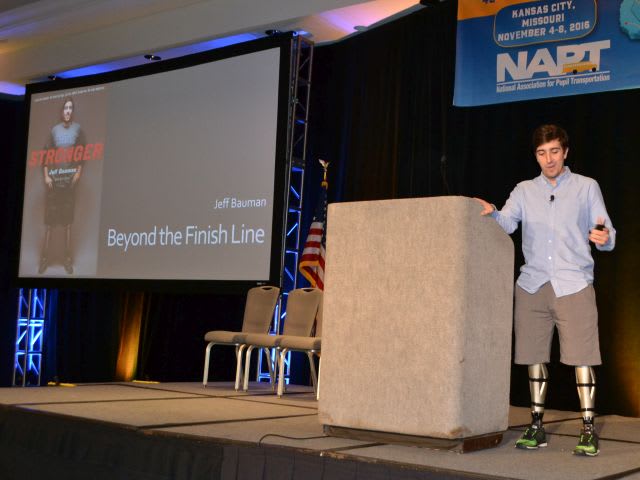
Jeff Bauman told NAPT Summit attendees about how he lost both legs in the 2013 Boston Marathon bombing but was able to give investigators a description of the suspect he had seen.
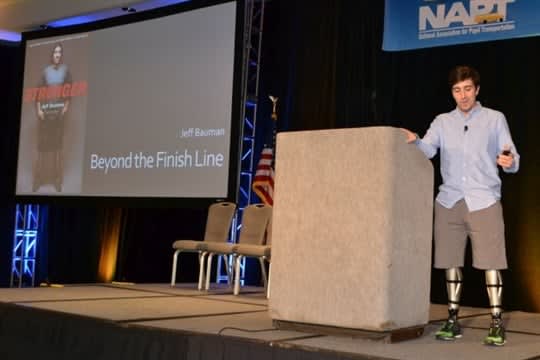
Jeff Bauman told NAPT Summit attendees about how he lost both legs in the 2013 Boston Marathon bombing but was able to give investigators a description of the suspect he had seen.
KANSAS CITY, Mo. — As Jeff Bauman waited for his girlfriend to cross the finish line of the Boston Marathon, a young man with a backpack bumped into him.
The young man looked out of place in the crowd and didn’t seem to be watching the marathon, Bauman thought. Even after the young man set down his backpack, Bauman turned his attention back to the race — he didn’t want to miss seeing his girlfriend, Erin, complete the 26.2-mile run. He also remembered feeling a sense of security being in Boston.
A few minutes later, Bauman heard three pops and saw a flash of light. Suddenly, he was on the ground. “It smelled like fireworks,” he recalled.
Bauman saw that his legs were “obliterated.” He remembers thinking that he was going to die, but he felt a strange sense of calm. A bystander in a cowboy hat, Carlos Arredondo, rushed to help him, and he was soon taken to the hospital. He survived, but both of his legs were amputated above the knee.
What the 27-year-old had just lived through was the Boston Marathon bombing on April 15, 2013, and he played a pivotal part in identifying one of the suspects.
Bauman shared his powerful story in a keynote presentation at the National Association for Pupil Transportation's (NAPT's) 2016 Summit in Kansas City on Sunday morning.
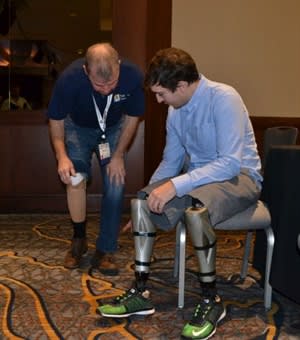
Summit attendee David McCrae, also an amputee, shows Bauman his prosthetic leg after Bauman's presentation.
In the hospital, Bauman gave the FBI and police a description of the bombing suspect he had seen, Tamerlan Tsarnaev, who was eventually tracked down and killed in a shootout with police. Bauman also later testified in the trial of Tsarnaev’s younger brother, Dzhokhar Tsarnaev, who was convicted in the bombing that killed three people and injured more than 200.
Meanwhile, Bauman said that he endured a time of “excruciating pain” after the attack as he underwent surgeries. He was fitted for prosthetic legs and went through physical therapy to learn to use them. About two months after losing his legs, he stood up for the first time.
Bauman became emblematic of the “Boston Strong” slogan in the wake of the bombings. He was invited to throw the first pitch at a Red Sox game at Fenway Park. He attended Erin’s next race, in Portland, Maine, and overcame his fear of returning to a finish line. Then in the next Boston Marathon, in 2014, Bauman returned to the site of the bombing — escorted by the mayor’s police detail — to cheer on the runners.
As he spoke to NAPT attendees, Bauman remained upbeat and elicited laughs from the crowd, but he acknowledged that the years after the bombing came with intense struggles that he had to work through. For one, he said that he overindulged in alcohol, but now he’s five months sober.
Bauman cowrote a book about his experience, called Stronger, which is being made into a film. He and Erin are now married and have a daughter.
In introducing Bauman, NAPT Executive Director Mike Martin said that his story is inspiring and powerfully illustrates the “If You See Something, Say Something” message that the Transportation Security Administration (TSA) promotes.
The presentation came a day after an extensive security training program that NAPT held with TSA for Summit attendees.
More Management
How to Build a Better Driver Training Program
Ready to boost up your school bus instructor training? Here’s how to pick the right talent and improve recruitment, retention, and safety.
Read More →
CALSTART and Forth Combine to Form Catalyst Mobility
The new name represents a renewed vision for the nonprofit focused on advancing clean, equitable, and affordable transportation solutions that move people and goods.
Read More →
What Makes a Great School Bus Driver Trainer?
Choosing the right school bus driver trainer takes more than experience. Learn six keys to selecting and developing trainers and evaluating program effectiveness.
Read More →

School Bus Contractors Expand Through New Deals, Acquisitions & Partnerships
STA's Canadian division acquires Ontario-based G&L Stevenson Transport while Durham School Services adds a new district contract in California, First Student adds a New Jersey contract, and Minnesota Coaches acquires Halo Transportation.
Read More →
Logan Bus Company Rolls Out AI Phone System for NYC School Bus Families
A summer pilot found that AI agents could handle most routine calls, freeing up time for customer service staff to focus on emergencies and complex family concerns.
Read More →
From Intent to Impact: What I Learned About Leadership from TAPT
A Texas transportation supervisor shares lessons on self-awareness, accountability, managing stress and building trust — and why investing in leadership development matters at every stage of your career.
Read More →
NAPT Names 2026 Award Recipients, Hall of Fame Inductee
Who earned national recognition for their work in student transportation? This year, NAPT named five recipients of its 2026 awards for service, safety, and leadership, plus its newest Hall of Famer.
Read More →
2026 State of Student Transportation Report
Driver shortages. Rising costs. Growing safety expectations. More data, but not enough time to act on it. The 2026 State of Student Transportation Report reveals what transportation leaders say is putting the most pressure on their operations—and where they’re investing next. See how your priorities compare.
Read More →
How to De-Escalate an Angry Person: 5 Steps for Handling Workplace Conflict
What makes emotions run high, and how should you handle an angry colleague or parent? Follow these steps for staying calm, listening, showing empathy, and resolving conflict.
Read More →
What Readiness Looks Like This School Year
Learn about the challenges shaping the 2026–2027 school year, from persistent driver shortages and budget pressure to technology and readiness gaps. See how school districts are responding and adapting in Zonar’s 2026 Back-to-School Readiness Report.
Read More →