




Report Recommends School Buses to Relieve Traffic in California County
A grand jury in Marin County calls for a coordinated school bus service to curb traffic congestion.

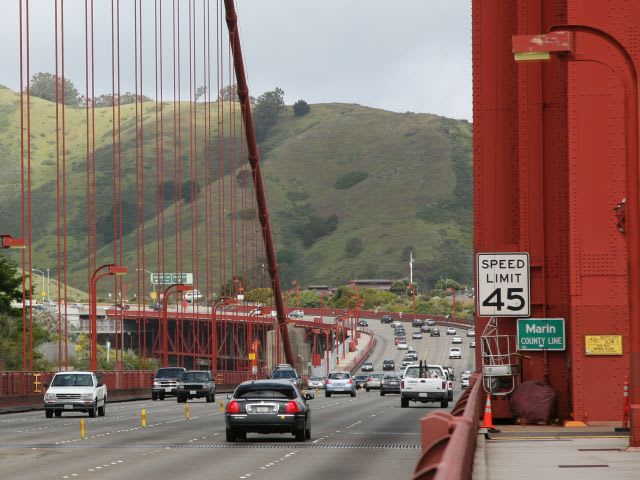
A grand jury in Marin County, north of San Francisco, is calling for a coordinated school bus service to curb traffic congestion. Seen here is the Marin County line on the Golden Gate Bridge. Photo by Daniel Schwen via Wikimedia Commons

A grand jury in Marin County, north of San Francisco, is calling for a coordinated school bus service to curb traffic congestion. Seen here is the Marin County line on the Golden Gate Bridge. Photo by Daniel Schwen via Wikimedia Commons
MARIN COUNTY, Calif. — Expanding school bus service is the best bet for curbing traffic congestion in this Northern California county, according to a new report.
The Marin County Civil Grand Jury, an investigative body that monitors the performance of local government, last week released “Yellow School Bus for Traffic Congestion Relief,” which gives an overview of local traffic and transportation issues and makes recommendations to address them.
Marin County, located across the Golden Gate Strait from San Francisco, has a population of about 260,000 people and a total land area of 520 square miles. The grand jury report identifies traffic congestion as a top concern among residents, with school-related traffic being a significant factor in the overall issue. Reducing the number of cars on the road, the report says, is a more effective approach to mitigating gridlock than are other projects like widening roads or optimizing traffic signals.
The grand jury points to yellow school buses as the best way to get more single-family cars off the road and decrease school-related traffic.
“If school buses were more widely available and used, it could make a significant, positive impact on congestion,” the report says. “Increasing school bus usage seems to be our best chance at reducing school-associated traffic congestion.”
The report also provides a historical background on pupil transportation funding in California.
“School buses were the norm until the 1978 passage of Proposition 13, which rolled back property taxes and capped annual tax increases,” the grand jury notes. “As funding dried up and many yellow school bus programs were cut back, parents were compelled to drive their children to school.”
Another decline in funding from 2000 to 2015 prompted further reductions in transportation service, according to the report, and several school districts in Marin County cut their entire school bus programs. Still, some local districts continue to offer various levels of school bus transportation.
The new report from the Marin County Civil Grand Jury cites a 2015 study conducted by Marin Transit, in partnership with the Transportation Authority of Marin and the Marin County Office of Education, that also supported the expansion of yellow school bus service in the county.
However, there are hurdles to be cleared in order to boost busing. The grand jury report cites the need for secured bus parking locations, dependable funding sources, and coordinated school bell times as key challenges that would have to be addressed.
Even so, the grand jury recommends the development of a coordinated yellow school bus service, to be managed by Marin Transit, for the urbanized areas of Marin County. The goal would be to begin operations by the 2019-20 school year.
The grand jury also calls on Marin County and local municipalities to “make financial support of all [yellow school bus] programs a part of each year’s budgeting process.”
The Marin County Civil Grand Jury’s school bus report is available here.
More Management

How to Build a Better Driver Training Program
Ready to boost up your school bus instructor training? Here’s how to pick the right talent and improve recruitment, retention, and safety.
Read More →
CALSTART and Forth Combine to Form Catalyst Mobility
The new name represents a renewed vision for the nonprofit focused on advancing clean, equitable, and affordable transportation solutions that move people and goods.
Read More →
What Makes a Great School Bus Driver Trainer?
Choosing the right school bus driver trainer takes more than experience. Learn six keys to selecting and developing trainers and evaluating program effectiveness.
Read More →

School Bus Contractors Expand Through New Deals, Acquisitions & Partnerships
STA's Canadian division acquires Ontario-based G&L Stevenson Transport while Durham School Services adds a new district contract in California, First Student adds a New Jersey contract, and Minnesota Coaches acquires Halo Transportation.
Read More →
Logan Bus Company Rolls Out AI Phone System for NYC School Bus Families
A summer pilot found that AI agents could handle most routine calls, freeing up time for customer service staff to focus on emergencies and complex family concerns.
Read More →
From Intent to Impact: What I Learned About Leadership from TAPT
A Texas transportation supervisor shares lessons on self-awareness, accountability, managing stress and building trust — and why investing in leadership development matters at every stage of your career.
Read More →
NAPT Names 2026 Award Recipients, Hall of Fame Inductee
Who earned national recognition for their work in student transportation? This year, NAPT named five recipients of its 2026 awards for service, safety, and leadership, plus its newest Hall of Famer.
Read More →
2026 State of Student Transportation Report
Driver shortages. Rising costs. Growing safety expectations. More data, but not enough time to act on it. The 2026 State of Student Transportation Report reveals what transportation leaders say is putting the most pressure on their operations—and where they’re investing next. See how your priorities compare.
Read More →
How to De-Escalate an Angry Person: 5 Steps for Handling Workplace Conflict
What makes emotions run high, and how should you handle an angry colleague or parent? Follow these steps for staying calm, listening, showing empathy, and resolving conflict.
Read More →
What Readiness Looks Like This School Year
Learn about the challenges shaping the 2026–2027 school year, from persistent driver shortages and budget pressure to technology and readiness gaps. See how school districts are responding and adapting in Zonar’s 2026 Back-to-School Readiness Report.
Read More →