





More Data: Report: 98% of School Districts Want Modern Transportation
Report: Bus Driver, Funding Shortages Part of School Transportation Crisis
Data from HopSkipDrive's new 2025 State of School Transportation shows school staff forced to manage increased needs, parents reporting job loss from cuts, and reduced bus routes.
September 5, 2025
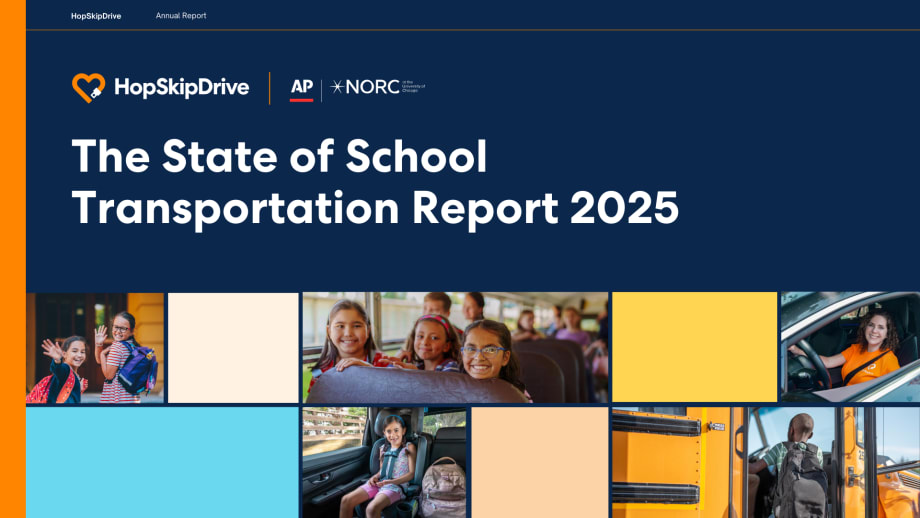
The report details persistent impacts of bus driver shortages and budget shortfalls.
Photo: HopSkipDrive
5 min to read
A new pair of surveys, conducted by the Associated Press-NORC Center for Public Affairs Research and HopSkipDrive, showcases the issues plaguing school administrators and the impacts on educators, parents, and students.
The surveys show that most school administrator respondents still face transportation challenges in their schools and districts, including the persistent impacts of bus driver shortages (80%) and budget shortfalls (73%) on transportation operations. Most students still rely on driving to school, even though nine in 10 school administrators say the number of students eligible for free school transportation is growing (44%) or staying the same (46%).
In the context of shifting transportation needs, the 2025 HopSkipDrive State of School Transportation Report examines the numerous challenges and constraints facing school administrators. Students are missing out on educational support and opportunities, and face issues with tardiness and absenteeism. Additionally, 11% of parents have lost their jobs due to the need to take their children to and from school or other activities.
This year's themes are echoed and continued from the company's 2024 report.
Key Facts: School Administrators
As demand rises and budgets tighten, school transportation operations struggle to keep up with the shortage of bus drivers, resorting to cutting or shortening bus routes and asking staff or parents to step in. The negative impacts are far-reaching, as many parents report that transportation is a significant consideration when choosing a school for their child.
Nine in 10 say the number of students who qualify for free, school-provided transportation in the last 5 years has stayed the same (46%) or increased (44%), and 45% expect the need to keep increasing over the next 5 years.
81% say school bus driver shortages are a problem in their school or district, including 46% who say it is a major problem.
26% of respondents report that their school or district has addressed these shortages by cutting or shortening bus routes.
73% reported transportation budget shortages have affected their transportation operations.
83% report that their teachers and educators have to step away from their core responsibilities to cover transportation needs.
89% say students in their school or district are typically driven to school.
75% say access to transportation has an impact on their school or district’s problems with chronic absenteeism.
“School administrators are sounding the alarm: transportation challenges are no longer just logistical — they’re educational. When teachers are pulled from classrooms to support operations and students miss out on learning opportunities, the ripple effects are profound,” said Joanna McFarland, CEO and co-founder at HopSkipDrive. “The good news is that administrators are open to innovative solutions, from centralized pick-up locations to supplemental transportation services, so every student can get to school safely, reliably, and ready to learn. Cutting transportation has become a default option with unacceptable consequences, shifting the burden to other educators, students and families.”
Key Facts: Parents of K-12 Students
As schools struggle to keep up with transportation needs, families are increasingly responsible for driving their students to and from school. This shift creates additional and damaging consequences for parents as students miss out on educational opportunities or face tardiness and absenteeism due to transportation challenges, the report announcement read.
26% say students have missed extracurricular activities in the last school year, 21% have missed school services like school meals or counseling, and 17% have missed tutoring or academic help.
78% of parents say transportation would be at least a somewhat important consideration if they could send their children to any school in their area.
44% say their students have been late to school at least a few times in the last year due to issues with transportation.
56% experience stress about their children’s transportation at least a few times a year, with a quarter feeling stressed at least monthly.
About three in 10 have missed work or been prevented from taking personal opportunities or work opportunities, and 11% have lost a job due to needing to take their children to and from school or other activities.
Women are significantly more likely than men to report being prevented from pursuing work opportunities (33% vs. 23%) or personal opportunities (37% vs. 23%) due to child transportation responsibilities.
20% of women without a college degree report having lost a job due to transportation responsibilities compared to 2% of women with a college degree.
“Transportation issues are impacting families in deeply personal ways — from missed work and lost jobs to children missing out on meals, counseling, and extracurriculars. These challenges are especially acute for mothers and for families with fewer resources,” said Jennifer Benz, deputy director of The AP-NORC Center. “The data show that when transportation breaks down, it’s not just a scheduling problem — it’s a barrier to opportunity. Understanding these impacts is essential to crafting solutions that work for both schools and families.”
Overview and Key Facts: A Way Forward
Parents and school administrator respondents share common ground on possible solutions to transportation challenges.
Most school administrator respondents favor:
Organizing centralized pick-up and drop-off locations for students using school buses (73%).
Improving pedestrian and bicycle infrastructure in areas near schools (70%).
Allowing school districts to use school-arranged supplemental transportation services (65%).
About four in 10 parents agree that offering school-arranged supplemental transportation services and improving safe pedestrian and bike infrastructure would make getting to school easier for their family, and a third say the same about organizing centralized pick-up and drop-off locations for students. About half say it wouldn’t make much difference to them.
About the Study
This study was conducted by The Associated Press-NORC Center for Public Affairs Research in partnership with HopSkipDrive.
The Parent Survey was conducted June 30 to July 11, 2025, using the AmeriSpeak Panel. Online interviews were conducted with 838 adults with school-aged children (children age 5-17). The overall margin of sampling error is +/- 4.6 percentage points.
The School Administrator Survey was conducted June 30 to July 25, 2025. Online interviews were conducted with 510 school administrators. Because non-probability panels do not start with a frame where there is known probability of selection, standard measures of sampling cannot be calculated for this sample.
Find the full 2025 report online HERE.
More Management

How to Build a Better Driver Training Program
Ready to boost up your school bus instructor training? Here’s how to pick the right talent and improve recruitment, retention, and safety.
Read More →
CALSTART and Forth Combine to Form Catalyst Mobility
The new name represents a renewed vision for the nonprofit focused on advancing clean, equitable, and affordable transportation solutions that move people and goods.
Read More →
What Makes a Great School Bus Driver Trainer?
Choosing the right school bus driver trainer takes more than experience. Learn six keys to selecting and developing trainers and evaluating program effectiveness.
Read More →


School Bus Contractors Expand Through New Deals, Acquisitions & Partnerships
STA's Canadian division acquires Ontario-based G&L Stevenson Transport while Durham School Services adds a new district contract in California, First Student adds a New Jersey contract, and Minnesota Coaches acquires Halo Transportation.
Read More →
Logan Bus Company Rolls Out AI Phone System for NYC School Bus Families
A summer pilot found that AI agents could handle most routine calls, freeing up time for customer service staff to focus on emergencies and complex family concerns.
Read More →
From Intent to Impact: What I Learned About Leadership from TAPT
A Texas transportation supervisor shares lessons on self-awareness, accountability, managing stress and building trust — and why investing in leadership development matters at every stage of your career.
Read More →
NAPT Names 2026 Award Recipients, Hall of Fame Inductee
Who earned national recognition for their work in student transportation? This year, NAPT named five recipients of its 2026 awards for service, safety, and leadership, plus its newest Hall of Famer.
Read More →
Sponsored•September 2, 2026
2026 State of Student Transportation Report
Driver shortages. Rising costs. Growing safety expectations. More data, but not enough time to act on it. The 2026 State of Student Transportation Report reveals what transportation leaders say is putting the most pressure on their operations—and where they’re investing next. See how your priorities compare.
Read More →
How to De-Escalate an Angry Person: 5 Steps for Handling Workplace Conflict
What makes emotions run high, and how should you handle an angry colleague or parent? Follow these steps for staying calm, listening, showing empathy, and resolving conflict.
Read More →
Sponsored•September 1, 2026
What Readiness Looks Like This School Year
Learn about the challenges shaping the 2026–2027 school year, from persistent driver shortages and budget pressure to technology and readiness gaps. See how school districts are responding and adapting in Zonar’s 2026 Back-to-School Readiness Report.
Read More →