




Pennsylvania district launches 23 CNG buses
Rose Tree Media School District hits the road with 15 new buses and eight retrofitted buses running on compressed natural gas. Superintendent James Wigo discusses the district's efforts to convert its fleet.


Superintendent James Wigo (right), school board President John Hanna (second from right) and other dignitaries took part in a ribbon-cutting ceremony for Rose Tree Media School District's new CNG buses.
MEDIA, Pennsylvania — With a mixture of new and retrofitted vehicles, a local school district has launched a fleet of 23 school buses powered by compressed natural gas (CNG).
Rose Tree Media School District recently purchased 15 new Thomas Built CNG buses and retrofitted eight older diesel buses to run on the alternative fuel.
Last week, the district held a ribbon-cutting ceremony for the CNG buses, with district stakeholders and other dignitaries getting a chance to ride one of the green vehicles.
PHOTOS: To view a photo gallery of Rose Tree Media School District's CNG bus ceremony, go here.
Rose Tree has already put the CNG buses into service, and Superintendent James Wigo said that results so far have been favorable.
"The drivers absolutely love the buses," Wigo said, noting that one of the unexpected benefits has been the quieter engine. "The kids are not screaming over the sound of the diesel. It really changed the whole environment on the bus."
Rose Tree decided to delve into CNG buses after an analysis by Johnson Controls found that on a slow conversion schedule, the district could achieve a $1 million net benefit over a 20-year period.
"That didn't sound like a lot, but we plan to convert the fleet quicker," Wigo said, "It takes some time to make up the cost differential [of a CNG bus compared to a diesel], but the whole time we’re using clean fuel. I think that’s the key."
Cutting emissions was one of the top factors in the decision to switch to CNG.
"We probably reduce hydrocarbon spewing by 25 to 30% in the CNG buses compared to diesel buses," Wigo said.
Grant funding has helped in acquiring the alternative-fuel buses. Over the past two years, Rose Tree has received about $800,000 in grants for the project.
The district also financed construction of a fast-fill CNG fueling station and retrofits to the bus garage for servicing the new vehicles.
In addition to the 23 units that are now in service, Rose Tree may acquire 12 more for the next school year, with more to come after that. The district has a total of 74 buses, transporting students to about 100 schools and logging just over 1 million miles per school year.
"We would love to have half of our fleet converted within the next three years," Wigo said.
More Alternative Fuels

CALSTART and Forth Combine to Form Catalyst Mobility
The new name represents a renewed vision for the nonprofit focused on advancing clean, equitable, and affordable transportation solutions that move people and goods.
Read More →
Alt-Fuel Moves: New Buses, Charging Hubs & Real-World EV Testing
Propane and electric school bus deployments continue to grow as districts add new vehicles, expand charging infrastructure, and gather more real-world operating data.
Read More →
Fewer Electric School Bus Models Reshape the U.S. Market
WRI’s latest buyer’s guide points to a consolidating electric school bus market, but fewer options may reflect a maturing industry rather than fewer meaningful choices for school bus operators.
Read More →
The Fuel Budget You Can Actually Predict: How Propane Autogas Keeps Money in the Classroom
Learn how propane autogas helps school districts manage fuel costs with predictable pricing, lower maintenance, and reduced emissions from former transportation director Joel Stutheit.
Read More →
Hendrickson, Driventic Introduce New Electric Powertrain for School Buses
ELECTRAAX, the electrified, lightweight drive axle offers integrated ePowertrain efficiency and modular flexibility for Class 6–7 school bus use.
Read More →
The Mobility House Joins PowerFlex in Fleet Electrification Deal
The acquisition combines intelligent charging software, bidirectional charging expertise, and fleet electrification services to support the growing adoption of electric school buses across North America.
Read More →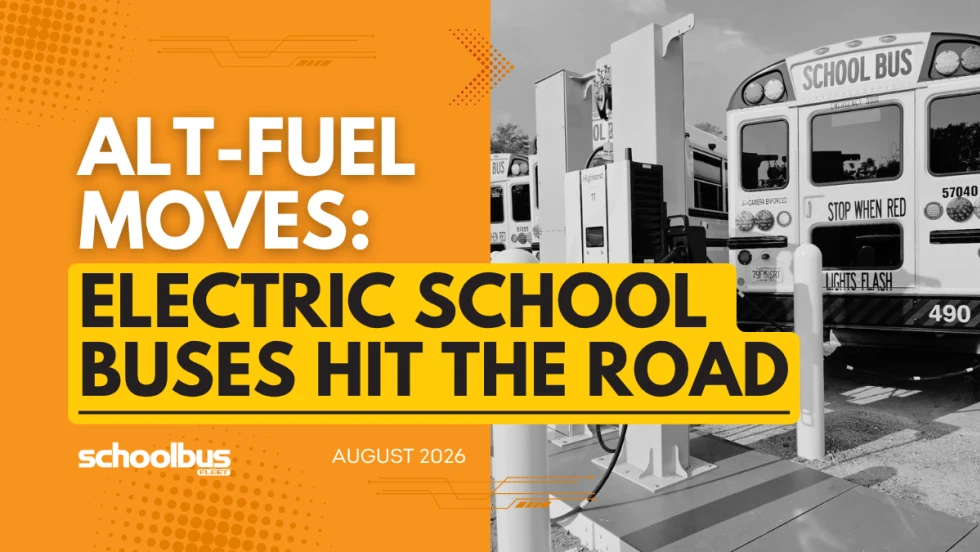
Alt-Fuel Moves: Electric School Bus Investments Hit the Road
See which districts across the U.S. are putting electric school buses into service, expanding charging infrastructure, and planning the next phase of fleet electrification.
Read More →
With Fuel Volatility Ahead, School Districts Turn to Propane
While diesel prices peaked above $5 this spring, districts with propane autogas-powered fleets paid under $2 per gallon, according to PERC.
Read More →
EPA Unveils Proposed Changes to 2027 Heavy-Duty Engine Rules
The federal agency has proposed changes to next year’s targets that would eliminate DEF derates, ease warranty requirements, and retain current NOx emissions standards.
Read More →
Alt-Fuel Moves: EV Charging & Infrastructure Projects Gain Momentum
The latest developments include new funding, charging infrastructure, utility investments, and fleet technologies designed to support the transition to electric school buses nationwide.
Read More →