




Financial statement presentation can impact bus companies
How a business presents its financial statements can mean the difference between lenders making loans to the customer or not. Here, an accounting expert outlines different methods of financial reporting.
In the U.S.’s fragile economic climate, financial statement presentation can mean the difference between lenders making loans to customers as needed during down times, as well as for the timing difference between the collection of receivables and payment of accounts payable or not.
Recently, a business owner and I met with a banker to discuss current and future borrowing needs. After some discussion, it was apparent, based upon the bank’s review of the customer’s financial statements, that there was concern over the value of company assets and the net income of the business.
We directed the banker to the basis of accounting upon which the financial statements were prepared. In this case, the financial statements were presented on the income tax basis of accounting.
The income tax basis of accounting reports depreciation in the financial statements using the same depreciation method as in the business’ income tax return. Some businesses use the income tax basis because it requires maintenance of only one set of depreciation schedules.
Different methods of financial presentation
One of the benchmarks of financial accounting is that all capital assets are recorded on the balance sheet at historical cost — for example, the price for which the item was purchased. In simple terms, financial statements do not necessarily reflect the “fair market value” of an asset.
Here’s an example: ABC Company purchases five new buses at $48,000 each. The “historical” cost figure of $240,000 would be reflected on the balance sheet under the “Property and Equipment” section for as long as the assets are owned by ABC Company.
For the purpose of reducing ABC Company’s income tax liability, the $240,000 would most likely be immediately depreciated under the federal Internal Revenue Service (IRS) Section 179 expensing rules. Financial statements issued under the income tax basis of accounting would reflect a zero “net book value” for the buses because they had been immediately expensed as allowed by the IRS as well as a substantial depreciation expense for the year.
However, the useful and realistic life of a new bus is probably 10 years or more. If ABC Company chose to present its financial statements under Generally Accepted Accounting Principles (GAAP), then the useful life of assets placed in service would be determined by management, and subsequently, the financial statements under GAAP would more accurately reflect the un-depreciated remainder of assets over time.
The chart below shows the asset difference on financial statements comparing accounting methods of income tax basis and GAAP basis one year after the equipment was purchased. This switch does not affect the tax return and/or subsequent tax liability. It is merely a different method of reporting the financial position of the company.
Income tax basisGAAP basis Cash $10,000 $10,000 Accounts receivable $20,000 $20,000 Buses $240,000 $240,000 Less: accumulated depreciation ($240,000) ($24,000) Net property and equipment - $216,000 Total assets$30,000$246,000
There are income thresholds and other rules affecting the amount of Section 179 expenses that can be taken in a tax year, and other factors, such as whether a capital asset is purchased new or used and how much is spent on capital assets.
Open communication is key
Communication is crucial for any business. Open communication with bankers and accountants form important passages for understanding the details of a financial statement presentation and, ultimately, help run a business successfully.
Kim Mahanna is a certified public accountant for Smith Schafer & Associates Ltd. For more information on this topic or tax-related questions, contact the Smith Schafer transportation team at (651) 770-8414.
More Management

EverDriven Integrates Pathwise's EZRouting into Routing Services
The new partnership combines trusted software with industry expertise to help district transportation teams streamline general education routing, improve efficiency, and lower operating costs.
Read More →
First Student Safety Executive Named Samsara Technology Leader of the Year
David Perez earned the honor for deploying AI-powered safety and fleet technologies that improved driver behavior and family communication.
Read More →
Zum Expands to Rhode Island with 2 New District Partnerships
The Ocean State becomes Zum’s 18th state served as the company expands its presence in the Northeast U.S., while launching operations in Philadelphia, and supporting FIFA World Cup 2026.
Read More →



The Driver Shortage Playbook
How student transportation fleets are hiring, retaining and adapting .
Read More →
Stertil-Koni Announces New Company President
Lewis Nelson joins the heavy-duty vehicle lift provider, succeeding Scott Steinhardt in the lead role.
Read More →
Tennessee Hall of Fame Honors Drivers for Decades of Service
Frances Theiring, a school bus driver for Wilson County Schools, retires this year after almost 50 years on the road. She is one of two long-time drivers honored for their service in the state.
Read More →
What Happens to a School Bus After Retirement? First Student Has a New Answer
Through a new partnership with Advanced Remarketing Services, proceeds from retired vehicle sales will support Special Olympics and other community-focused organizations while advancing sustainability goals.
Read More →
School Bus Logistics Adds 3 Data Analysts, Expands Routing Capabilities
Three new data analysts and a BusRight certification bring an added layer of support to the routing services districts already use.
Read More →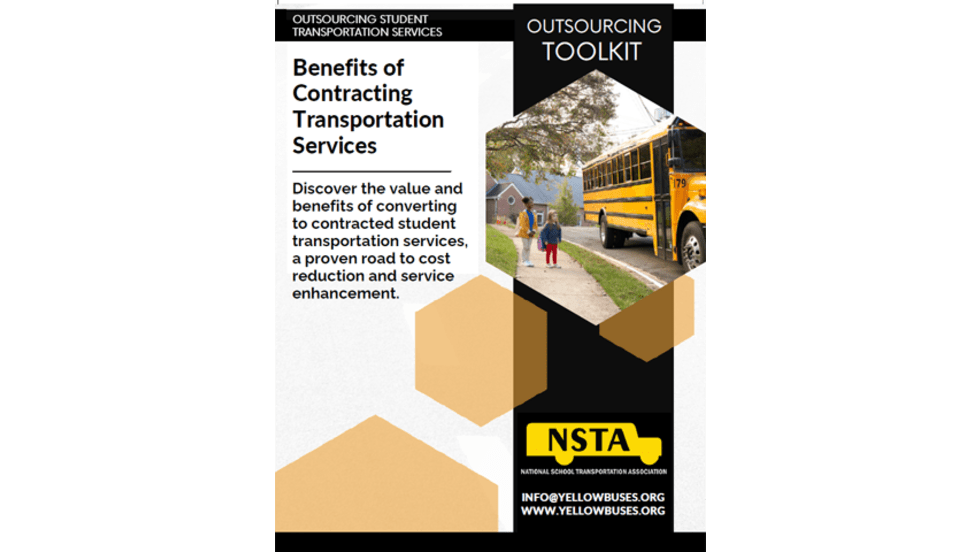
Outsourcing Student Transportation Services Toolkit
Did you know nearly 40% of school districts utilize a private contractor to serve their transportation needs? Explore why more school leaders are turning to contracted transportation services, and how outsourcing can create meaningful value without sacrificing control. Discover the practical benefits of a transportation services platform that provides flexibility with coordination.
Read More →
EverDriven Debuts TripCentral as New District Transportation Portal
The new transportation management hub takes over the district portal to power trip planning, operations, visibility, and intelligence for school district transportation needs.
Read More →