




Ellison Addresses ABA’s Questions About ‘Yellow Charter’ Buses
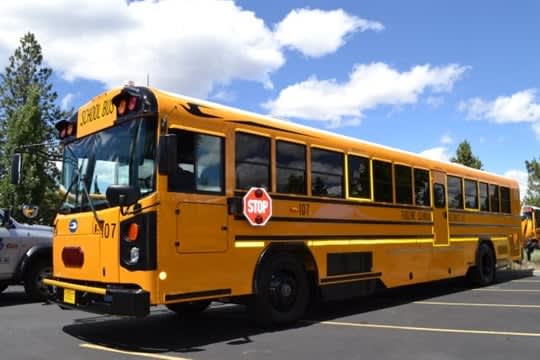
Following the motorcoach association’s response to an SBF article, Chris Ellison of Eugene School District clarifies details about the district’s charter-style school buses.


Following a motorcoach association’s response to an SBF article, Chris Ellison of Eugene School District clarifies details about the district’s charter-style school buses.
Following a motorcoach association’s response to an SBF article, Chris Ellison of Eugene School District clarifies details about the district’s charter-style school buses.
Editor’s note: The American Bus Association (ABA), a trade group for motorcoach and tour operators, recently issued a response to the School Bus Fleet June 2017 article “Oregon District Shuns Motorcoaches, Runs ‘Yellow Charters.'" ABA President and CEO Peter Pantuso raised several questions about Eugene School District’s charter-style school buses that are described in the article. Here, Chris Ellison, the district’s transportation manager, responds to the ABA to clarify details about the buses.
June 14, 2017
Dear Mr. Pantuso,
I appreciate your response to Thomas McMahon’s article featured in the June 2017 issue of School Bus Fleet magazine, “Oregon District Shuns Motorcoaches, Runs ‘Yellow Charters.’” However, there are many inaccuracies in your response, and I must take this opportunity to clarify these inaccuracies to be sure readers and other industry professionals are fully and accurately informed.
These “refurbished” buses that you speak of are, in fact, not refurbished. Nowhere in the article does it state that I took an existing bus and refurbished it with updated charter-style equipment. These buses were purpose-built at the factory by the manufacturer. In fact, all three major school bus manufacturers (Blue Bird, Thomas Built, and International) offer this “upfit” for their customers. This is no different than ordering leather for your seats. It is simply an option that has been vetted through rigorous federally-mandated safety testing.
As one of the most federally-regulated vehicles on the road, all equipment installed on school buses must pass FMVSS standards. If it does not, it simply cannot be installed and used.
You mention that school bus seats are designed for compartmentalization. You are correct. With these charter-style activity seats, they still provide compartmentalization, as they do not recline. Reclining seats are not allowed on school buses due to the loss of this compartmentalization. Again, these seats meet all FMVSS regulations.
Seat belts are currently a hot national topic in the pupil transportation industry. The fact is that unless local or state administrative rules require three-point lap/shoulder belts, they are not federally required on large school buses. My personal opinion is that it is a matter of time before all school buses are required to have three-point lap/shoulder belts, as more states are writing this requirement into rule. Oregon currently does not have this requirement.
You mention the addition of interior luggage racks and infer that this addition may compromise the roof/rollover crush standard. This again is false, as interior luggage racks have no relation to the roof/rollover crush standard on school buses. Interior luggage racks are allowed in many forms on school buses. However, Oregon’s minimum school bus construction standards state that these must be enclosed, padded, and wrapped in fire-block vinyl.
In your response, you stated, “In fact, the motorcoach industry is actually the safest mode of surface transportation according to both the U.S. Department of Transportation and the National Transportation Safety Board.” We know that school buses and motorcoaches are far safer than other means of student transportation, such as smaller passenger vehicles. Although on average about five school bus passengers die in crashes each year, school buses remain far safer than smaller passenger vehicles, especially those operated by teen drivers, which are 70 times less safe than school buses in terms of fatalities. Comparing school bus safety and motorcoach safety, however, is misleading at best. The operating environments and conditions of the two modes are often quite different, and serious injuries and fatalities to passengers are rare, making statistically valid conclusions about the relative safety of the two modes impossible. For those reasons, I would be interested in seeing any USDOT or NTSB studies, of which I am unaware, comparing the level of safety of school buses and motorcoaches.
Lastly, you mention that these “yellow charters” now fall under the purview and regulations of the Federal Motor Carrier Safety Administration (FMCSA) due to our school groups who pay for the use of these buses. This is incorrect, as we are governed and regulated by the Oregon Department of Education. We are a public agency and do not operate “for hire.” These buses are for internal use and are not applicable to FMCSA/DOT regulations.
I appreciate you taking the time to read this and allowing me to correct and clarify the issues you raised with ABA’s response to Mr. McMahon.
Sincerely,
Chris Ellison
Transportation Manager
Eugene School District 4J
ellison@4j.lane.edu
More Safety

How to Build a Better School Bus Driver Training Program
Is it time to strengthen your driver training? Here’s how to pick the right talent and improve recruitment, retention, and safety. This video is brought to you by IC Bus.
Read More →
Recent School Bus Accidents Leave 2 Dead, 2 Injured
Four school bus crashes in Florida, Illinois, and Georgia highlight risks in transportation lots, at bus stops, and during student loading and unloading.
Read More →
When Every Second Matters, Clarity Keeps Routes Moving
From routine delays to urgent incidents, strong communication practices help drivers, dispatchers, schools, and families respond with confidence.
Read More →

What Happens When a School Bus Catches Fire — and What Can Help
School bus fires are rare but can be devastating. Learn how advances in fire suppression and asset protection help fleets detect fires earlier, reduce damage, and improve safety.
Read More →
Geotab Launches Tool to Help Fleets Investigate Road Incidents
Geotab Investigations combines telematics data, video, documents, and other evidence to help fleets reconstruct incidents, resolve claims, and determine what happened.
Read More →
Texas Sixth Grader Wins 2026 National School Bus Safety Poster Contest
Sai Darshana Yekolu of Moseley Middle School in Prosper, Texas, was named the newest winner for her artwork, bringing the theme of “Safe Rides, Everyday Heroes” to life.
Read More →
Doing More With Less: How Transportation Directors Can Prioritize Safety Amid Budget Uncertainty
With diesel prices soaring and nearly one-third of transportation directors expecting budget cuts, maintaining student safety has never been more challenging. Download this guide to learn how leading districts are prioritizing risk, funding critical safety technology, and building stronger budget cases with data.
Read More →
Walton County Schools Adds Gatekeeper Stop-Arm Enforcement System
The Florida district will deploy Gatekeeper’s updated Student Protector technology, which now incorporates AI to improve video evidence.
Read More →
How To Build a More Secure School Bus Yard During and After Hours
As thefts and overnight security threats continue, school transportation leaders are combining stronger operational practices with AI-enabled surveillance to better protect buses, facilities, and staff.
Read More →
FMCSA Names New Chief Safety Officer: What School Bus Operators Should Know
Steve Dowling is set to lead the federal agency's efforts to advance commercial motor vehicle safety and reduce crashes, fatalities, and injuries on the nation's roadways.
Read More →