




E-Rate Wi-Fi Funding Proposal Sees Pushback Ahead of Meeting
Critics of the proposal argue that the added Wi-Fi would increase children’s access to risky and potentially harmful social media apps in an environment with limited supervision.

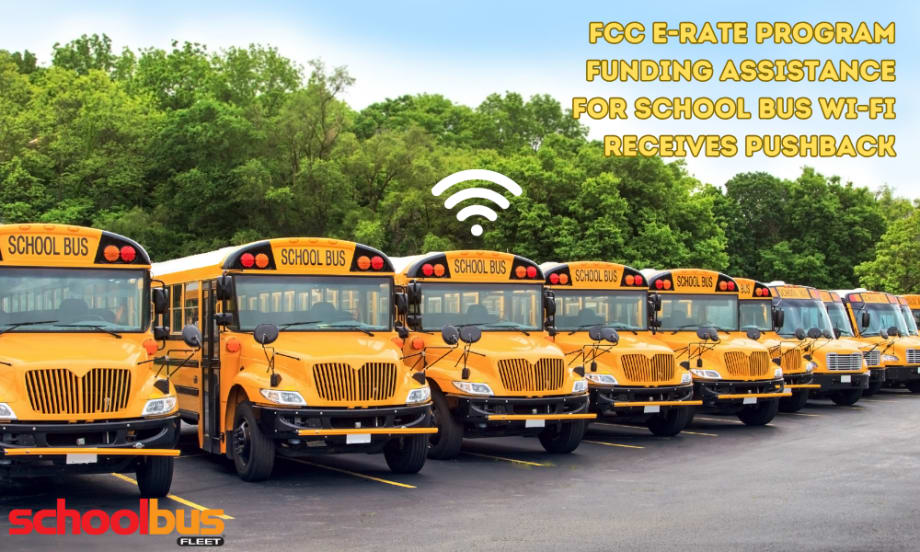
The FCC is scheduled to consider a proposal to allow E-Rate program funding to assist with Wi-Fi on school buses during its upcoming Oct. 19 meeting.
Photo: Canva/School Bus Fleet
A proposal to clarify a rule to state that school buses are eligible for the Federal Communications Commission E-Rate program is getting pushback. The program gives schools discounted Wi-Fi access.
FCC Chairwoman Jessica Rosenworcel, a Democrat, made the proposal in May 2022, to help millions of students caught in the homework gap, School Bus Fleetreported. The homework gap is barriers students face when working on homework without access to a reliable Internet connection.
The delay over movement on the proposal came as a result of a two-year holdup over a prior FCC board nominee. Anna Gomez was confirmed as the newest FCC commissioner in September. The board has a Democratic majority.
The FCC is scheduled to consider Rosenworcel's proposal during its upcoming Oct. 19 meeting.
About the FCC's E-Rate Program
Although the E-Rate program does not provide support for most off-campus services, the Commission has permitted the use of E-Rate-funded services in certain limited circumstances.
To remain consistent with its past determinations regarding other eligible off-campus use of E-Rate-supported services, the Declaratory Ruling would clarify that the use of Wi-Fi, or other similar access point technologies, on school buses is an educational purpose and the provision of such a service is therefore eligible for E-Rate funding.
The ruling would also direct the Wireline Competition Bureau to fund the provision of the services, as well as any E-Rate-eligible equipment needed to enable them, as part of the funding year 2024 eligible services list proceeding.
Pushback on the Declaratory Ruling
Top Republicans in House and Senate Commerce committees have criticized the proposal, arguing that the added Wi-Fi would increase children’s access to risky and potentially harmful social media apps in an environment with limited supervision, according to The Hill.
The GOP lawmakers also argue they don’t support the expansion because they don’t believe it falls under the scope of the E-Rate program.
Senate Commerce Committee Ranking Member Ted Cruz and House Energy and Commerce Chairwoman Cathy McMorris Rodgers recently sent a letter to Gomez, urging her to reject the proposal. The move followed a letter the Republicans sent Rosenworcel in July with similar opposition.
Cruz and McMorris Rodgers also released a joint statement saying the plan raises concerns about unsupervised internet access to social media sites.
Ben Weintraub, CEO of Kajeet, a company that puts and monitors Wi-Fi on school buses, recommends imposing filters to block certain social media sites on school buses.
Why is Onboard Wi-Fi Necessary?
In her proposal, Rosenworcel noted a report stating that there are at least 16 million students nationwide living in homes without a broadband connection, at a time when teachers are increasingly assigning homework that requires access to broadband and/or digital devices outside the classroom.
There is currently funding in place to support Wi-Fi capabilities on school buses. The Emergency Connectivity Fund, part of the American Rescue Plan Act of 2021, allows eligible schools and libraries to purchase eligible Wi-Fi equipment during the COVID-19 emergency period.
As it stands, the Emergency Connectivity Fund program will sunset on June 30, 2024.
Is There Time to Do Homework on the School Bus?
According to the academic paper, "Do Long Bus Rides Drive Down Academic Outcomes," the average bus ride is relatively short, only 21 minutes. The majority of students have commutes of less than 30 minutes. Only 6.% of students have long bus rides — 45 to 60 minutes, and 3.3% of bus riders have rides over one hour.
However, students with long bus rides are disproportionately Black and almost exclusively attend district choice or charter schools, researchers noted.
In his report, "Students of Color Caught in the Homework Gap," John Horrigan noted that 30.6% of Black households with one or more children age 17 or yonger lack high-speed home internet; over 3.25 million Black children live in these households.
It's important to note that this data comes from pre-pandemic research. It's possible these statistics have shifted. More recent data is likely still be collected. Still, Wi-Fi on the school bus could be utilized by millions of students in more rural areas with long bus rides — areas which may also not have broadband access for homes.
The Hill noted that advocates also argue that onboard Wi-Fi would benefit student-athletes who sometimes don't get home from their events until after 10 or 11 p.m.
Advocating for Onboard Wi-Fi Access
On Oct. 10, U.S. Dem. Sen. Peter Welch, a member of the Senate Commerce Committee, welcomed Rosenworcel to Williamstown (Vt.) for a discussion on rural broadband buildout, as well as the Central Vermont Supervisory Union’s efforts to install Wi-Fi on school buses and close the homework gap.
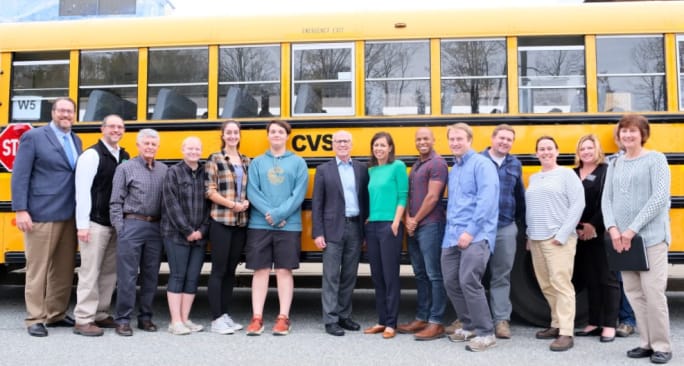
FCC Chairwoman Jessica Rosenworcel (center) is joined by Central Vermont Supervisory Union Superintendent Matt Fedders (far left) and U.S. Sen. Peter Welch (center) in a discussion advocating for school bus Wi-Fi funding under the E-Rate program.
Photo: U.S. Sen. Peter Welch
“So many students and educators in rural Vermont—and across rural America—know that learning has to happen beyond the walls of the school, often by necessity when they’re traveling for long distances to get to and from school. And today’s classroom is digital, with assignments that require broadband, strong streaming capabilities, and the need to upload and download files," Welch said. "With limited access, kids can fall into the ‘homework gap.' If we streamline connectivity funds, we could help kids learn and stay connected nationwide."
Welch and Rosenworcel were joined by Matt Fedders, Superintendent of the Central Vermont Supervisory Union, and students and teachers at the Williamstown Middle High School.
As a member of the House, Senator Welch supported bipartisan legislation to make Wi-Fi and similar technologies on school buses eligible under the FCC’s E-Rate program funding.
More Management

How to Build a Better Driver Training Program
Ready to boost up your school bus instructor training? Here’s how to pick the right talent and improve recruitment, retention, and safety.
Read More →
CALSTART and Forth Combine to Form Catalyst Mobility
The new name represents a renewed vision for the nonprofit focused on advancing clean, equitable, and affordable transportation solutions that move people and goods.
Read More →
What Makes a Great School Bus Driver Trainer?
Choosing the right school bus driver trainer takes more than experience. Learn six keys to selecting and developing trainers and evaluating program effectiveness.
Read More →

School Bus Contractors Expand Through New Deals, Acquisitions & Partnerships
STA's Canadian division acquires Ontario-based G&L Stevenson Transport while Durham School Services adds a new district contract in California, First Student adds a New Jersey contract, and Minnesota Coaches acquires Halo Transportation.
Read More →
Logan Bus Company Rolls Out AI Phone System for NYC School Bus Families
A summer pilot found that AI agents could handle most routine calls, freeing up time for customer service staff to focus on emergencies and complex family concerns.
Read More →
From Intent to Impact: What I Learned About Leadership from TAPT
A Texas transportation supervisor shares lessons on self-awareness, accountability, managing stress and building trust — and why investing in leadership development matters at every stage of your career.
Read More →
NAPT Names 2026 Award Recipients, Hall of Fame Inductee
Who earned national recognition for their work in student transportation? This year, NAPT named five recipients of its 2026 awards for service, safety, and leadership, plus its newest Hall of Famer.
Read More →
2026 State of Student Transportation Report
Driver shortages. Rising costs. Growing safety expectations. More data, but not enough time to act on it. The 2026 State of Student Transportation Report reveals what transportation leaders say is putting the most pressure on their operations—and where they’re investing next. See how your priorities compare.
Read More →
How to De-Escalate an Angry Person: 5 Steps for Handling Workplace Conflict
What makes emotions run high, and how should you handle an angry colleague or parent? Follow these steps for staying calm, listening, showing empathy, and resolving conflict.
Read More →
What Readiness Looks Like This School Year
Learn about the challenges shaping the 2026–2027 school year, from persistent driver shortages and budget pressure to technology and readiness gaps. See how school districts are responding and adapting in Zonar’s 2026 Back-to-School Readiness Report.
Read More →