




Getting Emergency Connectivity Fund Support for School Bus Wi-Fi: What to Know
Hotspots on school buses and devices for students who lack connectivity are eligible. As of June 29, schools and libraries eligible for funding from the E-rate program can apply and the deadline for the first round of funds is August 13.

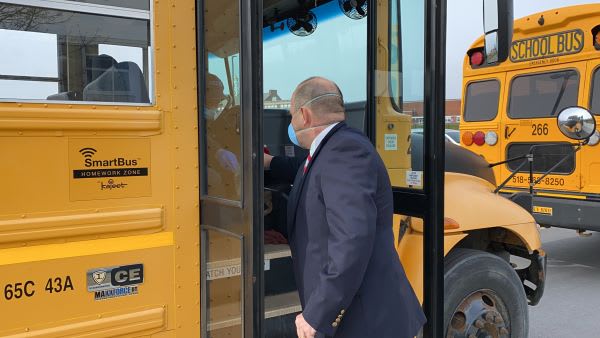
The Emergency Connectivity Fund will provide support for Wi-Fi hotspots on school buses.
Photo courtesy Kajeet
Federal funds will soon be available to help support school bus Wi-Fi equipment and service to help students in need.
As part of the American Rescue Plan passed by Congress in March, the $7.17 billion Federal Communications Commission’s (FCC’s) Emergency Connectivity Fund (ECF) will provide funding to schools and libraries so they can support off-campus connectivity for students, staff, and library patrons who lack sufficient broadband access to enable remote learning.
According to one study cited by a report and order from the FCC that details the funding program, an estimated 15 million public school students did not have access at home to an internet connection or a device sufficient for distance learning in spring 2020.
5 Tips for Delivering School Bus Wi-Fi During the Pandemic
As of June 29, schools and libraries eligible for funding from the E-rate program, which has historically provided funding for broadband services delivered to these educational facilities, can apply for support from the ECF program.
Among the purposes of the ECF, according to the report, is to provide support to school districts for Wi-Fi hotspots on school buses to expand broadband services to students and school staff who currently lack access.
ECF also can be used to pay for modems, routers, and portable connected devices (including laptops, tablets, and similar end-user devices), as well as advanced telecommunications and information services. Mobile phones, including smart phones, are excluded, the report states.
The program has a requirement that devices and service only be provided to recipients who lack a device sufficient for remote learning, according to the docket. Additionally, only one connected device per individual and a cap of $400 per device is allowed under the fund’s rules.
In addition to covering Wi-fi services moving forward, schools may be able to apply for reimbursement for the money they spent to cover broadband services they have already provided (for example, if they started using school buses as mobile Wi-fi hotspots last spring due to pandemic-driven school closures.)
VIDEO: Florida District School Buses Bring Wi-Fi to Students
If any funding remains after the initial application window (July 1, 2021 to June 30, 2022), the docket states, the FCC may open a second application window for reimbursement of expenses incurred before June 30, 2021 previously purchased to address the needs of students, school staff, and library patrons who lacked connectivity.
The deadline to apply for funds is August 13. The reimbursement time frame is from July 1, 2021 to June 30, 2022.
If a school is granted funding eligibility it must submit invoices paid for reimbursement within 60 days of their funding commitment decision letter, according to the docket.
While school bus operators are not eligible to directly receive ECF support, schools and libraries are eligible applicants. Pupil transporters should work with their school or district to ensure they submit the application and process reimbursement, said Michael Flood, senior vice president and general manager, education, for school bus Wi-Fi supplier Kajeet, told School Bus Fleet.
Flood also recommended that pupil transporters identify their installation window (usually during summer break) so that services are up and running before the academic year starts.
“Installation windows will start to fill up quickly,” he noted.
Additionally, Flood said, student transportation providers should figure out whether they want a hard-install solution or a portable kit.
Don’t forget, he added, to ask your provider if they have different configurations for smaller and larger buses or multi-carrier solutions for activity buses that may travel across different networks.
Kajeet’s complete suite of education broadband services and connected devices are 100% reimbursable through ECF, according to a news release from the company.
Meanwhile, Safe Fleet recently launched a free Grant Assistance Program to support school districts in accessing the necessary funding to equip their school buses with safety technology to support remote learning and help get students back in class safely.
The safety technology supplier, which also provides school bus Wi-Fi, has partnered with experts at policy training and consulting company Lexipol and EducationGrantsHelp.com to create the program.
Safe Fleet’s grant experts can provide guidance to school districts as they navigate ECF application details and the application process, Jacqueline Leclerc, marketing communications manager, school bus, for Safe Fleet, told SBF. The assistance program also helps districts with federal, state, and local grants, including American Rescue Plan funding.
In addition to Wi-Fi hotspot routers, funding that Safe Fleet assists school districts in applying for can potentially cover video surveillance equipment, student contact tracing, fleet management software, and the supplier’s patented Predictive Stop Arm solution to address heightened illegal passing near misses, Leclerc added.
More Management

How to Build a Better Driver Training Program
Ready to boost up your school bus instructor training? Here’s how to pick the right talent and improve recruitment, retention, and safety.
Read More →
CALSTART and Forth Combine to Form Catalyst Mobility
The new name represents a renewed vision for the nonprofit focused on advancing clean, equitable, and affordable transportation solutions that move people and goods.
Read More →
What Makes a Great School Bus Driver Trainer?
Choosing the right school bus driver trainer takes more than experience. Learn six keys to selecting and developing trainers and evaluating program effectiveness.
Read More →

School Bus Contractors Expand Through New Deals, Acquisitions & Partnerships
STA's Canadian division acquires Ontario-based G&L Stevenson Transport while Durham School Services adds a new district contract in California, First Student adds a New Jersey contract, and Minnesota Coaches acquires Halo Transportation.
Read More →
Logan Bus Company Rolls Out AI Phone System for NYC School Bus Families
A summer pilot found that AI agents could handle most routine calls, freeing up time for customer service staff to focus on emergencies and complex family concerns.
Read More →
From Intent to Impact: What I Learned About Leadership from TAPT
A Texas transportation supervisor shares lessons on self-awareness, accountability, managing stress and building trust — and why investing in leadership development matters at every stage of your career.
Read More →
NAPT Names 2026 Award Recipients, Hall of Fame Inductee
Who earned national recognition for their work in student transportation? This year, NAPT named five recipients of its 2026 awards for service, safety, and leadership, plus its newest Hall of Famer.
Read More →
2026 State of Student Transportation Report
Driver shortages. Rising costs. Growing safety expectations. More data, but not enough time to act on it. The 2026 State of Student Transportation Report reveals what transportation leaders say is putting the most pressure on their operations—and where they’re investing next. See how your priorities compare.
Read More →
How to De-Escalate an Angry Person: 5 Steps for Handling Workplace Conflict
What makes emotions run high, and how should you handle an angry colleague or parent? Follow these steps for staying calm, listening, showing empathy, and resolving conflict.
Read More →
What Readiness Looks Like This School Year
Learn about the challenges shaping the 2026–2027 school year, from persistent driver shortages and budget pressure to technology and readiness gaps. See how school districts are responding and adapting in Zonar’s 2026 Back-to-School Readiness Report.
Read More →