




Call for National Stop-Arm Campaign in NHTSA Meeting
Association officials ask NHTSA to raise public awareness on the dangers of illegal passing of school buses.

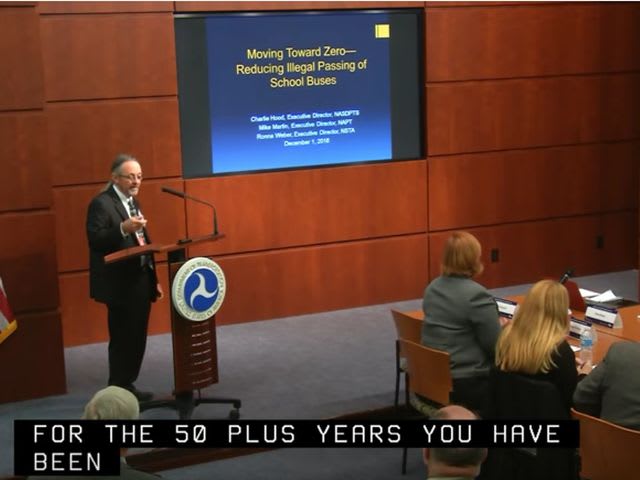
During a NHTSA meeting, industry association officials asked the agency to raise public awareness on the dangers of illegal passing of school buses. At the podium is Charlie Hood of NASDPTS. Screenshot from NHTSA webcast
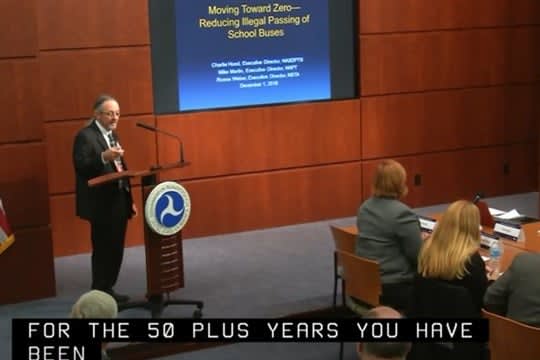
During a NHTSA meeting, industry association officials asked the agency to raise public awareness on the dangers of illegal passing of school buses. At the podium is Charlie Hood of NASDPTS. Screenshot from NHTSA webcast
WASHINGTON, D.C. — A meeting here last week centered on safety risks outside of school buses, including the dangers of stop-arm running.
The National Highway Traffic Safety Administration (NHTSA) event on Thursday continued a series of high-profile discussions on pupil transportation safety. The agency’s previous two meetings focused on seat belts on school buses.
Illegal passing of school buses, also known as stop-arm running, was a recurring topic during the Dec. 1 meeting. For its part, NHTSA has commissioned a study to gauge the effectiveness of camera enforcement of stop-arm violations.
Dr. Bryan Katz of ToXcel, the firm conducting the project for NHTSA, said that there are four observation sites for the study, in Virginia, Nebraska, Wyoming, and Mississippi. In each location, the goal will be to compare the rate of illegal passing before and after stop-arm cameras were installed on school buses.
Also at the meeting, the executive directors of the three national school bus associations — NAPT, NASDPTS, and NSTA — presented a coordinated message in which they pointed to stop-arm running as the top issue in school bus rider safety.
“The single biggest risk is cars that illegally pass school buses,” NAPT's Mike Martin said. “We believe many parents aren’t even aware that it’s happening. They need to know the facts so they can be effective local advocates.”
Martin, Charlie Hood of NASDPTS, and Ronna Weber of NSTA called on NHTSA to launch a national campaign targeting stop-arm running, which could tie in with the agency’s existing “Learn the Facts” campaign that promotes the benefits of school bus transportation.
The idea seemed to resonate with NHTSA Administrator Mark Rosekind.
“I’m with you — illegal passing needs a national program. We do that really well,” Rosekind said, referencing NHTSA’s “Click It or Ticket” seat belt campaign as an example of the agency’s effectiveness in raising public awareness on safety issues.
While Rosekind will leave NHTSA at the end of President Obama’s term in January, the administrator said that he would work on getting the ball rolling on a stop-arm campaign effort as well as on a meeting in which school bus OEMs could connect with other vehicle manufacturers and tech companies.
“What the yellow school bus has now is ancient,” Rosekind said on the technology topic. “School buses should be on the drawing board with everyone else. That’s an area we can help with.”
Also during NHTSA’s meeting last week, representatives from the New Jersey Motor Vehicle Commission explained the efforts that are underway to implement a requirement for exterior object-detecting sensors on new school buses in New Jersey. Other topics covered included crash trends, student pedestrian safety, and seat belts on school buses.
Derek Graham, state pupil transportation director for North Carolina, discussed a project that is underway in his state to test out lap-shoulder belts on school buses in 11 school districts. Graham said that early results have shown that elementary students are more compliant with buckling up than high school students, and drivers have reported improved discipline on the belt-equipped buses.
To view a recording of the NHTSA meeting or to access presentation files, go here.
More Safety
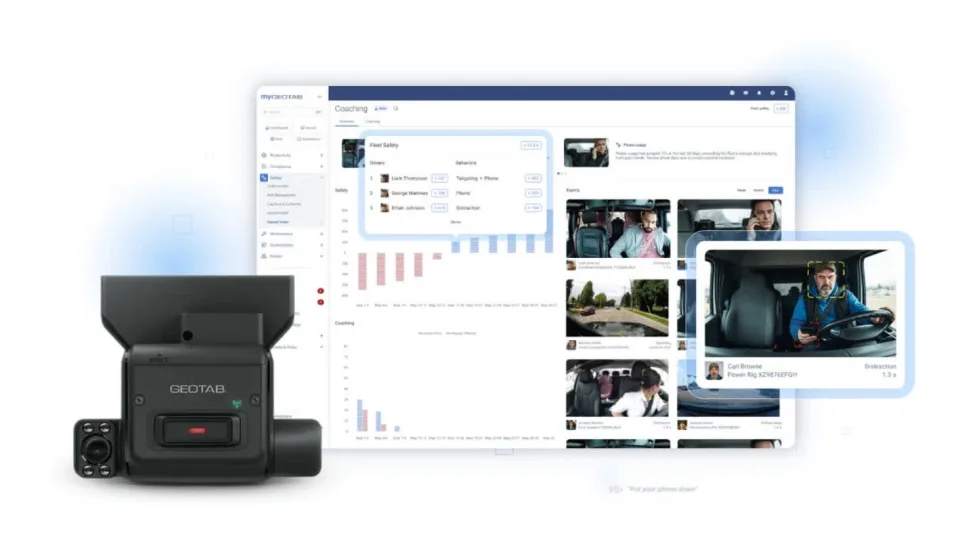
Geotab Expands Fleet Safety Tools With Video Coaching, Risk Insights
New safety and video capabilities aim to help fleet managers assess risk, support drivers, and take targeted action through video coaching, red-light violation detection, and more.
Read More →
How to Build a Better School Bus Driver Training Program
Is it time to strengthen your driver training? Here’s how to pick the right talent and improve recruitment, retention, and safety. This video is brought to you by IC Bus.
Read More →
Recent School Bus Accidents Leave 2 Dead, 2 Injured
Four school bus crashes in Florida, Illinois, and Georgia highlight risks in transportation lots, at bus stops, and during student loading and unloading.
Read More →

When Every Second Matters, Clarity Keeps Routes Moving
From routine delays to urgent incidents, strong communication practices help drivers, dispatchers, schools, and families respond with confidence.
Read More →
What Happens When a School Bus Catches Fire — and What Can Help
School bus fires are rare but can be devastating. Learn how advances in fire suppression and asset protection help fleets detect fires earlier, reduce damage, and improve safety.
Read More →
Geotab Launches Tool to Help Fleets Investigate Road Incidents
Geotab Investigations combines telematics data, video, documents, and other evidence to help fleets reconstruct incidents, resolve claims, and determine what happened.
Read More →
Texas Sixth Grader Wins 2026 National School Bus Safety Poster Contest
Sai Darshana Yekolu of Moseley Middle School in Prosper, Texas, was named the newest winner for her artwork, bringing the theme of “Safe Rides, Everyday Heroes” to life.
Read More →
Doing More With Less: How Transportation Directors Can Prioritize Safety Amid Budget Uncertainty
With diesel prices soaring and nearly one-third of transportation directors expecting budget cuts, maintaining student safety has never been more challenging. Download this guide to learn how leading districts are prioritizing risk, funding critical safety technology, and building stronger budget cases with data.
Read More →
Walton County Schools Adds Gatekeeper Stop-Arm Enforcement System
The Florida district will deploy Gatekeeper’s updated Student Protector technology, which now incorporates AI to improve video evidence.
Read More →
How To Build a More Secure School Bus Yard During and After Hours
As thefts and overnight security threats continue, school transportation leaders are combining stronger operational practices with AI-enabled surveillance to better protect buses, facilities, and staff.
Read More →