




1st school bus built on Ford Transit is Micro Bird T-Series
The new Transit chassis is lighter than the Ford E-350 and E-450 cutaways, which officials say allows for higher payloads and improved fuel economy in a Type A bus.

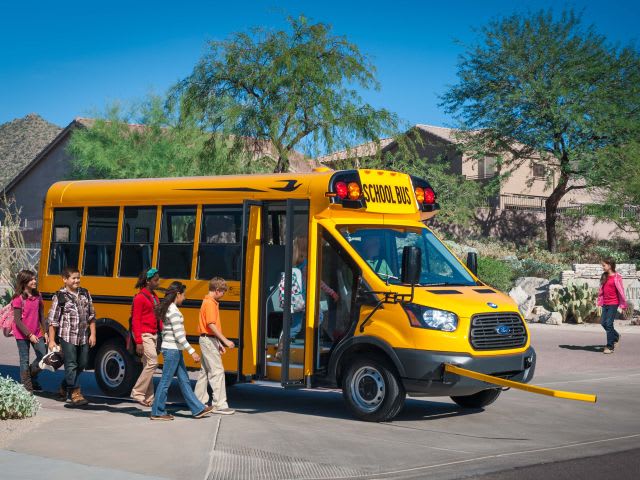
Production is underway for the Micro Bird T-Series, the first school bus on the new Ford Transit cutaway chassis.
With the recently unveiled Micro Bird T-Series, Blue Bird has become the first manufacturer to build a production Type A school bus on the new Ford Transit cutaway chassis.
Officials said that the company chose the Transit platform for its fuel economy, payload capabilities and product breadth.
“Transit’s lower chassis weight and better payload distribution allow us to provide our customers with increased passenger capacities, while at the same time reducing fuel consumption,” said Steve Girardin, president and CEO of Micro Bird Inc. “Transit also offers serious safety improvements through better driver ergonomics and visibility of the student loading zone.”
The T-Series offers a choice of two wheelbases, with capacities ranging from nine to 25 passengers and as much as 10,360 lbs. It is available in school bus, multi-purpose vehicle (MPV), multi-function school activity bus (MFSAB) and commercial configurations. Production is underway, with buses already on dealer lots.
Ford’s Transit is available in van, wagon, cutaway and chassis cab models, with a total of 47 configurations available from the factory.
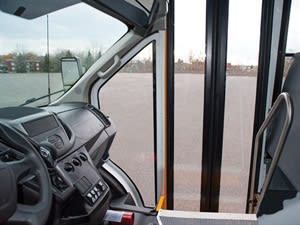
Micro Bird CEO Steve Girardin says that the Transit platform offers improved visibility of the student loading zone.
“School bus builders have relied on the Ford E-Series family for decades, and we are continuing to offer all of those popular models. The Transit cutaway is a great addition to the Ford school bus chassis lineup,” said Dennis Bearden, Ford’s RV and pool account manager for fleets. “Transit gives manufacturers a flexible and rugged base for building smaller, more-efficient Type A school buses and multi-function school activity buses.”
The Transit cutaway allows school bus builders to choose from three wheelbases, a gasoline or diesel engine, and single or dual wheels. It can be equipped with the school bus body builder prep package or the MFSAB body builder prep package. The prep packages include banded tinted front door glass, dual heavy-duty batteries, a heavy-duty alternator, front license plate bracket, auxiliary fuse panel, auxiliary heater/air-conditioning prep package, right-hand door delete and school bus yellow paint.
There are three Ford engines to choose from: 3.2L I-5 Power Stroke diesel, 3.7L Ti-VCT V6, or 3.5L EcoBoost V6. The 3.7L V6 engine is available with a compressed natural gas (CNG)/propane gaseous engine prep package to enable conversion to CNG or propane. The 3.2L turbo diesel engine is B20-capable, so it can run on a mix of 80% diesel and 20% biodiesel fuel. A six-speed automatic transmission with SelectShift tow/haul mode is standard.
Transit also features a unibody design and a much lighter GVW than the Ford E-350 and E-450 cutaway chassis, which Ford officials said contributes to bus builders’ ability to provide higher payloads and improved fuel economy in a Type A bus. Transit also provides low entry for riders and enhanced visibility for drivers, according to Ford.
In addition to Micro Bird, Ford works with Collins Bus Corp., Thomas Built Buses and Starcraft Bus.
Ford Transit is made at Ford’s Kansas City Assembly Plant in Claycomo, Missouri.
More Management

How to Build a Better Driver Training Program
Ready to boost up your school bus instructor training? Here’s how to pick the right talent and improve recruitment, retention, and safety.
Read More →
CALSTART and Forth Combine to Form Catalyst Mobility
The new name represents a renewed vision for the nonprofit focused on advancing clean, equitable, and affordable transportation solutions that move people and goods.
Read More →
What Makes a Great School Bus Driver Trainer?
Choosing the right school bus driver trainer takes more than experience. Learn six keys to selecting and developing trainers and evaluating program effectiveness.
Read More →

School Bus Contractors Expand Through New Deals, Acquisitions & Partnerships
STA's Canadian division acquires Ontario-based G&L Stevenson Transport; Durham School Services adds a new district in California; First Student expands in New Jersey; and Minnesota Coaches rebrands and acquires Halo Transportation.
Read More →
Logan Bus Company Rolls Out AI Phone System for NYC School Bus Families
A summer pilot found that AI agents could handle most routine calls, freeing up time for customer service staff to focus on emergencies and complex family concerns.
Read More →
From Intent to Impact: What I Learned About Leadership from TAPT
A Texas transportation supervisor shares lessons on self-awareness, accountability, managing stress and building trust — and why investing in leadership development matters at every stage of your career.
Read More →
NAPT Names 2026 Award Recipients, Hall of Fame Inductee
Who earned national recognition for their work in student transportation? This year, NAPT named five recipients of its 2026 awards for service, safety, and leadership, plus its newest Hall of Famer.
Read More →
2026 State of Student Transportation Report
Driver shortages. Rising costs. Growing safety expectations. More data, but not enough time to act on it. The 2026 State of Student Transportation Report reveals what transportation leaders say is putting the most pressure on their operations—and where they’re investing next. See how your priorities compare.
Read More →
How to De-Escalate an Angry Person: 5 Steps for Handling Workplace Conflict
What makes emotions run high, and how should you handle an angry colleague or parent? Follow these steps for staying calm, listening, showing empathy, and resolving conflict.
Read More →
What Readiness Looks Like This School Year
Learn about the challenges shaping the 2026–2027 school year, from persistent driver shortages and budget pressure to technology and readiness gaps. See how school districts are responding and adapting in Zonar’s 2026 Back-to-School Readiness Report.
Read More →