




Preventing dragging incidents: A school bus driver’s perspective
In response to a handful of tragic incidents in which students were dragged by their buses, I staged a re-enactment to find out how we can prevent these incidents. Findings showed drivers experience visual challenges involving the stairwell, mirrors and door activation button placement.
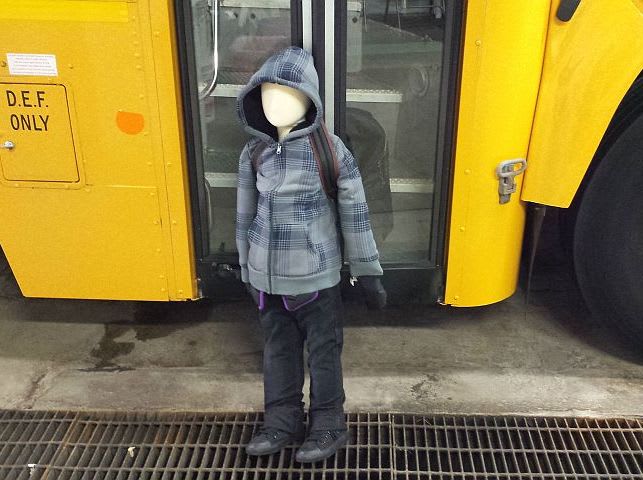
Bus driver Victoria DeCarlo created a driving course and used a dummy to re-enact how a student dragging may occur. She found that drivers experience visual challenges involving the stairwell, mirrors and door activation button placement.
Photo by Victoria DeCarlo
This past December, I found out that a student in New York was dragged by their bus, and I was devastated. The next day, I heard about another dragging incident, and became obsessed.
I wondered how this could be happening. It was like a contagious virus was going around, and I didn’t want to be susceptible to it. I wished we all could be immunized against it, so to speak.
How could we, as bus drivers, avoid this?
I feverishly started searching for articles on the incidents, trying to get as much information and insight on the subject as possible. I then ordered a 5-year-old/6-year-old dummy to put in the doors of the bus on my downtime, to try to come up with a possible solution. The dummy is faceless, showing no identity or gender. The reason for this? We don’t know the identity or gender of the next possible victim. (Hoping there will not be another.)
I then approached my supervisor, Perry Oddi, the transportation director at Lake Shore Central School District. I mentioned the articles and that the drivers involved in the dragging incidents were seasoned, veteran drivers and had to be safety-minded like us. I pointed out that if this had happened to them, then it could happen to any one of us.
Why was all the fault being placed on the drivers, who were also victims, of getting distracted, which is human, and happens to every one of us? We should show grace here for those drivers; we all want that for ourselves from time to time.
Then came the third dragging incident in New York state, with more occurring in neighboring states. It seemed to have become an epidemic.
So, how can we help to prevent this from happening again?
Here’s what Perry and I did.
I created a driving course that would re-enact, step by step, how a student dragging may occur. I wrote a script with a scenario that was, in part, similar to one of the articles I read, adding to it some overwhelming distractions I have experienced behind the wheel, which happen to every bus driver from time to time. This was done to prove that a mistake like a student getting trapped in the service door is possible, and incidents like this may continue if we do not research and resolve every aspect of this issue. (View more photos and videos of the re-enactment here.)
There were parts to be played by my coworkers who are involved in our student safety committee, trainers, and instructors. Perry played the driver during rehearsals.
On April 8, supervisors who are part of the New York Association for Pupil Transportation participated in the re-enactment. Little did these supervisors know that not only would they observe, they would be in the driver’s seat themselves, and go through the production course. They experienced firsthand how a student can potentially get trapped and forgotten in a moment of multiple distractions.
Most important, though, were the conclusions we shared based on what I had discovered in researching the subject. (Disclaimer: When I speak of the conventional and transit buses, I’m speaking of those types that we have here in our fleet.)
My research showed that contributing factors include:
• Narrow stairwells and doorways present a visual challenge to the bus driver. Additionally, the direction the bus is facing and having less light during winter months can exacerbate that challenge.
• Door activation button placement causes the driver to look away from the door, taking attention away from the disembarking student.
• If the cross-view mirror is not positioned in compliance, it may not show the entire service door, and may not help the bus driver ensure the student has safely exited the bus.
While conducting this research, I came up with some new driver training ideas and suggestions. These include using catch phrases that emphasize safety as a priority, and making dispatchers aware of the many distractions that the bus drivers are dealing with, and getting them to communicate with drivers in a patient and professional manner.
I hope you take time to view these research materials and share them with as many people in this industry as possible. Please keep your students and drivers safe and well trained, and have your drivers share the information with the students they transport.
“Safety First?” Let’s not say it. Let’s do it.
Victoria DeCarlo is a school bus driver, on bus #75, at Lake Shore Central School District, Angola, New York.
More Blog Posts
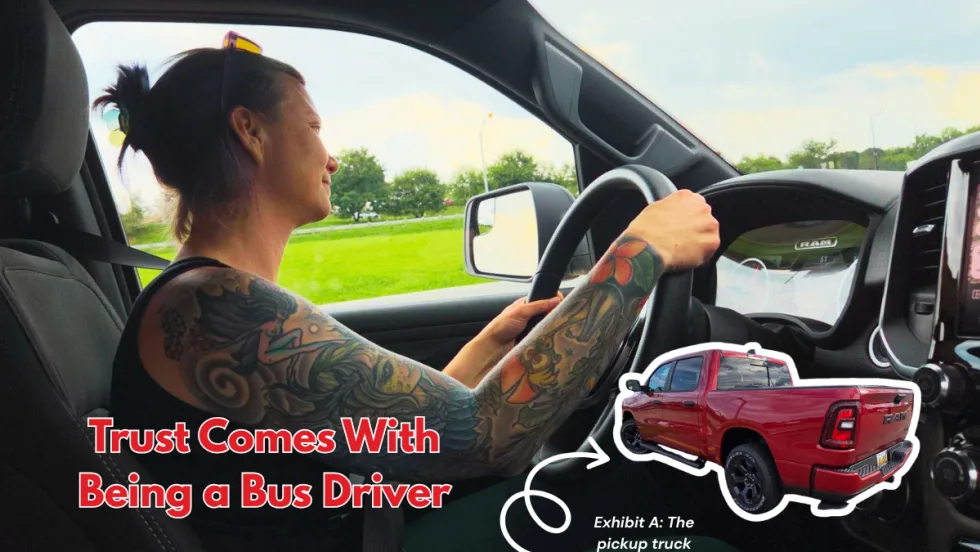
'I’m a School Bus Driver, You Can Trust Me'
A crowded Cleveland parking lot, a full-size pickup, and five unexpected words turned a stressful moment into a reminder of just how much trust we place in school bus drivers every day.
Read More →
The Sound of Summer Starting [Guest Editorial]
That unmistakable school bus rumble? It carries childhood memories, community routines, and a whole lot of unseen work behind the scenes.
Read More →
The Technology Power Combo That Enables EV Charging on Difficult Sites
As the pace of fleet electrification increases and charging infrastructure continues to pose challenges, many fleets find themselves puzzling over the question: how do I install charging infrastructure faster and more cost-efficiently?
Read More →
Trip Sheet: Farewell, Faithful Readers – Keep on Rolling
Executive Editor Wes Platt offers parting thoughts as he parks the School Bus Fleet bus to focus on ultra-local community journalism, making way for someone else to take the wheel as the pupil transportation industry continues to evolve.
Read More →
Trip Sheet: School Transportation Pros Can Champion Children's Mental Health
Children's Mental Health Awareness Day underscores the significance of school bus drivers in fostering supportive environments during students' journeys. SAMHSA's initiatives, including stigma reduction and access to resources, complement the Biden-Harris administration's funding efforts to enhance youth mental health services and workforce development.
Read More →
Trip Sheet: Is It Time for Daylight Saving Time to Clock Out?
How do you think the potential shift to permanent Daylight Saving Time or standard time would impact our daily lives and routines, especially considering the divided approach across various states?
Read More →
Trip Sheet: Meeting a Hero in My Own Back Yard
I remain impressed by the matter-of-fact heroism that’s often demonstrated by school bus drivers like Deona Washington who are caught in these situations where the best of us might lose our cool and panic. But, then again, bus drivers are a unique breed.
Read More →
Trip Sheet: 3 Takeaways from the EPA Clean School Bus Grant Program
Most applicants sought grant funding to acquire electric school buses, with propane coming in a distant second. No one indicated plans to purchase compressed natural gas (CNG) buses in this round. That’s not terribly surprising, I suppose, given how few school districts listed the inclusion of CNG buses in their fleets for our 2023 top district fleets survey.
Read More →
Trip Sheet: Let's Get Rolling: What's Coming in 2024?
Calendar pages keep flipping toward the mandates set in states like New York and California to transition their school bus fleets from diesel to zero-emission, but there’s plenty of reluctance and pushback.
Read More →
California School Children Ride in Green School Buses
Today, California prides itself on utilizing the most zero-emission (ZE) school buses in the country with over 1,689 being used by California school districts; and while the state is on a positive health trajectory thanks to a decree to eliminate gas and diesel vehicles, more work needs to be done to improve children’s well-being.
Read More →