




Why Miles Matter
A veteran transportation director discusses the importance of reducing fuel use — and how to make it happen.
Remember these headlines?
• "Fuel prices drive school bus worries" (Seattle Times)
• "Fuel costs dent area school-bus budgeting" (Washington Post)
• "High fuel costs straining school budgets" (Herald Times, Bloomington, Ind.).
We should remember them, as it was not that long ago — July of 2008 — when we saw gasoline prices rise to over $4 per gallon.
It is human nature for us to yearn for the good old days and slip back into past behaviors as the crisis of two years ago seems to have passed. Unfortunately, the conditions that created that crisis are still in place, just waiting to reemerge. And it is not just the economic impact that is of concern here.
Our economy, our foreign policy and the environment are all affected in some small way by something as simple as our sending a bus back to pick up a missed child. But we are not powerless in this situation. We have the ability, and perhaps even the obligation, to do everything we can right now to lessen our dependence on this fossil fuel.
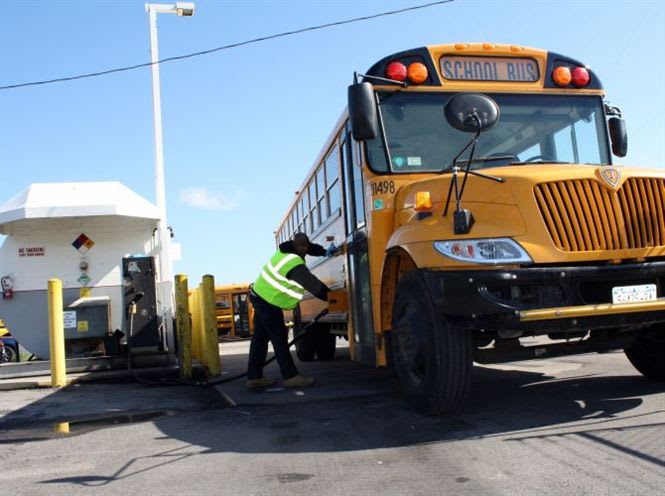
The American School Bus Council estimates that U.S. school buses use over 800 million gallons of diesel fuel each year, equating to 1,700 gallons per year for each bus. No matter how you look at it, our industry is a major player in the use of oil and therefore the future of our country’s well-being.
Our oil supply
According to the U.S. Energy Information Administration, we imported 37 percent of our oil in 1980. Today we import 57 percent, with predictions that this will rise to 66 percent by 2020.
Our growing dependence on imported oil will occur simultaneously with greatly increased competition from developing countries around the world. China’s need for oil is predicted to almost triple between 2000 and 2020. And oil supplies are primarily located in regions of the world that are not always the most amenable to U.S. interests.
There is a finite supply of oil that exists in the world — it is not a renewable resource. As worldwide demand grows, prices will inevitably increase as a simple function of supply and demand.
It does not matter what your politics are, or if you are an optimist or a pessimist about the future. There is a finite supply of oil in the world, it is generally not accessible in our country, there is an increasing number of countries that will need access to the same supplies we need, and we eventually will need to deal with this reality.
Perhaps the answer is just to continue the push towards energy conservation. Are you sufficiently confused yet on the new bus engine choices? How often do your thoughts voluntarily turn to alternative-fuel vehicles? Energy conservation will certainly play an important role in the years ahead, but it cannot by itself resolve the basic structural issue of our oil supply. We need to also recognize the reality that it is much easier to conserve energy than it is to produce or acquire it. Each gallon of fuel saved is one fewer gallon of fuel that needs to come to us from halfway around the world.
Things that cause miles
Each of our 480,000 U.S. school buses travels approximately 12,000 miles per year. These miles matter. Miles mean the use of fuel (approximately 7 miles per gallon for school buses). Miles mean driver payroll hours. Miles mean emissions. Miles mean wear and tear on the buses and on the roads. Miles mean time kids spend on the bus.
We decide through our actions whether these miles occur on an economical, planned basis or whether they occur on a random, uncontrolled basis.
Where do the 12,000 miles per year for each bus come from?
• The geography of a district plays a major role. Districts larger in size are probably going to travel more miles per bus than smaller districts. Bridges and highways can add miles to the travel plan. Of all the factors that create miles on the bus, basic geography is the one factor that is difficult for us to control.
• The student assignment plan determines where kids go to school and which kids are eligible for a bus ride. The more kids walk to neighborhood schools, the fewer miles the buses run. More school choice generally means more busing and therefore more miles.
• Bell schedules are a major determinant of bus schedules and, if not in transportation’s direct control, certainly within the overall district’s control. Arranging school times so that every bus can service at least two schools each morning and two schools each afternoon limits the miles the buses need to travel. They can perform more live work each day without adding the unproductive deadhead back and forth from the terminal.
• Early or partial dismissals also create miles. The teachers may think it is a great idea to send some of the kids home after a half day and have the buses returned for the regular dismissal, without giving the slightest thought to the extra miles created.
• Formal and informal policies can contribute to miles adding up. Do we send a bus back for a missed child? Is the driver allowed to take the bus home mid-day? Does the bus go out of its way to drop off the monitor after the run?
• Our routing plan is a huge determinant of the miles we use. How do we decide what work to assign to which bus? Do we direct the drivers on the most efficient route or do we expect or allow them to determine their own route?
• There are many hidden costs that also contribute fuel consumption: things like driving behaviors (hard starts and stops), air pressure in tires, clean air and fuel filters.
We can control most of the factors that add miles to our buses if we choose to do so.
[PAGEBREAK]
[IMAGE]550[/IMAGE]How to control miles
Transportation directors are often left out of the loop on major factors that create their service requirements, such as the student assignment plan, bell schedules and the locations of schools or programs. This does not mean that the transportation director should give up on trying to infl uence these important issues.
If not included in the design or placement of a major new transportation requirement, the transportation director should of course respond first with service that fully supports the program but also with an analysis of the associated costs and cost-savings options to be considered in the future. We should use a “Here’s what you asked me to do, and here are the associated costs as a result” type of approach so that the decision-makers understand the impacts of their choices for the next time.
There are many ways of limiting miles, however, that are fully within the control of the transportation director.
• You’ve got to get 500 children to a certain school. Can you do this with 10 buses? Does it take you 12 buses? 14? Your routing scenarios are governed by the external constraints of bell schedules, geography and assignment plan, but within those constraints you have the ability to use your tools, your skills and your experience to create the absolutely most efficient routing plan that could exist for that school.
• Your bus leaves the yard in the morning and travels to its first pickup. Is that first pickup close to the originating yard or perhaps closer to another yard? The bus drops at its first school and heads to its second run of the morning. Is the first pickup of the second run close to the first school or perhaps closer to another of the early tier schools? The bus makes its run into its second school of the morning. Is the run assigned to a bus whose mid-day yard is in the direction of the second school of the morning?
Yard to first pickup. First school to first pickup on second run. Second school back to yard. All three of these travel distances are examples of deadhead mileage that we can control. At Buffalo (N.Y.) Public Schools, I was able to maintain a 65-percent live to 35-percent deadhead mileage ratio through careful attention to these assignments.
• You create your carefully constructed route, you send the driver out with his or her schedule of lefts and rights, and you might expect that you’ve done your job. But is the driver actually running the route as you have directed, or is he or she running it “the way I’ve always run it,” possibly adding extra miles to each day’s usage? Following buses has never been practical. The only way you can know for sure is to use a GPS tool that will give you the ability to monitor your drivers’ adherence to their scheduled routes.
• A bus burns a gallon of fuel for each 60 minutes of idling. Think your drivers are not idling out there? As with adherence to your scheduled routes, the use of GPS monitoring is the only sure way to affect this critical element of driver behavior.
• One driver routinely gets 8 miles per gallon while another gets only 6.5 miles per gallon on the same model bus. Is it the driver, is it theft, is it excessive idling, is it a mechanical problem on the bus? The only way to know is to first make sure that you are capturing this level of detail to begin with, and then to dig deeper into the details.
The days of sending a driver out with just a list of stops should be only a memory for the old timers among us. There is a tremendous level of technology readily available to transportation directors today to assist with the efficient management of their fleets. You need the tools, the skills and, most importantly, the will to run your buses using the lowest amount of fuel necessary to accomplish your responsibilities.
Call to action
Using less fuel is not just a matter of fiscal savings; it also impacts our environment, foreign policy and the future. Every gallon we save creates one fewer reason for us to rely on others for the basic resources we need to run our schools.
Our primary job is to provide service to children. Is it much of a stretch to say that our kids will be inheriting a world from us in 20 years that will be greatly affected by the decisions we make today? I hope that all of us will make a pledge to ourselves to use less fuel next school year compared to what we used this year.
Talk to your administrators about the efficient scheduling and placement of programs. Reassess your policies on the extra trips you make. Take a hard look at your routing plan to make sure you are providing your required service with the right number and most efficient routes possible. Scrutinize your bus connections to make sure that your deadhead mileage is as tight as it can possibly be. Make sure your drivers are following their routes. Teach your drivers responsible driving habits to conserve fuel and develop ways to monitor their compliance. Figure out a way to get the data you need to manage your fuel usage.
As an industry, we need to do this for our children. Let’s get serious on this in 2010 so that our children will have one fewer thing to worry about in 2030.
John P. Fahey was in charge of the Buffalo Public Schools transportation program for 18 years. He joined the Tyler’s Versatrans Solution team as a consultant at the start of 2010. He can be contacted atjohn.fahey@tylertech.com.
More Management

Logan Bus Company Rolls Out AI Phone System for NYC School Bus Families
A summer pilot found that AI agents could handle most routine calls, freeing up time for customer service staff to focus on emergencies and complex family concerns.
Read More →
From Intent to Impact: What I Learned About Leadership from TAPT
A Texas transportation supervisor shares lessons on self-awareness, accountability, managing stress and building trust — and why investing in leadership development matters at every stage of your career.
Read More →
NAPT Names 2026 Award Recipients
Who earned national recognition for their work in student transportation? This year, NAPT named five recipients of its 2026 awards for service, safety, and leadership.
Read More →


2026 State of Student Transportation Report
Driver shortages. Rising costs. Growing safety expectations. More data, but not enough time to act on it. The 2026 State of Student Transportation Report reveals what transportation leaders say is putting the most pressure on their operations—and where they’re investing next. See how your priorities compare.
Read More →
How to De-Escalate an Angry Person: 5 Steps for Handling Workplace Conflict
What makes emotions run high, and how should you handle an angry colleague or parent? Follow these steps for staying calm, listening, showing empathy, and resolving conflict.
Read More →
What Readiness Looks Like This School Year
Learn about the challenges shaping the 2026–2027 school year, from persistent driver shortages and budget pressure to technology and readiness gaps. See how school districts are responding and adapting in Zonar’s 2026 Back-to-School Readiness Report.
Read More →
Changing Lanes: Executive Moves at Summit School Services, Zum, STA, Cummins, Transit Technologies, Driventic, & Cadex
See who's been hired, promoted, and appointed to leadership positions at various school transportation industry suppliers and private contractors.
Read More →
Industry Moves: Companies Expand Fleet Service & EV Infrastructure Footprints
The new facilities and regional hubs could mean faster access to shop equipment, charging support, and transportation technology for fleet operators.
Read More →
Doing More With Less: How Transportation Directors Can Prioritize Safety Amid Budget Uncertainty
With diesel prices soaring and nearly one-third of transportation directors expecting budget cuts, maintaining student safety has never been more challenging. Download this guide to learn how leading districts are prioritizing risk, funding critical safety technology, and building stronger budget cases with data.
Read More →
Zum Reaches 19 States With New York Expansion
The addition of the Empire State to the student transportation company's roster marks a growing expansion in the Northeast as it scales its tech and school bus services.
Read More →