




What We Can Learn from a U.S. Navy Crew’s Response to a Terrorist Attack
SBFX keynote recap: A look at how former U.S. Navy Commander Kirk Lippold’s leadership played a role in his crew’s response to the attack by al Qaeda in Yemen.

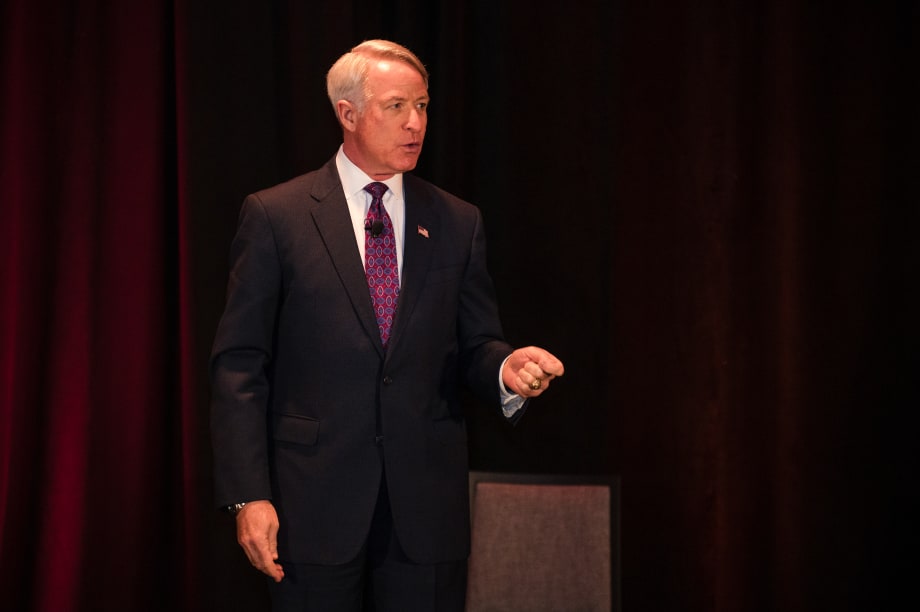
Cmdr. Kirk Lippold shared his pillars of leadership to School Bus Fleet ConneX attendees.
Photo: Lauren Brooks, Monclay Media
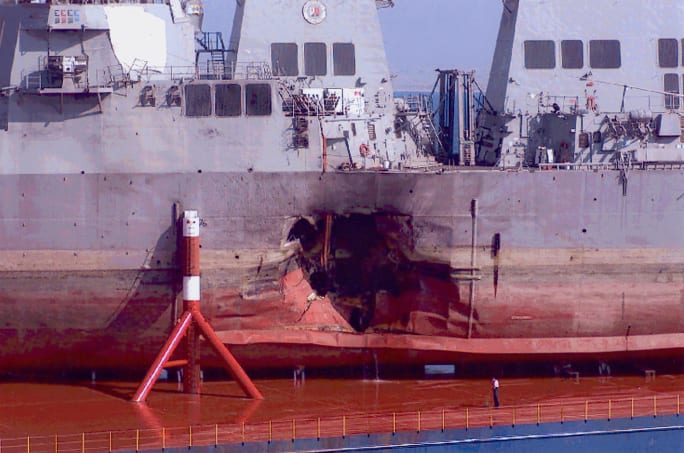
The explosion blew a 40-ft. hole in the side of the USS Cole.
Photo: FBI Media
On October 12, 2000, suicide terrorists exploded a small boat alongside the USS Cole as it was refueling in the Yemeni port of Aden, killing 17 U.S. sailors and injuring nearly 40 other crew members.
The attack was the deadliest on a U.S. vessel since the attack on the USS Stark in 1987, and one of the most significant terrorist incidents prior to 9/11.
The explosion left a 40-ft. hole in the side of the ship, exposing it to potential threats.
Cmdr. Kirk Lippold was tasked with continuing to lead his crew in its response during the immediate aftermath: both caring for the wounded and protecting the ship after it had been breached.
Lippold shared his story of his crew’s response during his keynote address at the 2023 School Bus Fleet ConneX in Scottsdale, Ariz.
It’s hard to imagine that comparisons can be drawn between a terrorist attack and pupil transportation, but Lippold believes that watching the way his crew responded after the attack is proof they were led by a good leader. In the same way, the way your transportation department staff responds to an incident — big or small — can reveal how well you have prepared them to handle the unknown.
Making Decisions Quickly
As Lippold began walking around the ship, he was his chief gunner’s mate responding to the blast with his security team to reestablish a perimeter around the ship.
It was at that moment Lippold realized he had no idea what he was walking into, something he likened to the early days of the COVID-19 pandemic, when leaders across all industries — pupil transportation included — had to make decisions with very little knowledge of what the future held.
“We don't know what we don't know. Think back to March 10, 2020. We didn't know what was going to happen,” Lippold said. “We didn't know what was going to go on in schools. We didn't know what was going to go on with our nation. We were guessing as this thing called COVID began to invade every single one of our lives, as we wondered how we’re going to deal with it. It's now the same with me. I didn't know for sure what had happened.”
Once Lippold confirmed the ship had in fact experienced an external explosion, he realized he had to help his crew.

Cmdr. Kirk Lippold was in command of the USS Cole when it came under an attack off the coast of Yemen.
Photo: National Archives
“I was within the golden hour. I needed to get them found, assessed, and off the ship in the local hospitals if I expected to save them,” Lippold said.
Learning to act quickly when crisis strikes is something Lippold said every leader must do.
“Anytime you have a crisis, you're going to start making decisions. And when you make those decisions, you act in the now; you think ahead, and you make those decisions based upon the best information that you have at that moment.”
Leaders must also then learn to adapt as time goes on and they learn more about the crisis they are responding to.
“People are going to be bringing you more information. As you get more information and better information, guess what you're going to do? You're going to change your decision. You're not a politician, you're not locked into a decision,” Lippold explained. “And if you get better information that means you need to make a 180 on one you just made, you do it.”
Lippold realized he was going to have to hand over the reins to someone else as he circled the ship to get a better idea of what was going on. He left his chief in charge of ensuring no other boats got close to the ship, while he figured out a way to contact the Yemeni Port Authority.
Lippold asked the port authority for three things: a freeze on all harbor movements since he did not know where the attack originated, a notification to local hospitals that wounded sailors needed their help, and a boat to transport them to land to get to those hospitals.
When Your Team Uses What They’ve Learned
After assessing the damage, Lippold went back inside the ship and discovered his sailors had innovated, coming up with a makeshift triage area to care for the wounded since the main triage area the ship had intended to use for disasters had been severely damaged.
“As captain, I would have given anything to bend down and talk to them. But I can't; they are not my number one priority. My number one priority has to be the ship because if we can’t save the ship, nothing else is going to matter.”
When Lippold returned to the central control station, he discovered that his crew members had things under control.
“At that point, I got to make the best decision of my command. I kept my mouth shut. Those teams were doing exactly what we had trained them to do and didn't need me to be giving them any guidance whatsoever,” Lippold said.
Keeping Your Team Calm
The chief engineer asked Lippold at that point, “are we going to lose the ship?” He simply responded with, “no,” explaining to her that parts of the ship could still be salvaged. This response brought the tension levels down.
“This is where professional competence pays off. Because everyone suddenly realized we're going to be able…to save USS Cole,” Lippold said.
Showing That You Trust Your Team
When leaders say they trust their teams, they must be willing to make decisions on their behalf, trusting that they know what they’re doing, Lippold explained.
“I'm telling them we're going to be able to save the ship. They put that total belief in me because I knew that they were doing exactly what they were trained to do,” he said. “They didn't need me to be giving them that little bit of five-minute guidance.”
When Lippold returned to the triage area, he watched as the crew came up with a way to get the injured off the ship and onto the boat that would take them to shore to local hospitals for treatment. The first day, 33 wounded sailors were evacuated within 99 minutes.
In the days following, the injured were able to be brought stateside for treatment, thanks to the help of a crew from France, and then a crew from the U.S.
A member of Lippold's crew, who assisted in bringing the injured back to the U.S., could have stayed and not returned and Lippold would have understood, he said. But instead, she chose to return to the USS Cole within 48 hours to continue to offer her assistance, and to lead well.
“When you give someone a task or a job, do they stand there and start asking you a litany of questions, or do they go do it because they know you've got their back?” Lippold asked. “[My navigator] walked off that ship wearing the clothes on her back right after a terrorist attack, went into a foreign country, got on an aircraft from another country, flew to a third country, doesn't come home, and flies back into aid, reports back aboard for duty. That's a level of dedication I have [within my crew].”
Lippold encouraged SBFX attendees to read a popular essay on leadership from 1899, called “A Message to Garcia.” Penguin Random House describes the meaning of the essay to say that when asked to perform a task, don't ask questions. Rather, “just do it—and you will become more valued and respected than you ever imagined possible.”
Guiding Your Crew Through Decision-Making
Still, there will be people on your team who will need some guidance to help them make decisions. Lippold encourages people to explain plausible solutions in a way that the particular crew member understands it.
“As people bring me a problem, it's this small, tiny wedge. When people bring a small issue to make a decision on, take that wedge and make it your world to get the best information possible,” Lippold explained. “What that really takes is that ability to have that focus and vision so that you can understand how to gain that big picture while still keeping all the details necessary that you need to in order to make the best decisions possible.”
Maintaining Efficient Communication With Your Crew
As time went on, Lippold realized he needed to find a way to communicate the importance of what the sailors were doing, so they would maintain the drive needed to continue their efforts to restore the ship’s integrity.
“I had to find a way to communicate with them. It's the same thing that happened to us during COVID. We had to find new ways of communicating. How many of us got roped in with this thing called Zoom? We had to find a way to be able to make things still happen,” Lippold said. “It was the same thing on the ship. As I'm looking at [the crew] there, I knew that I needed to make sure they understood what we were doing and why we were doing it and why it was important. Their job mattered.”
Speaking Up When Necessary and Making Tough Decisions Four Your Team
As FBI and NCIS agents began their investigation into the attack, a three-star admiral boarded the ship to speak with Lippold. He told him he was feeling pressure from Washington to allow the sailors to go home.
When he encouraged Lippold to send at least half the crew home, Lippold spoke up, saying that he couldn’t disagree more.
“This crew saved their ship, this crew saved their shipmates, and this crew will get the USS Cole outport onto this heavy lift ship, and then we will go home together,” Lippold said.
Lippold credited the admiral, who had the final say, for siding with him and allowing him to keep his crew onboard.
However, by the time the two met to discuss it, the admiral’s team had already told the crew that half of them would be going home. When they found out that was not the case, they were not happy. But Lippold stressed the importance of staying with the ship until the very end, even if it was a hard decision to make.
“It's not just doing the right thing at the right time for the right reasons. That's ethics. It's making those decisions on both the moral and ethical side that really define integrity. Because consequences are what people measure up. When you measure the consequences, guess what? That's when it’s tough; that's when the rubber meets the road. That's when you have to make those right decisions,” Lippold said.
Celebrate Victories With Your Team
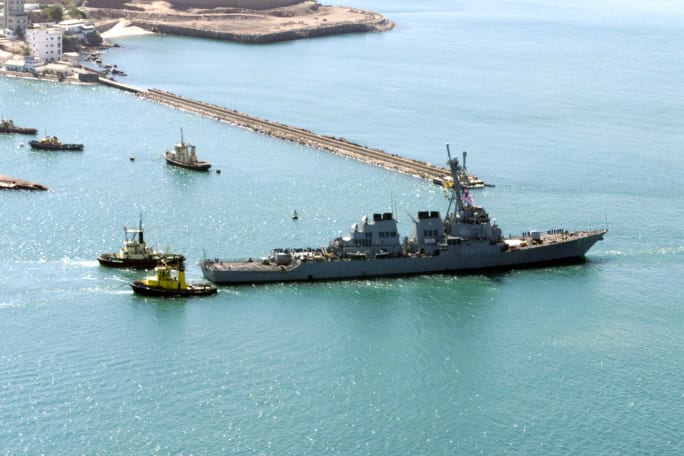
The USS Cole was towed from the Aden Harbor to be lifted onto a heavy lift ship after the attack.
Photo: National Archives
When the time came to get the USS Cole onto the heavy lift ship that would remove it from the port, Lippold wanted his crew to know they hadn’t done all their work for nothing.
“We had bounced back and shown that resiliency to pick ourselves up by our bootstraps and be able to get our ship back underway,” Lippold said.
As the ship was departing the harbor, the team played the Star-Spangled Banner as a show of strength, with Yemeni sailors coming to attention at the pier in response.
Building a Confident Team
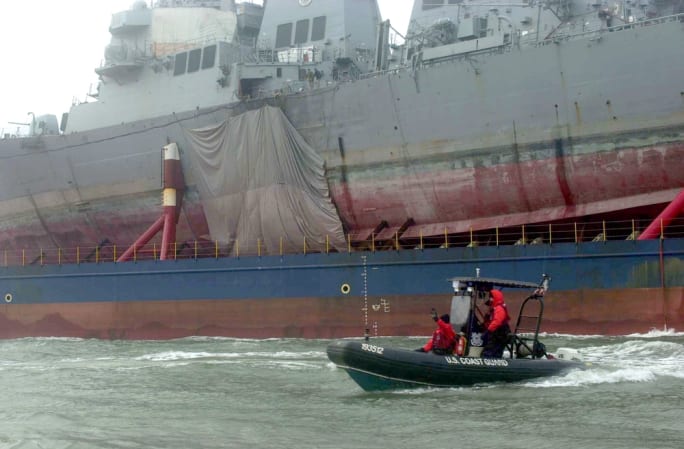
The USS Cole aboard the Blue Marlin was escorted into a U.S. port several months after it was attacked off the coast of Yemen.
Photo: DVIDS
As the heavy lift ship was on its way, its captain took a moment to show Lippold the extent of the damage, which he could now see much more clearly. He believes his training helped prepare his crew to take on this disaster headfirst.
Lippold shared his pillars of leadership that he believes helped prepare his crew be prepared for whatever came their way:
Professional competence.
Make decisions.
Trust your people.
Focus and vision.
Communicate.
Integrity.
Resiliency.
“When you put the conditions in place, when you build these pillars into what you do with your people, there is nothing that they can’t accomplish,” Lippold said.
More Management

How to Build a Better Driver Training Program
Ready to boost up your school bus instructor training? Here’s how to pick the right talent and improve recruitment, retention, and safety.
Read More →
CALSTART and Forth Combine to Form Catalyst Mobility
The new name represents a renewed vision for the nonprofit focused on advancing clean, equitable, and affordable transportation solutions that move people and goods.
Read More →
What Makes a Great School Bus Driver Trainer?
Choosing the right school bus driver trainer takes more than experience. Learn six keys to selecting and developing trainers and evaluating program effectiveness.
Read More →


School Bus Contractors Expand Through New Deals, Acquisitions & Partnerships
STA's Canadian division acquires Ontario-based G&L Stevenson Transport while Durham School Services adds a new district contract in California, First Student adds a New Jersey contract, and Minnesota Coaches acquires Halo Transportation.
Read More →
Logan Bus Company Rolls Out AI Phone System for NYC School Bus Families
A summer pilot found that AI agents could handle most routine calls, freeing up time for customer service staff to focus on emergencies and complex family concerns.
Read More →
From Intent to Impact: What I Learned About Leadership from TAPT
A Texas transportation supervisor shares lessons on self-awareness, accountability, managing stress and building trust — and why investing in leadership development matters at every stage of your career.
Read More →
NAPT Names 2026 Award Recipients, Hall of Fame Inductee
Who earned national recognition for their work in student transportation? This year, NAPT named five recipients of its 2026 awards for service, safety, and leadership, plus its newest Hall of Famer.
Read More →
2026 State of Student Transportation Report
Driver shortages. Rising costs. Growing safety expectations. More data, but not enough time to act on it. The 2026 State of Student Transportation Report reveals what transportation leaders say is putting the most pressure on their operations—and where they’re investing next. See how your priorities compare.
Read More →
How to De-Escalate an Angry Person: 5 Steps for Handling Workplace Conflict
What makes emotions run high, and how should you handle an angry colleague or parent? Follow these steps for staying calm, listening, showing empathy, and resolving conflict.
Read More →
What Readiness Looks Like This School Year
Learn about the challenges shaping the 2026–2027 school year, from persistent driver shortages and budget pressure to technology and readiness gaps. See how school districts are responding and adapting in Zonar’s 2026 Back-to-School Readiness Report.
Read More →