




Trends in Bus A/C Systems
Photo Above: Carrier Transport Air Conditioning offers several roof-mount systems for school buses, including the AC-310, which has a cooling capac...
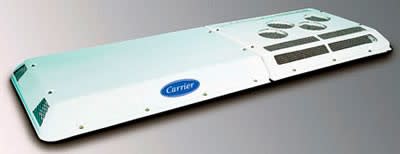
Photo Above: Carrier Transport Air Conditioning offers several roof-mount systems for school buses, including the AC-310, which has a cooling capacity of 83,000 BTU/hour. Officials in the air conditioning industry reveal that their pupil transportation clients are increasingly requesting systems and components that are efficient and appealing to the eye and that take up as little space as possible.
Therefore, while companies continue to offer traditional ceiling-mount evaporators, bulkhead or in-wall evaporators (usually installed in the area above a bus’ front and rear windows) are becoming a popular choice for school buses.
“About 85 percent of our clients in Texas are switching to our bulkhead-style evaporators,” says Cheyne Rauber, general manager of Rifled Air Conditioning. “You can have the same performance as the older style evaporator, but you have [a flush-mounted] fit and finish that doesn’t obstruct the headroom.”
School bus operations are also purchasing more roof-mount air conditioning systems (where the condenser is located on top of the roof as opposed to under the bus, in the skirt area) and more roof-mount condensers. “We’re seeing a wider acceptance of these types of systems across the board,” says Dave Oberdorff, marketing manager of Carrier Transport Air Conditioning. “It’s not just at Carrier — most of our competitors also offer roof-mount systems.”
“Rooftop condensers are becoming very popular in the Northeast,” Rauber adds. “The salt from the roads can damage skirt-mount condensers, so putting the unit on the roof extends its life.”
The following outlines system specifications and new developments from seven air conditioning manufacturers, many of which also provide maintenance and installation services to end users.
ACC Climate Control
ACC Climate Control offers numerous air conditioning components for school buses. Scott Hamilton, part of the company’s sales team, says the most commonly installed evaporator/condenser combination is a dual set of its 23023 Series Evaporator Twin Blower and its 25031 Series Condenser.
The evaporator has a cooling capacity of 53,000 BTU/hour and features an orifice tube that is used in conjunction with an enhanced copper tube and an aluminum fin coil to enhance the unit’s durability and maximize BTU output.
The condenser’s counter-flow coil circuitry and the crosshatching within its tubing walls improve heat rejection and sub-cooling. The unit has a heat-rejecting capacity of 78,000 BTU/hour and can generally be installed without cutting large holes in a bus’ skirt.
Hamilton says ACC Climate Control strives to “think outside of the box” when developing its products — the company uses an orifice tube accumulator design system rather than dryers with expansion valves. “Expansion valves are a high-failure item in most air conditioning systems,” Hamilton explains. “An orifice tube is not [as likely to fail], and with an accompanying accumulator, more oil will be sent back to the compressor and increase its lifespan.”
The company also uses ground-leg switching, which decreases the number of hot wires running through a system and which Hamilton believes makes ACC’s products safer compared to companies that use multiple wires to power their units.
American Cooling Technology Inc.
According to Vice President J.R. Lucas, American Cooling Technology (ACT) specializes in “split” air conditioning systems, where the evaporator is installed inside the bus and the condenser is installed under the bus.
ACT offers ceiling-mount evaporators and in-wall evaporators. Two series of in-wall evaporators are available: the EZ and EV (evaporator vertical) series. Within the EZ series, Lucas says the EZ-2 is a popular model. This unit has a cooling capacity of 50,000 BTU/hour. It can be flush-mounted at the front or rear of a bus and its louver design enhances airflow throughout the vehicle. The EZ-2 also features pressure switches to ensure compressor protection, and its rifled copper tubing coils increase system performance.
The EV-10 has a cooling capacity of 30,000 BTU/hour and comprises many of the same features as the EZ-2. It can be installed in the front or rear of a bus; however, it is also specially designed to be installed in areas where space is limited.
ACT offers skirt-mount condensers for school buses, including the CS-3. This unit has a heat-rejecting capacity of 78,000 BTU/hour, which results in a lower cooling temperature and lower head pressure, while its 12-inch fan increases airflow.
“We’re also developing and testing rooftop condensers,” Lucas says. “People are asking for them to avoid bringing heat and dust from the road into their buses.”
Carrier Transport Air Conditioning
Carrier Transport Air Conditioning manufactures several roof-mount systems for school buses. The AC-310 has a cooling capacity of 83,000 BTU/hour, while the AC-350 has a cooling capacity of 96,000 BTU/hour. The company’s newest rooftop unit — the AC-410 — is designed for use on small school buses.
Oberdorff notes that there are advantages to using a roof-mount system. “The evaporator and condenser are on the roof, which frees up space inside and under the bus,” he explains.
While the company’s roof-mount systems are more expensive than other air conditioning options because they include a fiberglass base and cover, Oberdorff says they are desirable because they distribute air evenly throughout the bus. They also have a higher cooling capacity than systems with skirt-mount condensers because they pull in air from the roof as opposed to the ground, he adds.
Carrier offers a line of in-wall evaporators as well, each of which has flexible mounting configurations and enhanced tube and fin coils for maximum cooling capacity. The IW-1 and IW-2 can fit most school bus models, while the IW-14 has been developed for Collins Bus Corp. and Trans Tech Bus units.
Oberdorff says that these systems’ flush-mount installation at the front and rear of a bus offers a significant increase in head clearance and increased air distribution compared to ceiling-mount evaporators.
Climate Comfort Technologies’ CC 234 roof-mount air conditioning system has a cooling capacity of 96,000 BTU/hour.Climate Comfort Technologies
Climate Comfort Technologies (CCT) specializes in roof-mount air conditioning systems and offers three for school buses. Scott Imamura, vice president of sales, says the CC 234 is the largest system and can be installed on virtually any 40-foot school bus in the U.S.
The CC 231 DL (dual loop) is a mid-size application and can fit on buses smaller than 40 feet long. The dual loop feature signifies that the unit has two engine-driven compressors. Imamura says the CC 210 DL is an option for fleets with 15- to 20-foot buses, but he notes that it is more common to see a split system on a bus this size.
Each unit has built-in diagnostics and corner or straight ducting and is available in white or yellow. Several other features differentiate them from competitors’ roof-mount systems, Imamura adds. Each system’s one-piece fiberglass housing is molded to fit the bus’ roof, enabling the evaporator and condenser to be hooked together, thereby increasing efficiency and eliminating the need for fittings.
Any time you have fittings, you increase the chance for leaks, Imamura explains, so it is important to develop systems that require as few fittings as possible.
The units also feature heavy-duty, transit-style components, which Imamura says make for maintenance-friendly systems. The brushless motors, for instance, have a longer lifespan compared to competitors’ motors, and all of the coils are self-cleaning.
Rifled Air Conditioning Inc.
Rifled Air Conditioning (RAC) offers traditional ceiling-mount evaporators and skirt-mount condensers, but Rauber says many of the company’s pupil transportation clients are now purchasing in-wall evaporators and roof-mount condensers.
Two popular in-wall evaporators are the BH-20 and the BH-10. The BH-20 has a cooling capacity of 60,000 BTU/hour and is designed specifically for IC buses. It can be mounted in the front or rear bulkhead areas and can be shaped and molded to fit the bus’ contours. The unit’s grill style and louvers ensure that a large volume of air flows through the vehicle.
The BH-10 has a cooling capacity of 36,000 BTU/hour. It can be fitted in numerous manufacturers’ buses, and in areas where headroom, size, weight and amperage draw are considerations. The evaporator’s louvers and down-force air channels maximize airflow.
RAC also manufactures driver compartment in-dash systems according to bus type. Rauber says the RE-ICDA10 Evaporator Dash A/C (for IC’s conventional unit) is RAC’s most requested in-dash application.
Finally, the company is working on developing mount kits for a streamlined, transit-style compressor manufactured by Bitzer. “RAC was the first in the industry to install this compressor in a school bus,” Rauber says. “We want to design kits that will enable it to be mounted on a number of different school bus engines.”
This roof-mount condenser from Thermo King Corp. can be used for the company’s ShuttleAire S-40 split air conditioning system.Thermo King Corp.
Thermo King Corp.’s systems for school buses are categorized in two ways: those operated by a transit-style compressor mounted on a rear-engine bus, and those operated by an automotive-style compressor mounted on a front-engine bus.
According to Product Manager John Arkesteyn, the LRT and the Citi RT — high-capacity roof-mount systems for large buses — fall into the first category. The LRT and the Citi RT feature technology designed to provide optimum temperature control — IntelligAIRE and ClimaAIRE, respectively.
The company also offers the D5, a heavy-duty, transit-style school bus HVAC (heating, ventilating and air conditioning) system. Arkesteyn says the D5 is available in a roof-mount condenser model and a skirt-mount condenser model.
Thermo King’s second category of climate control systems comprises the ShuttleAire SR-50, a lightweight, one-piece rooftop air conditioning system for full-size school buses, as well as the ShuttleAire S-20, ShuttleAire S-30 and ShuttleAire S-40 — split systems designed for 14- to 34-foot buses. They are available with roof-mount, skirt-mount or low-profile condensers and standard evaporators. Each ShuttleAire system features ClimaAIRE technology.
Thermo King strives to provide quality products to its customers, Arkesteyn notes. For instance, the ShuttleAire systems’ frames are made from aluminum to protect against corrosion, whereas many companies use galvanized steel. To enhance wire durability, the company uses tinned wires with a special, high-temperature-tolerant sheathing in all of its products; the wires are also individually marked to facilitate ease of maintenance.
An FK30 C325 transit-style compressor is mounted on a MaxxForce DT engine in an IC unit with a bracket developed by Trans/Air Mfg. Corp.Trans/Air Mfg. Corp.
Trans/Air Manufacturing Corp. offers roof-mount air conditioning systems and several in-wall evaporators and condenser units for school buses. President Rick Lehnert says the company recently developed a bracket to mount a transit-style compressor — the FK30 C325 — on the MaxxForce DT engine in an IC school bus and in Thomas Built Buses’ Saf-T-Liner rear-engine school bus.
“A transit-style compressor is beneficial because it is heavy-duty,” Lehnert explains. “It will last longer, be more durable and work more efficiently while using less horsepower per BTU.”
Of the company’s skirt-mount condensers, Lehnert says the SMC3L is a newer model that has a micro aluminum channel, which reduces refrigerant requirements and gives the unit a lighter weight.
The SMC3L rejects heat at a rate of 55,000 BTU/hour. It has a permanent magnet motor with ball bearings, and its fan and shroud are made of glass-filled nylon plastic.
Together, the motor/fan assembly has a low-profile surface mount. The condenser’s sight gauge is visible from outside of the bus and includes a moisture indicator.
Some of Trans/Air’s systems are installed at the OEM level, but the company offers comprehensive kits that enable the end user to install the equipment after the bus has been built; installation trainers can also be sent to bus operations to assist personnel.
Finally, Lehnert notes that Trans/Air is ISO 9000:2001 certified, and its installation facilities have also received the certification.
More Management

How to Build a Better Driver Training Program
Ready to boost up your school bus instructor training? Here’s how to pick the right talent and improve recruitment, retention, and safety.
Read More →
CALSTART and Forth Combine to Form Catalyst Mobility
The new name represents a renewed vision for the nonprofit focused on advancing clean, equitable, and affordable transportation solutions that move people and goods.
Read More →
What Makes a Great School Bus Driver Trainer?
Choosing the right school bus driver trainer takes more than experience. Learn six keys to selecting and developing trainers and evaluating program effectiveness.
Read More →

School Bus Contractors Expand Through New Deals, Acquisitions & Partnerships
STA's Canadian division acquires Ontario-based G&L Stevenson Transport; Durham School Services adds a new district in California; First Student expands in New Jersey; and Minnesota Coaches rebrands and acquires Halo Transportation.
Read More →
Logan Bus Company Rolls Out AI Phone System for NYC School Bus Families
A summer pilot found that AI agents could handle most routine calls, freeing up time for customer service staff to focus on emergencies and complex family concerns.
Read More →
From Intent to Impact: What I Learned About Leadership from TAPT
A Texas transportation supervisor shares lessons on self-awareness, accountability, managing stress and building trust — and why investing in leadership development matters at every stage of your career.
Read More →
NAPT Names 2026 Award Recipients, Hall of Fame Inductee
Who earned national recognition for their work in student transportation? This year, NAPT named five recipients of its 2026 awards for service, safety, and leadership, plus its newest Hall of Famer.
Read More →
2026 State of Student Transportation Report
Driver shortages. Rising costs. Growing safety expectations. More data, but not enough time to act on it. The 2026 State of Student Transportation Report reveals what transportation leaders say is putting the most pressure on their operations—and where they’re investing next. See how your priorities compare.
Read More →
How to De-Escalate an Angry Person: 5 Steps for Handling Workplace Conflict
What makes emotions run high, and how should you handle an angry colleague or parent? Follow these steps for staying calm, listening, showing empathy, and resolving conflict.
Read More →
What Readiness Looks Like This School Year
Learn about the challenges shaping the 2026–2027 school year, from persistent driver shortages and budget pressure to technology and readiness gaps. See how school districts are responding and adapting in Zonar’s 2026 Back-to-School Readiness Report.
Read More →