




Related: Guidelines for Designing a School Bus Maintenance Facility
Transitioning to a New School Bus Facility: What You Need to Know
The Chandler (Ariz.) Unified School District #80 transportation team recently moved its operations from three small locations to a new facility that features significant upgrades. Here, they detail the process and share lessons learned.

Nicole Schlosser・Former Executive Editor
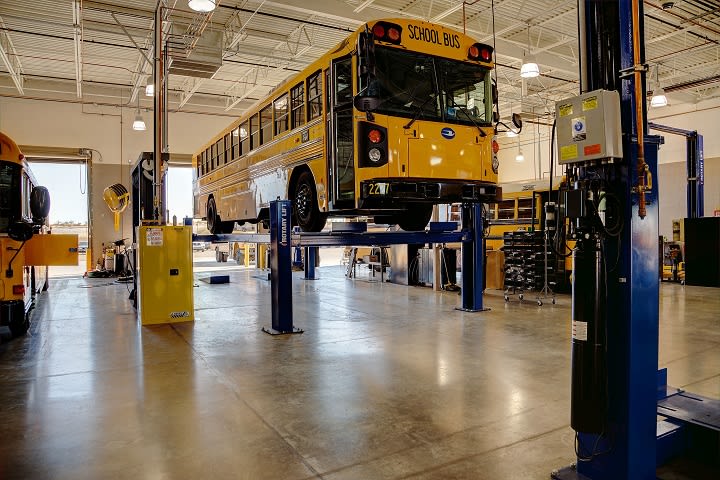
Photo courtesy Brock Elliott Photography
8 min to read
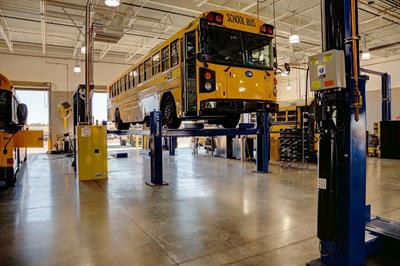
Photo courtesy Brock Elliott Photography
The Chandler (Ariz.) Unified School District #80 (USD) transportation team recently moved to a new facility that features significant upgrades, including nearly all new equipment, about double the space in one location, and changes that better accommodate the desert heat.
A need for a new transportation facility arose as the district added schools in response to increasing enrollment. The district is made up of 44 schools and two more are being built over the next few years.
The team quickly moved its operations from three separate locations into the Ira L. King facility, a new 35,000-square-foot building, on July 22, just in time for the new school year — which started the following day.
As one can imagine, it was no small undertaking. David Thiele, the district’s fleet supervisor, who assisted in the planning process and new facility design, said that transportation department staff members had to move 279 buses in one day and worked off of picnic tables during approximately the first month of the transition. However, careful planning, delegating, and teamwork resulted in a more efficient facility.
Sharing Lessons Learned
Three members of the team who played an integral role in the transition — Sandy Brown, transportation supervisor; Steve Hewitt, the director of transportation and community education; and Thiele; detailed for School Bus Fleet the process, some key procedures they employed to make the transition, and lessons learned.
Former Digs
One of the buildings that the team had been operating in before was about 20,000 square feet, 60 years old, and had needed updates for about 15 years, Thiele said. Dispatch was located there and the team ran special-needs buses from that site.
The second building, where the shop was located, was adjacent to a high school and built for the purpose of housing vocational studies, and more importantly, wasn’t designed for any type of buses or garage, Thiele noted.
The third location was a gravel lot with a temporary office. It was used to run general-education routes during the transition to the new building.
Choosing One Location
The transportation department weighed the cost of several smaller locations versus building one large, fully operational facility, and realized that having one centrally-located building was significantly less expensive than operating several smaller sites.
“Having one yard would allow us to have better supervision, customer service, and efficiencies,” Hewitt says. “Each smaller yard would still need a couple of mechanics, a dispatcher, receptionist, and at least one supervisor, which equates to an average of five to six staff per location. One yard allowed us to have better coverage for less cost.”
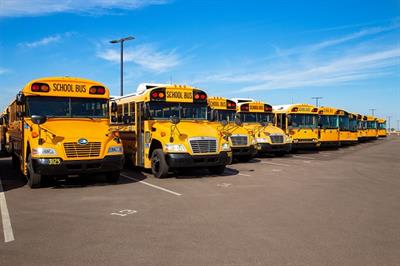
The Chandler USD transportation team advises pupil transporters who are moving to a new facility to have a plan in place in advance for parking lot spots and entrances and exits. Photo courtesy Brock Elliott Photography
The transportation department presented its findings to district administrators and began looking for a central location that fit their budget. After selecting a couple of sites, the team checked the overall mileage to and from those locations to see which would be more advantageous and ensured there would be enough room for the entire bus fleet and nearly 30 additional white fleet vehicles. The building also needed to house over 350 staff members and still have room for a growing team.
Once the team procured an architectural firm and building contractor, district leadership, including the director of construction, Thiele, and Hewitt worked with the designer and builder over several meetings and tours of other top-of-the-line facilities.
“It took almost two-and-a-half years of research and looking for property before we finalized the property we now sit on,” Hewitt says.
The Transition
Designing the new facility involved many team players but was mostly driven by the associate superintendent and director of construction. The team, including Hewitt, Thiele, and other transportation staff members, worked with the architectural firm and builder. Representatives from those companies visited the City of Flagstaff’s facilities to get ideas for designing the new shop and transportation environment.
“That visit helped us determine that larger garage doors, along with wider spacing between the bays, is essential to employee safety inside the shop,” Thiele says.
The team also visited other district and city transportation departments, as well as a couple of school bus dealerships.
The design and build process was completed within one year. In the meantime, transportation staff members needed parking spaces, so Thiele opened a temporary site of about 2.5 acres, which accommodated over 100 buses, along with a mobile washroom and office at the largest of the former locations.
“To work on buses, we had to bring them back to the [location at the] high school, about a mile away,” Thiele says.
Then came time for the move, which took the transportation leadership team approximately three months to plan.
“We had two to three plans, depending on when construction was completed or complete enough for us to take ownership,” Hewitt says.
Although the move was not as seamless as planned and took almost 15 hours, staff members from several district departments contributed to a well-received opening.
“With the help of almost 400 amazing district staff, we opened successfully,” Hewitt adds.
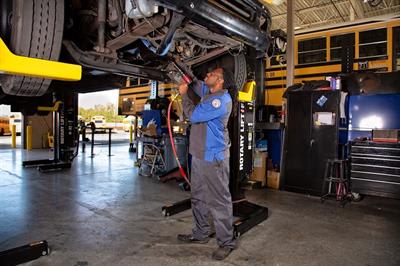
The district’s new facility features 16 bays, five 40,000-pound vehicle lifts, and a 1,400-square-foot parts department. Photo courtesy Brock Elliott Photography
Delegating, Teamwork
That success can, in part, be attributed to many team members taking on extra work. Thiele transferred three mechanics to the new facility, along with approximately 80 buses, the weekend before school started. More mechanics and some drivers stepped in to help during the first three days of school. The transportation department also formed a team of drivers to clean the old facilities.
Mechanics were finishing bus repairs from over the summer at the old sites for about a month before they were completely resettled in the new facility, Brown says.
The move and first quarter of the school year were expected to be tough, given that the temperatures in August and September were the hottest on record, with almost every day over 106 degrees Fahrenheit, and that the start of every school year brings several new routes, drivers, and students.
To handle the challenge, all exempt staff members put in 60 hours a week for the first six weeks. The supervisors team was and is still available to drivers and bus attendants every day from 5:30 a.m. to 6:30 p.m. (Before the move the three supervisors were working 10-plus hours a day and were still unable to cover the full 13 hours of operations across the three sites.)
“Drivers, mechanics, and bus attendants always have a supervisor on duty to bring issues to,” Hewitt says. “It might not be their direct report, but they are available at all hours of operations.”
A Fresh Start
The new facility is comprised of 18.5 acres and accommodates 252 drivers, 61 bus attendants, 15 mechanics, and several office staff members, Hewitt says.
Thanks to the efforts of the district’s chief financial officer, superintendent, and the Chandler community, Chandler USD was able to replace and enhance most of its shop equipment, he adds.
The facility features five 40,000-pound vehicle lifts, four of which are portable; a 1,400-square-foot parts department; and 16 bays, with two designated just for service and an engine wash bay. Thiele designed harnesses that are placed above the bays for mechanics to work on the buses’ rooftop air-conditioning units.
The bays have 20-foot-high ceilings, eight swamp coolers and eight fans to combat the Arizona heat, as well as eight heaters for the desert’s cool mornings and evenings.
Additionally, mechanics from each of the three old sites now work together since there is enough room to do so in the new building. Working together in one location has improved communication within the department as a whole, Hewitt says.
After the new facility opened, the transportation department added shelving in the parts room to make inventory management easier, and new software from Navistar, Insite Pro, and Caterpillar ET, to diagnose maintenance issues and reduce repairs.
Putting Parking Plans in Place
One hurdle that has since been tackled, Brown says, is establishing a system for parking buses in the new lot, which has 340 spaces.
Brown and Thiele advise other pupil transporters who are moving to a new facility to ensure they have a plan in place in advance for parking lot spots and entrances and exits, and to consider the size of their department and the space needed for training, meetings, and visitors.
The day that the team moved into the bus yard, the parking lot was not finished; some painted lines were still wet and some areas had yet to be painted. As the buses arrived from the old yards, drivers parked them in the order that they arrived.
The next morning, which was the first day of school, drivers were asked to come in early to find their bus. By the following day, the parking spaces lines were dry, the missing spaces completed, and drivers were given their parking space assignments.
With so many ideas on direction of travel in the yard, backing into spaces, parking nose-to-nose, and shared pull-though spaces, Brown says, the team formed a committee comprised of general-education and special-needs drivers, mechanics, and leadership staff to come up with a plan. Committee members held a couple meetings, reviewed various diagrams of parking lot designs, and shared the final design with the drivers and attendants.
“We listened to all concerns and suggestions and were able to come up with a final diagram that addressed every concern,” Brown says.
Simply put, the team advises readers going through a similar transition to “plan, plan, plan, and then have a back-up plan.”
Moving Forward
As the team continues to enhance parking lot safety and efficiency, a representative group of 24 leadership and office staff, drivers, mechanics, and bus attendants, is creating a workplace constitution titled “How you want to be treated in the workplace.”
Having 350 staff members move from a few locations to one has caused some anxiety in those who felt more comfortable at the smaller location, Hewitt says, but adds that with all staff members adopting a positive attitude toward each other, the transition will become easier for everyone.
Apparently, that unease doesn’t interfere with camaraderie among team members; they recently held “the biggest and best holiday party on record,” and helped drivers in need with food boxes for the holidays, Hewitt says.
“It’s the little things that this amazing team with giant hearts is able to do on a daily basis that will continue to move us closer together as one team,” he adds.
Subscribe to Our Newsletter
More Management

How to Build a Better Driver Training Program
Ready to boost up your school bus instructor training? Here’s how to pick the right talent and improve recruitment, retention, and safety.
Read More →
CALSTART and Forth Combine to Form Catalyst Mobility
The new name represents a renewed vision for the nonprofit focused on advancing clean, equitable, and affordable transportation solutions that move people and goods.
Read More →
What Makes a Great School Bus Driver Trainer?
Choosing the right school bus driver trainer takes more than experience. Learn six keys to selecting and developing trainers and evaluating program effectiveness.
Read More →


School Bus Contractors Expand Through New Deals, Acquisitions & Partnerships
STA's Canadian division acquires Ontario-based G&L Stevenson Transport while Durham School Services adds a new district contract in California, First Student adds a New Jersey contract, and Minnesota Coaches acquires Halo Transportation.
Read More →
Logan Bus Company Rolls Out AI Phone System for NYC School Bus Families
A summer pilot found that AI agents could handle most routine calls, freeing up time for customer service staff to focus on emergencies and complex family concerns.
Read More →
From Intent to Impact: What I Learned About Leadership from TAPT
A Texas transportation supervisor shares lessons on self-awareness, accountability, managing stress and building trust — and why investing in leadership development matters at every stage of your career.
Read More →
NAPT Names 2026 Award Recipients, Hall of Fame Inductee
Who earned national recognition for their work in student transportation? This year, NAPT named five recipients of its 2026 awards for service, safety, and leadership, plus its newest Hall of Famer.
Read More →
Sponsored•September 2, 2026
2026 State of Student Transportation Report
Driver shortages. Rising costs. Growing safety expectations. More data, but not enough time to act on it. The 2026 State of Student Transportation Report reveals what transportation leaders say is putting the most pressure on their operations—and where they’re investing next. See how your priorities compare.
Read More →
How to De-Escalate an Angry Person: 5 Steps for Handling Workplace Conflict
What makes emotions run high, and how should you handle an angry colleague or parent? Follow these steps for staying calm, listening, showing empathy, and resolving conflict.
Read More →
Sponsored•September 1, 2026
What Readiness Looks Like This School Year
Learn about the challenges shaping the 2026–2027 school year, from persistent driver shortages and budget pressure to technology and readiness gaps. See how school districts are responding and adapting in Zonar’s 2026 Back-to-School Readiness Report.
Read More →