




Tracking and Analyzing Road Breakdowns
Tracking road breakdowns is key to fine-tuning an operation’s preventive maintenance program. How often your buses need to be brought in for routine m...
Tracking road breakdowns is key to fine-tuning an operation’s preventive maintenance program. How often your buses need to be brought in for routine maintenance and safety checks can be determined by analyzing road call and repair records on your fleet. Some transportation departments record this information manually, especially smaller operations. Larger operations often use a fleet software program to track breakdowns and repairs. We contacted transportation directors, maintenance supervisors and mechanics across the country to find out how they track breakdowns and repairs and how they use that information to improve their operations. Here’s what we found.
Tracking systems
Brad Barker, head mechanic for Park City (Utah) School District, uses a fleet software package to help track breakdowns, repairs and costs. All repair orders and road calls are entered into the software program and downloaded to Microsoft Excel. Barker uses the Excel data to customize reports to meet his needs. He can target specific inspections or analyze yearly repairs and calculate the frequency of each type of breakdown. Barker uses the data as a tool to pinpoint problem areas in fleet maintenance. For example, after running a repair report on his fleet, he found that his mechanics were replacing a lot of brake linings. A great deal of road salt is used in Park City, which gets into the brake linings and causes them to crack and come off the brake shoes. In response to the discovery, Barker now has his drivers ride the brakes on their buses when they drive around the garage to their parking spots. This helps to dry out the brake linings. Another problem area that Barker identified by analyzing maintenance reports is excessive spring pin failure. After discovering the problem, Barker’s shop staff tried different types of greases and a different style of spring pin. “We’re always adjusting the preventive maintenance program. You must be willing to change,” says Barker. Dave Voiles, transportation service manager for Bend/LaPine (Ore.) School District, says that fleet maintenance software helps him organize information and identify repair patterns on his fleet of 105 buses. He uses that data in deciding which vehicles to replace. The average bus in Bend/LaPine’s fleet is 15 years old. In choosing vehicles to replace, Voiles cannot always get rid of the oldest vehicles. He must first replace the buses that cost the most money to maintain, no matter what their age. By tracking service records, however, Voiles has discovered that older buses actually have fewer problems than new ones. “New buses usually require more work [than older buses] the first few years,” explains Voiles. Though fleet maintenance software can be very helpful in tracking repairs, it is not the answer for everyone. Howard Yamaguchi, owner of Yamaguchi Bus Service, operates a fleet of eight buses on the island of Kauai, Hawaii. Because his fleet is small, he has decided that purchasing a fleet software package is unnecessary. Yamaguchi enters all repair orders and road calls into a logbook manually. He says this method works well for him and that he has no difficulty using written records to track road breakdowns.
Breakdown causes
There are certain breakdowns that all school bus operators experience, regardless of where they are located. Here are five of the most common causes of road breakdowns:
Charging systems -- Weston Hiott, transportation supervisor for Oconee County School Bus Shop in Walhalla, S.C., says he has experienced a significant number of battery failures this year because of a colder-than-normal winter. Knowing that there is an increase in dead batteries during the cold season can help school bus mechanics adjust their preventive maintenance schedule to include load-testing batteries at each maintenance interval. This helps them determine which batteries to replace -- before it’s too late. Other common charging system problems are alternator failure, starter failure and loose or corroded connections.
Heating and cooling systems -- Extreme heat is one sure way to tax a vehicle’s heating and cooling systems, so during the warmer months, it’s important to keep a close eye on these systems. Signs of system failure include leaky radiators, loose hoses and clamps and water pump failure. In addition to checking heating and cooling systems during normally scheduled maintenance, drivers can help by reporting leaks that are found during their routine inspections.
Electrical components -- Ranging from shorted wiring and safety light failure to headlight failure, all school bus operators at one time or another have experienced electrical problems. Fleets operating in regions that use salt on roadways fight a constant battle with corrosion of electrical systems. However, this type of corrosion is not confined to those who operate in cold climates. At Yamaguchi’s Bus Service in Hawaii, problems with electrical systems are particularly common, due to a combination of high humidity and corrosion from the salt spray of the ocean. Though Yamaguchi can’t do much to prevent corrosion of his buses’ electrical systems, his awareness of the problem enables him to head-off breakdowns by checking system components on a regular basis. Compressed air systems -- Air systems, like so many other systems on a bus, often fall victim to temperature extremes. In the cold winter months, Voiles in Bend, Ore., has seen a noticeable increase in air valve seal failures. Another common compressed air failure is faulty reaction of the air compressor, which then triggers other compressed air components, such as stop arms and doors, to malfunction. Air line leaks are also recurring problems, causing a rapid loss of too much air.
Fuel systems -- Jelled fuel is a common problem experienced by operators in regions where buses are exposed to extreme cold. Gordon Wilder, transportation director for Vance County Schools in Henderson, N.C., was faced with jelled fuel when the temperature dropped to well below freezing. Usually, this complication can be avoided by putting additives in the fuel or equipping buses with fuel line heaters. However, if the fleet is located in a region that doesn’t typically face such weather extremes, the operator may find himself unprepared for fuel jelling.
Evaluating costs
The most common causes of road breakdowns are not necessarily the most costly. For example, tire blowouts and flat tires do not make the top of most operators’ “causes of breakdowns” list. Tires do, however, make their list of “top maintenance expenses.” Butch Clement, head mechanic for Central Square (N.Y.) School District, attests to the role tires play in fleet maintenance. “We have very few tire problems, but tires are still a major expense in maintaining the fleet,” he says. Those repairs that cost an operator the most money often depend on local circumstances, like weather and road conditions. Jim Felmlee, transportation supervisor for LeSueur-Henderson (Minn.) Public Schools, spends a large portion of his budget on tires. However, it is not tire replacement that hits his budget the hardest. “Broken shackles and spring replacement are the most costly items because of rough roads,” he says. About 75 percent of his district’s roads are unpaved.
Road call response
When a driver experiences a breakdown and calls for help, it is important that a trained mechanic listen carefully to the driver and do some quick troubleshooting. By referring to vehicle repair records, a mechanic can more easily get to the root of the problem when a bus breaks down. The driver of the disabled bus should move it as far away from the flow of traffic as possible. In the event that the stalled bus is started before the spare bus arrives, the driver should remain at the location where he reported the stall. Voiles recommends making sure that all passengers are safely transferred to the spare bus and the bus is on its way before attempting to repair the disabled bus. Whatever method is used for responding to a road breakdown, it should be done in a timely fashion. The longer a bus is stranded, especially in traffic, the greater the potential for an accident to occur. In addition to safety, we must keep in mind what we’re there for in the first place -- to get the kids to school. “How quickly a school bus gets back on the road is important so that students don’t lose educational time,” says Wilder.
Preventive maintenance
Drivers can play a key role in helping to prevent breakdowns by conducting thorough pre-trip and post-trip inspections. Reporting problems (existing or potential) to mechanics, either verbally or in writing, is vital. Communication among drivers is also important. As a bus leaves the lot, a driver who remains behind may notice a leak from underneath the bus that pulled out. This should be reported. “Regular routine maintenance is the key to preventing road breakdowns. Equally helpful is having qualified, trained personnel who can catch the small things before they become big things,” explains Barker. Author Evan Force, a former school district transportation supervisor, is a freelance writer in Grand Rapids, Mich.
More Maintenance
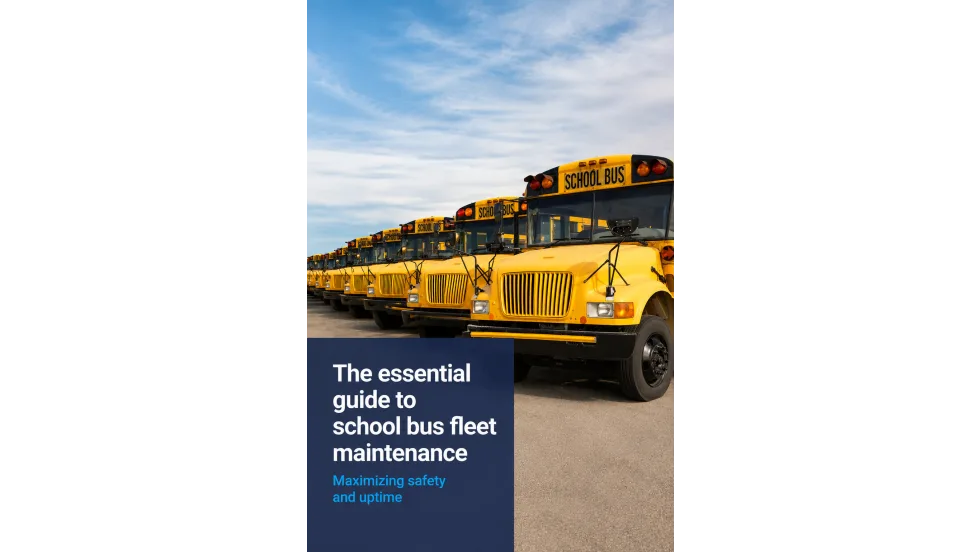
The essential guide to school bus maintenance and student safety
Reactive maintenance puts students at risk of breakdowns, delays and roadside emergencies. This guide gives transportation directors a data-driven framework to predict failures, extend bus lifespans and improve fleet reliability across every route.
Read More →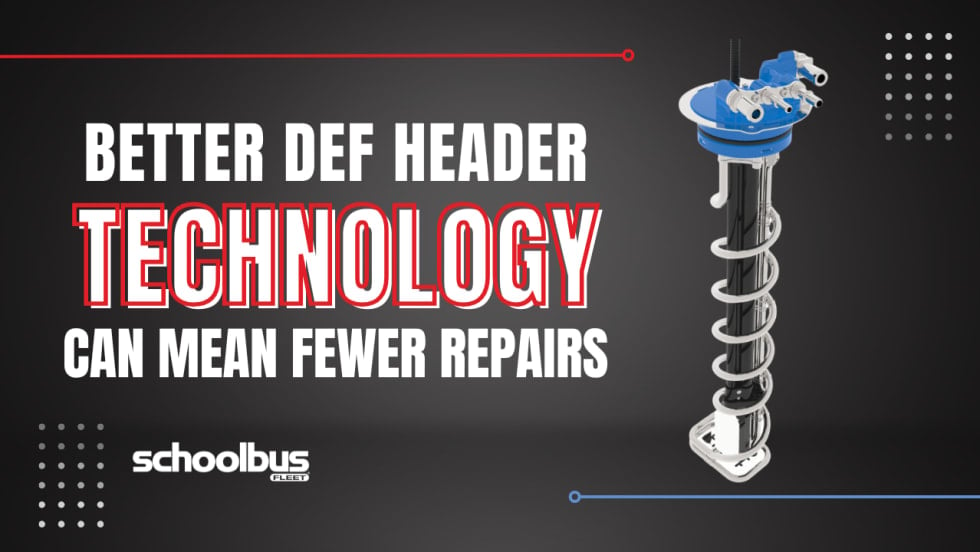
The Evolution of DEF Header Technology: What School Bus Operations Should Know at Replacement Time
See what school bus fleets should consider when replacing DEF headers to improve reliability, reduce repeat repairs, and control maintenance costs.
Read More →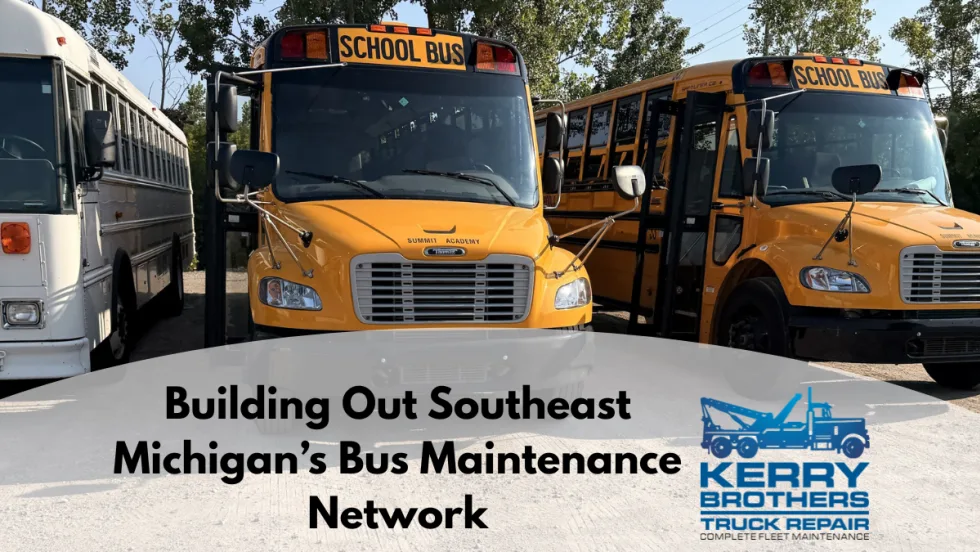
Kerry Brothers Grows Michigan School Bus Repair Network
The acquisition of Downriver Truck and Bus expands Kerry Brothers’ school bus maintenance footprint across southeast Michigan, adding repair capacity, diagnostic resources, and state inspection support.
Read More →
Noregon Introduces CAN Bus Diagnostic Tool, Expands JPRO Features
CAN Mentor and the latest JPRO update aim to simplify vehicle network diagnostics and improve repair efficiency for technicians of all experience levels.
Read More →
Cummins on Smarter, Simpler Engine Innovation
Cummins discusses its first-ever gasoline engine for school buses, EPA 2027, and why bus fleets still want durable, simpler internal combustion options.
Read More →
Report: 72% of Diesel School Buses Now Use Advanced Low-Emission Engines
New data shows advanced low-emission diesel technology continues expanding across school bus fleets, even as electric bus adoption gains momentum.
Read More →
Vampire Tools' CAIMAN 7.5-Inch Multi-Purpose Screw Extractor Long-Nose Pliers with Crimper
Vampire Tools introduced the VAMPLIERS Caiman 7.5-inch multi-purpose pliers, combining screw extraction, cutting, crimping, and gripping functions into a single tool designed for fleet maintenance professionals.
Read More →
How Advanced Diagnostics Helps Bus Fleets Stay Ahead of Repairs
Chat with Noregon’s Kevin Smallhorn at ACT Expo about bus diagnostic tools, telematics integration, CNG maintenance support, and strategies to help reduce downtime and improve uptime.
Read More →
How School Bus Fleets are Getting Ahead of Breakdowns
Don’t let bus downtime wear you down. Here’s how bus operators are shifting from manual processes to AI-powered, data-driven maintenance systems for improved reliability and safety.
Read More →
Pennsylvania School Bus Maintenance Team Praised for Dedication to Safety
Matthews Bus Company’s West Jefferson received a letter of commendation from the Pennsylvania State Police for their fleet inspections.
Read More →