




Top 100 News
News related to the Top 100 School District Fleets includes cost-cutting measures that improved performance at a Virginia district, a significant reduction in diesel use in Florida school fleets, and hands-on survival rescue training at a Houston district.
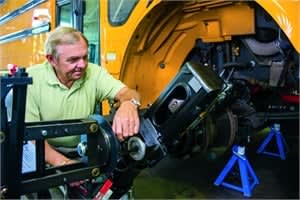
Prince William County Public Schools began buying buses with disc brakes, which Director of Transportation Services Ed Bishop says improved braking and saved money on maintenance. Photo courtesy Thomas Built Buses.
Prince William County cuts vehicle breakdowns by 50%, crashes by 35%
Investing time in maintenance and money in better equipment for school buses has not only improved the performance of Prince William County Public Schools’ fleet, it has cut costs significantly.
The fleet, composed of 850 Thomas Built route buses, serves 93 schools and transports about 61,000 students daily, according to Director of Transportation Services Ed Bishop. The drivers log an estimated 11.3 million miles per year.
Cutting costs started with examination of data from a crash review board. The operation wanted to determine if bus design or maintenance had an impact on the numbers or types of crashes taking place. Data from the maintenance management system were also studied to see where the biggest expenditures were, and what types of common faults were being experienced.
The fuel management system was next on the list; fuel consumption data for every vehicle in the fleet were observed to identify any abnormalities that caused expenses.
As a result, four areas were identified where significant costs were cut: major component replacement on mostly engines, expenditures on tires, expenditures on batteries and expenditures on brakes.
Engines were put through an internal fuel management program where fuels were sampled and tested to determine which fuel resulted in the least wear and tear on the engine. Then other parts of the bus that add to engine wear and tear were inspected.
“We just took a look at simple things, such as the quality of fuel filters, oil filters and air filters,” Bishop said. “We thought that if we were able to improve these filtering processes then that would also give us a cleaner-running engine.”
Fuels and parts were then adjusted to better quality ones. This reduced the number of engine breakdowns and replacements, drastically cutting costs on usual engine repairs.
It was also discovered that a significant amount of avoidable expenses were due to tire replacements.
“We looked at the tires and said, ‘Wow, we sure spend a lot of money on tires. What can we do to improve that?’” Bishop said.
The fleet started a tire management program where tire pressures were maintained properly. Driver training programs were adjusted as well to make sure drivers weren’t damaging tires by scraping curbs or hitting them.
Also, buses were bought with disc brakes to improve brake life cycles.
“We found that not only improved the braking of our buses, but changed the frequency with which we had to replace brake linings and the time required to do so,” Bishop said. “You spend an extra $1,500 [buying a bus with disc brakes versus conventional brakes], but over a 14-year life cycle, you save thousands.”
Higher-quality batteries and alternators were purchased, and the number of situations where buses wouldn’t start because of battery issues was cut by at least 50%, Bishop added.
With the help of Thomas Built dealer Sonny Merryman, a predictive maintenance program was developed to track breakdowns. Measures were taken to avoid them, their costs and their negative impact on student instructional time. Vehicle breakdowns were reduced by 50%.
[PAGEBREAK]As an example, buses would often have to pull over and call for service because a signal light or other bulb wasn’t working. “An analysis of these breakdowns caused us to invest in LED lighting at a higher acquisition cost per bus, but in the long term, it reduced the total cost of ownership of the bus and increased instructional time,” Bishop said.
Also, the district’s crash numbers are down by 35% and are being reduced every year. This has been aided by the predictive maintenance program but is primarily a result of improvements in driver training programs, enforcement of safety standards and bus routing.
Bishop joined Prince William County Public Schools more than 11 years ago, after retiring from a 30-year career of service in the U.S. Army. He credits his staff for the success of the district’s fleet, especially Vehicle Safety Coordinator David Walton, who is primarily responsible for the effective cost-cutting programs.
The most important part of these improvements was that students didn’t miss class because buses were breaking down on them, and that they arrived to school safely, Bishop said.
“Bus acquisition, preventive maintenance services, unscheduled repairs, etc., is all focused to achieving those top two goals,” he added. “Our breakdown rate has gone down, our crash statistics have gone down, and that means maximizing instruction time.”
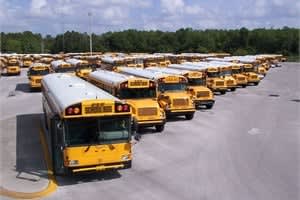
Reduced idling, biodiesel and new buses have helped Orange County (Fla.) Public Schools lessen the amount of diesel used by its yellow fleet.
Orange County cuts diesel use by 151K gallons in a year
Florida’s Orange County Public Schools actively measures key performance indicators (KPIs) to manage its operations.
One of the many strategies implemented in the last school year was to reduce the amount of diesel fuel utilized by the district’s yellow fleet. Jim Beekman, senior director of transportation, said that the effort is being carried over to this year as well.
Here is an example of a report on objectives from the operations division’s publication on performance, which is sent to the school board on an annual basis:
Department objective: To reduce the amount of hazardous waste produced and to increase the amount of recycling of hazardous and non-hazardous materials generated by the department
Measure: Reduce idling time
Target: 468.7 hours per school day
Result: 442.5 hours per school day
The measure determines how long buses are idling before, between and after runs. District officials said that this is important to monitor because it has a direct influence on fuel expenditures as well as the amount of emissions placed in the air.
The department measured 100% of its route buses for idling in 2012-13, which resulted in reducing idling time from 520.7 hours per school day to 442.5 hours.
Based on a fuel cost of $3.55 per gallon, a total of $61,025 dollars in fuel costs was avoided last year through the anti-idling program. As for the environmental impact, the effort reduced the fleet’s carbon matter output by 170.3 metric tons.
Lessons learned from this new measure have pushed the goal out to managers’ scorecards to be monitored on a weekly basis, in order for the department to be more responsive to any spikes in the data that may occur.
Additionally, Orange County Public Schools has utilized biodiesel fuel and, through its capital campaign, has purchased more fuel-efficient buses to replace older buses.
The combined initiative of anti-idling, biodiesel and fuel-efficient buses resulted in an overall reduction of 151,788 gallons of diesel fuel this past year. The economic benefit was a cost avoidance of $538,847 in fuel costs to the district, and the environmental benefit was a reduction of 1,503 metric tons of carbon matter output.
Orange County Public Schools, which is based in Orlando, transports 67,618 students per day on 906 route buses, traveling about 16.6 million miles per year.
[PAGEBREAK]
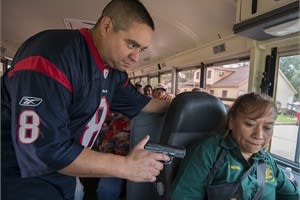
One of the drills prepared drivers and attendants to respond to an armed intruder
on the bus.
Houston school bus staff trains on survival rescue
More than 1,200 school bus drivers and attendants from Houston Independent School District (HISD) recently took part in hands-on survival rescue training to prepare them to respond to emergency crises on the bus.
HISD’s transportation services department held the training over two weeks in August, in partnership with the Houston Fire Department. The event took place at the fire agency’s training facility.
The survival rescue training featured mock emergency drills to prepare bus drivers and attendants for a variety of crises. The drills simulated the effects of a fire on a school bus, an armed intruder on board and a wreck involving a train, among other scenarios. All activities involved real school buses, trains, vehicles, fire, smoke, weapons and staged injuries.
“This training challenges every attendee with realistic emergency situations where the safety of the students on board will depend on their ability to respond successfully,” HISD Transportation Operations Manager Chester Glaude said before the event. “In addition, transportation team members will learn safe evacuation methods, student management, how to remain calm in a crisis, and first aid for burns and smoke inhalation.”
HISD’s transportation services department will also be rolling out a silent panic alarm, which has been activated on all of the district’s school buses. District officials said that HISD is one of the first public school districts to offer this feature.
The district’s drivers and attendants got another lifelike training experience last year, in a mock disaster drill. In 2012, the HISD transportation department added counter-terrorism instruction to its training. Part of the program was the disaster drill, in which an older model school bus was turned on its side and used as a hands-on learning lab for the transportation staff.
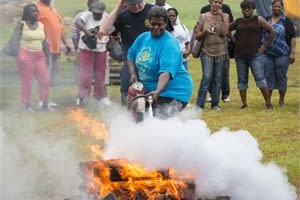
A recent Houston ISD training event featured mock emergency drills to prepare bus drivers and attendants for a variety of crises. Here, a trainee practices using a fire extinguisher.
The drivers and attendants made use of previous training on such topics as student management and emergency evacuation, in addition to counter-terrorism. Also, the mock disaster drill involved staged human injuries, which allowed the staff to practice the first aid training they had received earlier in the year.
HISD transports about 30,000 students per day on 890 route buses, logging about 14.4 million miles per year.
Gwinnett County adding stop-arm cameras to up to 40% of fleet
In an effort to improve student safety at school bus stops, Georgia’s Gwinnett County Public Schools (GCPS) is introducing an automated stop-arm enforcement program utilizing Redflex Student Guardian.
Redflex Student Guardian is a safety camera system that monitors and detects drivers who illegally pass school buses. Redflex has partnered with Blue Bird Corp. to offer the system to the district.
GCPS planned to initiate the program with the installation of 100 school buses by Labor Day. The district expects to outfit up to 40% of its school bus fleet later in the school year, officials said.
The Student Guardian camera system consists of a single enclosure installed approximately 6 feet behind the stop arm, monitoring traffic in both directions. The system is activated when the bus’ stop arm and amber lights are displayed and children are entering or exiting the bus.
Since the technology is automated, the bus driver is free to focus on students, according to the company. Evidence of potential violations, including video and photos, is submitted to local law enforcement to determine whether a citation is warranted.
“GCPS had many options for a stop-arm enforcement provider. We’re very excited and honored to be selected,” said Thomas O’Connor, president of Redflex Student Guardian.
“The Student Guardian program is already operating in five Georgia school districts, with another 66 programs operating throughout the United States. We are confident the program will serve as a deterrent in Gwinnett County, thereby increasing safety for local students.”
Student Guardian was developed by Redflex Traffic Systems Inc. GCPS has an agreement with Redflex to operate Student Guardian without any upfront costs to the district, city or state. The program is fully funded by violations, officials said.
GCPS transports 125,791 students per day on 1,709 route buses, logging more than 23.4 million miles per year.
More Management

How to Build a Better Driver Training Program
Ready to boost up your school bus instructor training? Here’s how to pick the right talent and improve recruitment, retention, and safety.
Read More →
CALSTART and Forth Combine to Form Catalyst Mobility
The new name represents a renewed vision for the nonprofit focused on advancing clean, equitable, and affordable transportation solutions that move people and goods.
Read More →
What Makes a Great School Bus Driver Trainer?
Choosing the right school bus driver trainer takes more than experience. Learn six keys to selecting and developing trainers and evaluating program effectiveness.
Read More →

School Bus Contractors Expand Through New Deals, Acquisitions & Partnerships
STA's Canadian division acquires Ontario-based G&L Stevenson Transport while Durham School Services adds a new district contract in California, First Student adds a New Jersey contract, and Minnesota Coaches acquires Halo Transportation.
Read More →
Logan Bus Company Rolls Out AI Phone System for NYC School Bus Families
A summer pilot found that AI agents could handle most routine calls, freeing up time for customer service staff to focus on emergencies and complex family concerns.
Read More →
From Intent to Impact: What I Learned About Leadership from TAPT
A Texas transportation supervisor shares lessons on self-awareness, accountability, managing stress and building trust — and why investing in leadership development matters at every stage of your career.
Read More →
NAPT Names 2026 Award Recipients, Hall of Fame Inductee
Who earned national recognition for their work in student transportation? This year, NAPT named five recipients of its 2026 awards for service, safety, and leadership, plus its newest Hall of Famer.
Read More →
2026 State of Student Transportation Report
Driver shortages. Rising costs. Growing safety expectations. More data, but not enough time to act on it. The 2026 State of Student Transportation Report reveals what transportation leaders say is putting the most pressure on their operations—and where they’re investing next. See how your priorities compare.
Read More →
How to De-Escalate an Angry Person: 5 Steps for Handling Workplace Conflict
What makes emotions run high, and how should you handle an angry colleague or parent? Follow these steps for staying calm, listening, showing empathy, and resolving conflict.
Read More →
What Readiness Looks Like This School Year
Learn about the challenges shaping the 2026–2027 school year, from persistent driver shortages and budget pressure to technology and readiness gaps. See how school districts are responding and adapting in Zonar’s 2026 Back-to-School Readiness Report.
Read More →