




5 Things Fleets Need to Know About the Drug & Alcohol Clearinghouse
The Federal Motor Carrier Safety Administration's Drug & Alcohol Clearinghouse has been in effect for a little over a year – but there are still some stumbling blocks fleets can run into.


Well thought out written policies can help fleets avoid fines for violating clearinghouse regulations.
Photo: Quest Diagnostics
At the end of 2020, nearly 48,000 drivers had been taken off the road, at least temporarily, because of drug or alcohol violations that are tracked in the Federal Motor Carrier Safety Administration’s Drug & Alcohol Clearinghouse.
“The good news is, that’s only about 1.5% of CDL drivers, much better than many had expected and good news for the industry,” says P. Sean Garney, vice president of Scopelitis Transportation Consulting.
The clearinghouse, which went into effect in January 2020, is an electronic database that tracks commercial driver’s license holders who have tested positive for prohibited drug or alcohol use, as well as refusals to take required drug tests, and other drug and alcohol violations. When a driver who has been found to be in violation completes the required return-to-duty process, this information is also recorded in the clearinghouse.
The clearinghouse has long been sought as a way to keep commercial drivers who have violated federal drug and alcohol rules from lying about those results and simply getting a job with another motor carrier.
But the clearinghouse does present some stumbling blocks for motor carriers that aren’t on top of their game. Following are five areas worth revisiting.
The latest clearinghouse numbers
The Federal Motor Carrier Safety Administration recently released its February 2021 summary report of the Drug & Alcohol Clearinghouse.
More than 5.4 million queries had been made as of March 1. That includes more than 1.7 million full queries for pre-employment.
As of March 1, nearly 63,300 total drug violations had been reported since the Clearinghouse began operation. Nearly 53,000 of those were due to a positive drug test (81%), more than 9,000 due to refusing to take a drug test, and more than 1,500 were “actual knowledge of a drug violation.”
Marijuana was by far the most common drug identified, more than 34,000 – nearly four times as prevalent as the next closest drug, cocaine, at just over 9,000.
1. Make sure you’re registered in the clearinghouse
As of March 1, 215,670 employers were registered in the clearinghouse – but that means there are still a large number of motor carriers that have not yet registered.
“I’ve assisted a couple of motor carriers in the last six months that were audited, and one of the violations they got was not being registered,” says Jerad Childress, an attorney who specializes in helping fleets with DOT compliance issues. One carrier he worked with had contracted with a third-party clearinghouse assistant to help with compliance. But these third parties don't always actually register the motor carrier.
“One of these motor carriers had 30 trucks, and the person responsible for compliance was also responsible for accounting and other things, so they couldn’t keep up with all their compliance requirements,” he says. “They thought this third party was going to take care of them and register them with the clearinghouse, but they did not.”
Childress says he has seen a number of roadside violations being issued that note that a motor carrier is not registered in the clearinghouse. And that’s not counting ones where the enforcement official didn’t check or didn’t include it in the notes.
Scopelitis’ Garney says, “We believe 2021 will see continued growth as carriers are reminded by FMCSA and others that use of the clearinghouse is required.”
2. Know that fines have gone up
In January, the Federal Motor Carriers Safety Administration set the fines for any violations of the clearinghouse regulations, including companies that are not reporting violations to the clearinghouse – or reporting them improperly.
DOT issued a final rule saying drivers, carriers and medical review officers (MROs) could be fined up to $5,833 for each violation of any provisions within the Drug & Alcohol Clearinghouse. This could be not reporting violations, querying the database without the proper consent to the driver, or other offenses. This is much higher than was suggested when the rule was proposed.
“That means if a motor carrier is not in compliance with the clearinghouse for a year and is audited, the FMCSA will discover a high rate of these violations. If the agency chooses to lay the hammer down, they could be subject to civil penalties much larger than we typically see,” Childress says. “While civil penalties are not always issued, we normally see a potential range of $10,000 to $50,000 for civil penalties following an audit with extensive violations. Now we have the chance to see civil penalties closer to the six-figure range, which would be a surprise for many motor carriers to see – even big ones.”
3. Update your drug and alcohol policies
To help avoid potentially running into those fines, Childress emphasizes the importance of proper (and up-to-date) drug and alcohol policies.
“Since the clearinghouse has been in effect, I’ve reworked a number of drug and alcohol policies. I've also gotten my hands on a lot of policies in the context of an audit that have not been changed since the clearinghouse has been in effect.”
And that’s a big no-no, he says. A thorough drug and alcohol policy should include topics such as when you’re going to be reporting, what you’re going to be reporting, how quickly that report goes to the clearinghouse and under what circumstances. An effective policy also should deal with reasonable suspicion and actual knowledge, which he says can be very confusing.
More suggestions about what to include in fleet policies are included in the topic areas below.
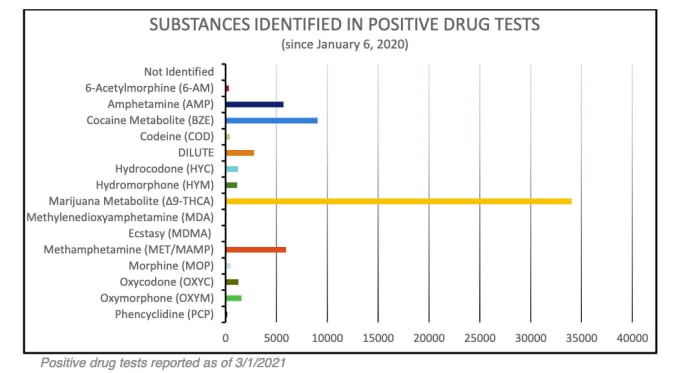
Marijuana is by far the most common illegal drug found in driver drug tests.
Graph: FMCSA Drug & Alcohol Clearinghouse Report
4. Understand reasonable suspicion and actual knowledge
“A carrier reporting through the clearinghouse must do so deliberately and with knowledge of what they’re doing,” Childress says. One area where motor carriers are submitting false information is in not understanding the definition of “actual knowledge."
Childress says the FMCSA has indicated the removal of incorrect actual-knowledge reports from the clearinghouse is a time-consuming process that can be avoided.
“You’ve got to be sure on actual knowledge,” he says, “because not only have civil penalties increased, but motor carriers also have the risk of having a driver file a lawsuit in the instance of improper reporting of actual knowledge if the driver can't get a job because of a motor carrier's reporting actual knowledge improperly.”
The line between reasonable suspicion and actual knowledge can seem blurred, he says, and both can cause problems for fleets that don’t handle them correctly.
“If you’re not properly trained to identify reasonable suspicion, you should not be sending a driver for reasonable-suspicion testing," Childress says. “Motor carriers must have an individual trained on reasonable suspicion making the determination.”
If a trained person believes a driver is acting impaired, he or she can initiate a reasonable suspicion testing. But that’s not the same as “actual knowledge.”
“Actual knowledge” is defined in 382.107 and means that an employer has knowledge that a driver has used alcohol or controlled substances based on the employer's direct observation of the employee, information provided by the driver's previous employer(s), or a traffic citation for driving a CMV while under the influence.
Direct observation as used in this definition, says FMCSA, means “observation of alcohol or controlled substances use” while a driver is subject to performing a safety-sensitive function, “and does not include observation of employee behavior or physical characteristics sufficient to warrant reasonable suspicion testing.”
Childress recommends that fleet drug- and alcohol-testing policies provide detail on actual knowledge, what it is, and some examples of when actual knowledge is or isn't present.
Another thing to put in an internal drug and alcohol policy to avoid incorrect reporting is an approval process for reporting to the clearinghouse, Childress suggests. “Reporting to the clearinghouse isn’t terribly common, but it has the potential for big impacts to the carrier and the driver. Each time reporting is necessary, it may be good to have a few sets of eyes on the information, particularly when submitting actual knowledge.”
Policies also need to include the company’s policy on self-reporting as an exception to actual knowledge, he said. The self-reporting exception to actual knowledge cannot be used unless 382.121 is followed precisely.
“Say a driver comes to work and before the driver performs any safety-sensitive functions the driver says, ‘Hey, I’ve had some alcohol.’ As long as the motor carrier complies with 382.121, the driver doesn’t have to be subject to all of the typical consequences of this prohibited conduct. The driver would be permitted to go through a return to duty process.”
However, in order to do that, a motor carrier must have a written policy that explains its use of that exception and satisfies the requirements found in 382.121.
5. Consider return-to-duty policies
There’s a widespread perception in the industry that once a driver tests positive for a prohibited substance, he might as well hang up his CDL. But that doesn’t have to be the case, and given the driver shortage, motor carriers should look at hiring drivers who have successfully completed the DOT’s return-to-duty process.
A Failed Drug Test Doesn't Have to be the End of the Road for Truck Drivers
“This year, we’ll start be able to start measuring the success of return-to-duty programs as drivers begin completing their follow-up testing plans,” says Scopelitis’ Garney. “A driver typically needs to take a minimum of six follow-up tests over a 12-month period to be fully requalified to drive. We’ll keep a close eye on that as we continue to evaluate the clearinghouse’s effectiveness.”
Garney adds that the percentage of drivers who are returning to the industry after a drug or alcohol violation is consistently improving.
“Of the 55,901 drivers declared ineligible [at the end of 2020], almost 8,000 (14%) have returned to the wheel of a truck and another 7,500 are eligible for return to duty testing. This is up from only 5% of drivers who had passed the return-to-duty test when data was first released in June 2020. It’s heartening to see this trend continue because it means drivers are committed to their craft and willing to overcome adversity to keep trucking.”
One figure of concern, looking at the latest clearinghouse numbers through February, is that more than 38,000 of drivers who had violations – 64% – have not even started the return-to-duty process.
“The driver shortage is unfortunately being exacerbated by what we all agree is a great program in the clearinghouse,” Childress says. “It’s appropriately tracking drug and alcohol violations, which we agree is positive.”
One problem, he says, is that while there is a return-to-duty process that can allow drivers with violations to go through documented treatment and testing and become qualified to drive again, many drivers and carriers aren’t taking advantage of it.
“The return to duty process can be a little onerous, but carriers shouldn’t shy away from that process. It’s not terribly complicated.”
The return-to-duty process is time-consuming for drivers, and Childress believes that more drivers will be available to re-enter the industry once they get through it – if carriers will hire them. “Carriers shouldn’t automatically shy away from a driver completely if they’re had some type of violation,” Childress says.
In their drug and alcohol policies, motor carriers should consider including how they will approach the return-to duty process. “That’s a way to make sure, when you do hire a driver who’s gone through the return-to-duty process and is later involved in an accident, the motor carrier can demonstrate the policy was in place and that it was followed.”
That policy can set more stringent requirements for drivers beyond what’s required in the DOT-required return-to-duty process.
Another suggestion is that if you’re going to have a policy that sets forth the hiring of drivers who have been through a return-to-duty process, make sure every dispatcher or manager who interacts with drivers is trained on reasonable suspicion.
In fact, he says, “I think every motor carrier would do well to make that a best practice.” It’s a one-time training and there are many third parties that offer it.
“What’s important is to store those credentials and make sure you can produce them in the event of a safety audit. The FMCSA has always seemed somewhat impressed by carriers that can provide a big file of folks trained on reasonable suspicion, because it shows the carrier is buying in to safety and looking to identify folks that are abusing substances. Little things like that can demonstrate a carrier that is on top of compliance vs. a carrier who is not.”
Originally posted on Heavy Duty Trucking
More Management

How to Build a Better Driver Training Program
Ready to boost up your school bus instructor training? Here’s how to pick the right talent and improve recruitment, retention, and safety.
Read More →
CALSTART and Forth Combine to Form Catalyst Mobility
The new name represents a renewed vision for the nonprofit focused on advancing clean, equitable, and affordable transportation solutions that move people and goods.
Read More →
What Makes a Great School Bus Driver Trainer?
Choosing the right school bus driver trainer takes more than experience. Learn six keys to selecting and developing trainers and evaluating program effectiveness.
Read More →


School Bus Contractors Expand Through New Deals, Acquisitions & Partnerships
STA's Canadian division acquires Ontario-based G&L Stevenson Transport while Durham School Services adds a new district contract in California, First Student adds a New Jersey contract, and Minnesota Coaches acquires Halo Transportation.
Read More →
Logan Bus Company Rolls Out AI Phone System for NYC School Bus Families
A summer pilot found that AI agents could handle most routine calls, freeing up time for customer service staff to focus on emergencies and complex family concerns.
Read More →
From Intent to Impact: What I Learned About Leadership from TAPT
A Texas transportation supervisor shares lessons on self-awareness, accountability, managing stress and building trust — and why investing in leadership development matters at every stage of your career.
Read More →
NAPT Names 2026 Award Recipients, Hall of Fame Inductee
Who earned national recognition for their work in student transportation? This year, NAPT named five recipients of its 2026 awards for service, safety, and leadership, plus its newest Hall of Famer.
Read More →
2026 State of Student Transportation Report
Driver shortages. Rising costs. Growing safety expectations. More data, but not enough time to act on it. The 2026 State of Student Transportation Report reveals what transportation leaders say is putting the most pressure on their operations—and where they’re investing next. See how your priorities compare.
Read More →
How to De-Escalate an Angry Person: 5 Steps for Handling Workplace Conflict
What makes emotions run high, and how should you handle an angry colleague or parent? Follow these steps for staying calm, listening, showing empathy, and resolving conflict.
Read More →
What Readiness Looks Like This School Year
Learn about the challenges shaping the 2026–2027 school year, from persistent driver shortages and budget pressure to technology and readiness gaps. See how school districts are responding and adapting in Zonar’s 2026 Back-to-School Readiness Report.
Read More →