




Team stays proactive to maintain safe service
From its school bus maintenance to its driver training, the transportation employees at Forest Hills Public Schools in Grand Rapids, Mich., look ahead and analyze information to identify potential problems or areas that need improvement.

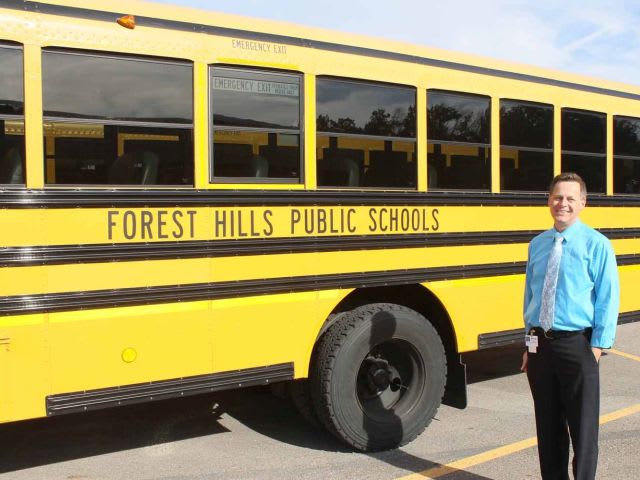
Darryl Hofstra has been Forest Hills Public Schools’ supervisor of transportation since 2004, a role he’s proud to hold. He says it is a premier district in the Grand Rapids area and in the state of Michigan.
For the transportation team at Forest Hills Public Schools in Grand Rapids, Mich., being proactive is the name of the game in order to get students to and from school safely.
“It’s about looking at data and making data-driven decisions,” Supervisor of Transportation Darryl Hofstra says. “It’s about identifying potential problems and eliminating them ahead of time.”
A case in point is maintenance of the district’s 80 school buses, which are on a 12-year replacement cycle. In months when salt is used on the roads, buses are brought in every two weeks to be washed to help prevent corrosion from the salt, which ultimately extends the service of the buses.
Buses are also brought in to the shop every 3,000 miles for a safety inspection and a general overview of any service that needs to be performed. Hofstra says the preventive maintenance program is comprehensive, and one thing he’s adamant about and has worked with his technicians on is addressing issues with buses before they become a problem.
“We do everything we can to mitigate breakdowns in the field because it causes a lot of problems for everyone,” Hofstra says. “One example is, if we determine that there’s a common thing that’s happening and we’ve seen it routinely with a particular model year or style of bus, we begin identifying why it’s happening and take steps to correct it proactively.”
This rigorous approach to maintenance has paid off. The district has finished in the 95% to 100% category for school bus inspections performed by the Michigan State Police’s Bus Inspection Unit since Hofstra joined the district in 2004.
In addition, when one of the district’s buses caught fire while a driver was on a route in November, Hofstra immediately took action. The nine buses in the fleet that are of the same year and model as the bus that caught fire were removed from service, and as of mid-December, they remained out of service.
Investigators determined that the main power distribution module under the hood of the bus was the point of origin and the cause of the fire, but as of mid-December, the reason for the component’s failure was not yet known.
Hofstra says the remaining nine buses in the fleet of that same year and model have been fully inspected, and the power distribution module in those buses has been replaced by the manufacturer utilizing its dealer’s master technician.
(Hofstra hoped to be able to return the nine buses to service in early January once documentation from the manufacturer and dealer confirmed that the buses are safe to operate.)
[PAGEBREAK]
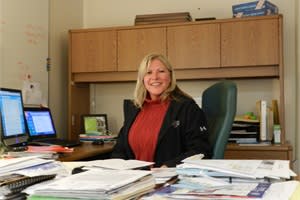
Lead Trainer Leslie Bramble says the operation’s training program is thorough, and that some of its standout components include instruction on bus components and on the state’s laws that apply to school buses. “Darryl pushes all of us to be very conscious of training,” she says.
Continuous improvement for drivers
Hofstra praises the driver whose bus caught fire for acting quickly and safely evacuating the students on board after she noticed that something was wrong with the bus.
“The [emergency response] training that we’ve provided has paid off,” he says. “With any situation like that, there are always things to look at to determine if there are things that we need to pay more attention to — we’re not finding that in this case, fortunately. I did have a de-briefing meeting with my entire staff a few days after the incident to enable them to be fully informed and to ask questions.”
Hofstra believes it’s important to be proactive in school bus driver training. In addition to participating in evacuation drills with students, Forest Hills Public Schools’ drivers undergo two days of in-service training every year, and in preparing for the instruction, Hofstra identifies areas that the drivers need to work on.
“If I’ve seen a spike in a certain type of at-fault crash within the fleet, I’ll develop training around that item,” he says as an example.
He also has a couple of drivers on staff who have completed Michigan’s Train-the-Trainer program, and those individuals work with school bus driver applicants, helping them to complete behind-the-wheel training, pass the CDL test, etc.
Lead Trainer Leslie Bramble has completed the Train-the-Trainer program and has incorporated information from it into her training program for drivers. She says the training is thorough, and some of its standout components include instruction on bus components and on the state’s laws that apply to school buses.
“Darryl pushes all of us to be very conscious of training,” she says.
Safety signal for bus riders
Also among Forest Hills’ bus drivers are several who have received specialized training and who have been selected to serve on a safety team to instruct students in kindergarten through sixth grade on the operation’s bus safety rules and procedures, and to teach them about the safety features of school buses.
As part of the safety training program, the elementary school students receive a school bus safety coloring book that was designed and printed by the Michigan Association for Pupil Transportation (MAPT).
In addition, a pupil transportation statute in the state of Michigan requires that if a school district uses a signal given by the bus drivers to notify students when it is safe for them to cross the street prior to boarding a school bus or after disembarking, it must be a universal signal used by all the drivers.
There isn’t a requirement on what the signal must be, so at Forest Hills Public Schools, Hofstra says the signal the transportation team came up with reminds him of Jeannie in the TV show “I Dream of Jeannie,” when she crossed her arms in front of her to grant a wish.
“The drivers go to the bus window and close one arm down on the other in the direction the students will be walking,” he explains.
The district transports about 6,000 students. Bus service for Forest Hills Public Schools’ special-needs students is contracted to nearby Kent ISD, a regional educational service agency, under a consortium-based agreement. Some special-needs students are mainstreamed on buses with their regular-education peers.
Under the agreement with Kent ISD, Forest Hills Public Schools’ transportation department provides transportation for students to Kent ISD’s specialized programs, and the department is reimbursed for the service.
[PAGEBREAK]
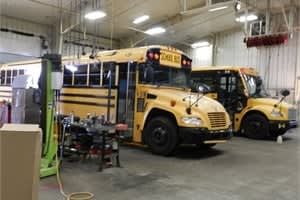
In months when salt is used on the roads, buses are brought in every two weeks to be washed to help prevent corrosion from the salt, which ultimately extends the service of the buses.
Active pupil transportation career
Hofstra’s pupil transportation career has spanned 25 years, and he has held nearly every position possible, from school bus driver to dispatcher to trainer, and he also did some bus maintenance and office work early in his career.
He became a bus driver in 1988 while he was working at Gull Lake Community Schools in Richland, Mich. He then moved to Portage (Mich.) Public Schools, where he took on many roles in addition to school bus driver, and at Lansing (Mich.) School District, he served as transportation supervisor until 2004.
“Forest Hills is one of the premier school districts in our area and in our state, so I was very pleased and proud to be hired as their supervisor of transportation,” Hofstra says.
Hofstra has also been active in Michigan’s pupil transportation community: He’s been an MAPT member for more than 15 years, and he’s served in various capacities in the association, from a regional representative to a board member to, most recently, president. (He’s now immediate past president.)
He says he likes his staff to get involved with MAPT activities as much as possible, so he often sends his technicians and school bus driver trainers to courses offered by the association. Hofstra says that the association does not currently offer a lot in terms of courses for school bus drivers, but that is a goal.
“While I was in office [as president of MAPT], one of the things we talked about is offering more training for bus drivers,” he says.
Seeking out future leaders
Hofstra also acknowledges the value of providing learning opportunities for young people who are interested in working in pupil transportation, either at an administrative level or in maintenance, especially since industry veterans are retiring.
One way to recruit future yellow bus leaders is through internships. Forest Hills Public Schools doesn’t currently offer transportation- or maintenance-related internships for students, but Hofstra did mentor a student several years ago.
The student — named Houston — spent time learning about the pupil transportation industry from Hofstra from the time he was in seventh grade to the end of high school. Houston, now 21, still stays in touch with Hofstra, who says Houston is interested in becoming a transportation director.
“It’s important, and it’s something that more of us should focus on — myself included,” Hofstra says of taking time to nurture interest in pupil transportation.
He notes that attending job fairs is another way that he and his colleagues can reach out to students and others to inform them about working in the industry.
Fleet Facts
School buses: 80
Transportation staff: 89
Students transported: 6,000
Schools served: 14
Area of service: 65 square miles
Student safety signal video
School bus driver Dick Teft demonstrates and explains the signal used at Forest Hills Public Schools to help students safely cross the street prior to boarding or after disembarking the school bus. To view the video, go here.
More Management

How to Build a Better Driver Training Program
Ready to boost up your school bus instructor training? Here’s how to pick the right talent and improve recruitment, retention, and safety.
Read More →
CALSTART and Forth Combine to Form Catalyst Mobility
The new name represents a renewed vision for the nonprofit focused on advancing clean, equitable, and affordable transportation solutions that move people and goods.
Read More →
What Makes a Great School Bus Driver Trainer?
Choosing the right school bus driver trainer takes more than experience. Learn six keys to selecting and developing trainers and evaluating program effectiveness.
Read More →

School Bus Contractors Expand Through New Deals, Acquisitions & Partnerships
STA's Canadian division acquires Ontario-based G&L Stevenson Transport while Durham School Services adds a new district contract in California, First Student adds a New Jersey contract, and Minnesota Coaches acquires Halo Transportation.
Read More →
Logan Bus Company Rolls Out AI Phone System for NYC School Bus Families
A summer pilot found that AI agents could handle most routine calls, freeing up time for customer service staff to focus on emergencies and complex family concerns.
Read More →
From Intent to Impact: What I Learned About Leadership from TAPT
A Texas transportation supervisor shares lessons on self-awareness, accountability, managing stress and building trust — and why investing in leadership development matters at every stage of your career.
Read More →
NAPT Names 2026 Award Recipients, Hall of Fame Inductee
Who earned national recognition for their work in student transportation? This year, NAPT named five recipients of its 2026 awards for service, safety, and leadership, plus its newest Hall of Famer.
Read More →
2026 State of Student Transportation Report
Driver shortages. Rising costs. Growing safety expectations. More data, but not enough time to act on it. The 2026 State of Student Transportation Report reveals what transportation leaders say is putting the most pressure on their operations—and where they’re investing next. See how your priorities compare.
Read More →
How to De-Escalate an Angry Person: 5 Steps for Handling Workplace Conflict
What makes emotions run high, and how should you handle an angry colleague or parent? Follow these steps for staying calm, listening, showing empathy, and resolving conflict.
Read More →
What Readiness Looks Like This School Year
Learn about the challenges shaping the 2026–2027 school year, from persistent driver shortages and budget pressure to technology and readiness gaps. See how school districts are responding and adapting in Zonar’s 2026 Back-to-School Readiness Report.
Read More →