




Streamlining Spec’ing to Get the Best Bus Fit
Gathering a team of staff members and coming up with a list of must-have items, as well as staying familiar with FMVSS and state regulations, can help save time and effort when working with the dealer to build the optimal bus for your operation.

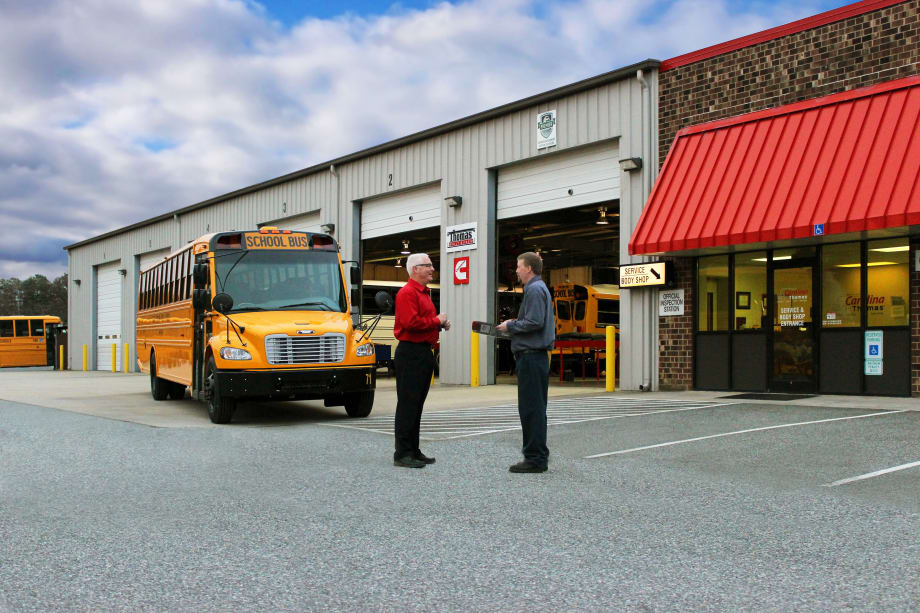
It’s recommended that transportation directors check in with the dealer ahead of time on existing specs that already match their criteria. Dealers can also help word specs so they don’t conflict with federal or state requirements. Shown here is dealer Carolina Thomas Buses.
Spec’ing school buses can be complicated, but forming a team of staff members who work with the buses regularly to create a list of must-have items, checking in with a dealer on existing specs, and being aware of state and national specifications can make the process go much more smoothly and help secure the optimal bus for your operation’s needs.
Gather team to determine needs, wants
Dealers say that the transportation director or shop foreman should be prepared with a specific list of features they want and need and any problems they need to solve.
To come up with a thorough list, assemble a team of staff members who regularly work with the buses — technicians, drivers, parts department personnel and trainers — for feedback on equipment, such as seating, types of mirrors, LED lights and heaters, that have worked best and have the longest lifespan, says Ricky Stanley, compliance engineering state specifications coordinator for Thomas Built Buses.
Additionally, list what services are provided, such as transportation for athletic competitions or for special-needs students, to determine extra equipment needed, such as wheelchair lifts, seat belts or a luggage base, says Dan Kobussen, owner of Kobussen Buses Ltd., who is on the writing committee for vehicle specification for the National Conference on School Transportation (NCST).
The team should also take into consideration factors such as environmental requirements dictated by a cold or hot climate and route size.
It’s also important to note when spec’ing alternative-fuel buses that many states currently do not have requirements beyond Federal Motor Vehicle Safety Standards (FMVSS), Stanley says.
It is recommended that specifications for propane-powered buses include compliance with Canadian safety standard CMVSS 301.1, which deals with propane fuel system integrity, says Bruce Miles, engineering manager, policy and validation, for Blue Bird Corp. The fuel systems on propane buses should also comply with National Fire Protection Association (NFPA) 58, and, on compressed natural gas (CNG) buses, NFPA 52. However, the NFPA codes are not federal requirements, he notes.
Often with alternative-fuel buses, vehicle range is important, Stanley points out.
“Many vehicles have a certain size tank, and some school districts may need buses to run a certain distance on a route,” he says. “If you don’t have a large enough fuel tank to make that distance, then that could be critical.”
Miles also advises against starting with diesel specs when creating alternative-fuel bus specs because of equipment differences. For example, diesel buses usually have a specification for a fuel sender access plate in the floor. However, propane and CNG buses don’t need that plate because there isn’t a fuel sender in the tank.
Transportation directors simply need to know what they’re looking for, advises Jeff Reitz, president of Central States Bus Sales. “They don’t have to know how to get there. It’s the dealer’s responsibility to figure that out. If they want a smoother ride, [we can] find the suspension to give that to them. If they can clearly state their objectives, that helps.”
“They’re the ones that are living in that operation. They know what’s going to work best for them,” Reitz adds. “We can make recommendations we’ve seen [work] industry-wide, but we don’t know the needs associated with that particular school’s transportation.”
Get familiar with state, federal requirements
Ensuring that the items on the list are in compliance with state regulations can save some time when meeting with the dealer. The transportation director may want to contact their state director to make sure their list meets all the state requirements, Stanley advises.
While manufacturers typically have departments that focus on federal and state standards, it is helpful to be aware of specifications, particularly regional differences, says Mash Angolkar, chief engineer for IC Bus.
Most importantly, customers should work closely with their dealer and manufacturer to verify that a new feature request, such as seating or lighting, doesn’t interfere with a regulatory standard; those trump everything else. For example, FMVSS 222 addresses minimum and maximum seat spacing.
“[Seats] can’t be placed closer together or farther apart than a specified distance,” Miles says. “It would defeat the purpose of FMVSS 222: compartmentalization.”
All school bus specifications should be written with the NCST’s National School Transportation Specifications and Procedures document as a model, adds Miles, who served on the steering committee for NCST and the technical advisory committee. If they are not mandated in the state specifications, the specs should include a statement that basically says the bus will meet all NCST requirements if not in conflict with state specs.
Required specs are impacted every five years by the NCST, which assembles representatives from every state to vote on changes to its document. The document contains many standards designed to fit every state’s needs.
NCST met most recently in May in Des Moines, Iowa, to review the 2010 version of the document and recommend changes.
Changes made in the School Bus Body and Chassis Specifications section of the 2015 document that will affect specifications include the requirement for the driver’s seat belt to be a high visibility contrasting color, Miles says. Additionally, changes were made to include the new Ford Transit Type A chassis; incorporate alternative-fuel requirements into the body and chassis specifications; and allow a left side entrance door for buses using one-way streets.
Changes made in the Specially Equipped School Bus Specifications section include the requirement to supply an adjustment device as part of the occupant restraint system if the upper torso belt anchorage is higher than 44 inches measured from the vehicle floor; and recommending installation of an emergency evacuation device that can withstand at least a 300-lb. load when used as an emergency stretcher or drag.
The revisions adopted in May are being edited and are expected to be published in the document by early 2016, says Murrell Martin, chairman of the 16th NCST and Utah state director of pupil transportation. There is also an interim process for congress members to submit changes for review between now and 2020, when NCST will meet again.
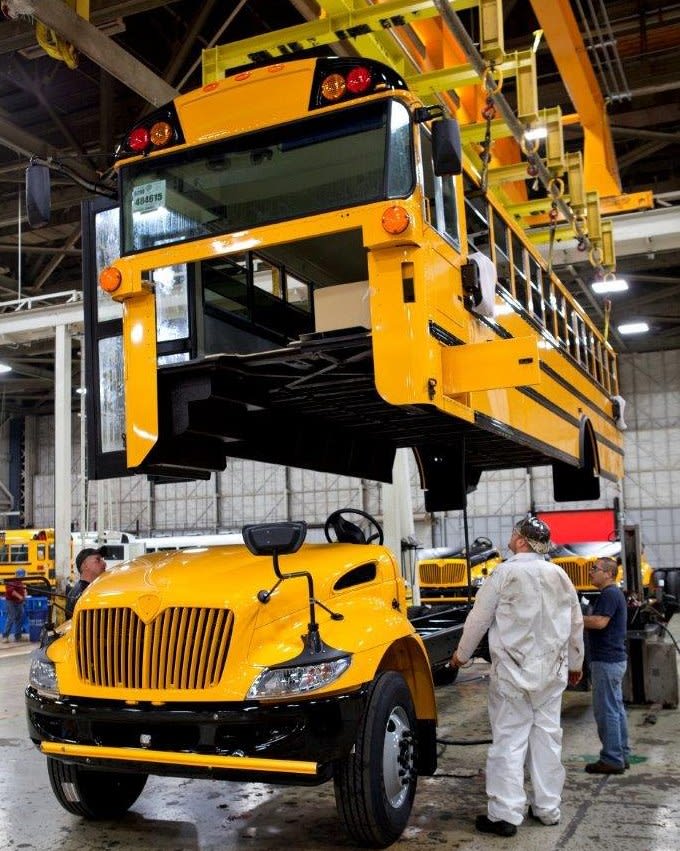
Manufacturers such as IC Bus often come up with new solutions that can benefit customers and communicate those to their dealers. Shown here is an IC Bus CE Series being made for a customer in Texas.
Do a preliminary dealer check-in
After creating a list, directors should check in with their dealer ahead of time and discuss their goals and criteria, advises Tom Schaaf, general manager of Carolina Thomas Buses. Dealers can then check if another customer already met those goals successfully, saving time in writing specs.
Reitz agrees, and says Central States offers pre-written specs to help customers so they don’t feel like they have to “reinvent the wheel.”
A dealer’s specification personnel can also recommend appropriate wording for special equipment or features that the customer wants, such as for TVs or overhead luggage for multi-function school activity buses, to prevent conflicts with FMVSS or state requirements, Reitz adds.
Dealers can also recommend wording to allow the use of equipment that is already available from manufacturers, and avoid creating unique equipment installations whenever possible. That saves money, Miles says.
“Unique specifications are more expensive to produce because special installations take extra personnel and time, reducing production efficiency,” he explains. “If unique equipment installations are necessary, knowledgeable specification personnel can recommend the appropriate wording to allow the OEMs the necessary design flexibility.”
Update existing specs
It’s also helpful to have the team review existing specifications and weed out the outdated ones; working with outdated specs is a common hurdle, Miles says.
“Some customers may have a spec that they started using 20 years ago,” he says. “No one remembers why it’s there, but it stays in there and keeps improvements from happening.”
For example, many older specifications require an over-rated front axle and front suspension. That subjects passengers to a stiffer ride than necessary and “the bus body structure is subject to much greater forces, possibly resulting in higher maintenance costs over the life of the bus,” Miles explains.
Additionally, unnecessary requirements can impose unintended limits on OEM design flexibility and possibly restrict the availability of other desired equipment, he adds.
Brainstorm more questions for dealers
In addition to finding out from the bus dealer what specs are already out there, it’s good to ask for anything else that came about in a team brainstorm.
Customers should never avoid asking questions, because the manufacturer may already have a solution, even if it’s not readily apparent, says Justina Morosin, vice president of sales for IC Bus.
For example, IC Bus now offers a solution for loose garbage cans on buses.
“Some drivers have come up with unique solutions, but IC Bus actually has a garbage can that is enforced right into the structure of the bus so it doesn’t move as the bus moves,” Morosin explains.
More Management

How to Build a Better Driver Training Program
Ready to boost up your school bus instructor training? Here’s how to pick the right talent and improve recruitment, retention, and safety.
Read More →
CALSTART and Forth Combine to Form Catalyst Mobility
The new name represents a renewed vision for the nonprofit focused on advancing clean, equitable, and affordable transportation solutions that move people and goods.
Read More →
What Makes a Great School Bus Driver Trainer?
Choosing the right school bus driver trainer takes more than experience. Learn six keys to selecting and developing trainers and evaluating program effectiveness.
Read More →


School Bus Contractors Expand Through New Deals, Acquisitions & Partnerships
STA's Canadian division acquires Ontario-based G&L Stevenson Transport while Durham School Services adds a new district contract in California, First Student adds a New Jersey contract, and Minnesota Coaches acquires Halo Transportation.
Read More →
Logan Bus Company Rolls Out AI Phone System for NYC School Bus Families
A summer pilot found that AI agents could handle most routine calls, freeing up time for customer service staff to focus on emergencies and complex family concerns.
Read More →
From Intent to Impact: What I Learned About Leadership from TAPT
A Texas transportation supervisor shares lessons on self-awareness, accountability, managing stress and building trust — and why investing in leadership development matters at every stage of your career.
Read More →
NAPT Names 2026 Award Recipients, Hall of Fame Inductee
Who earned national recognition for their work in student transportation? This year, NAPT named five recipients of its 2026 awards for service, safety, and leadership, plus its newest Hall of Famer.
Read More →
2026 State of Student Transportation Report
Driver shortages. Rising costs. Growing safety expectations. More data, but not enough time to act on it. The 2026 State of Student Transportation Report reveals what transportation leaders say is putting the most pressure on their operations—and where they’re investing next. See how your priorities compare.
Read More →
How to De-Escalate an Angry Person: 5 Steps for Handling Workplace Conflict
What makes emotions run high, and how should you handle an angry colleague or parent? Follow these steps for staying calm, listening, showing empathy, and resolving conflict.
Read More →
What Readiness Looks Like This School Year
Learn about the challenges shaping the 2026–2027 school year, from persistent driver shortages and budget pressure to technology and readiness gaps. See how school districts are responding and adapting in Zonar’s 2026 Back-to-School Readiness Report.
Read More →