




Speakers Inspire, Challenge Pupil Transporters in Richmond
A headline-grabbing statement on seat belts, a man who overcame great odds by learning to walk again, and a creative school bus safety play were among the highlights of the industry conferences in November.
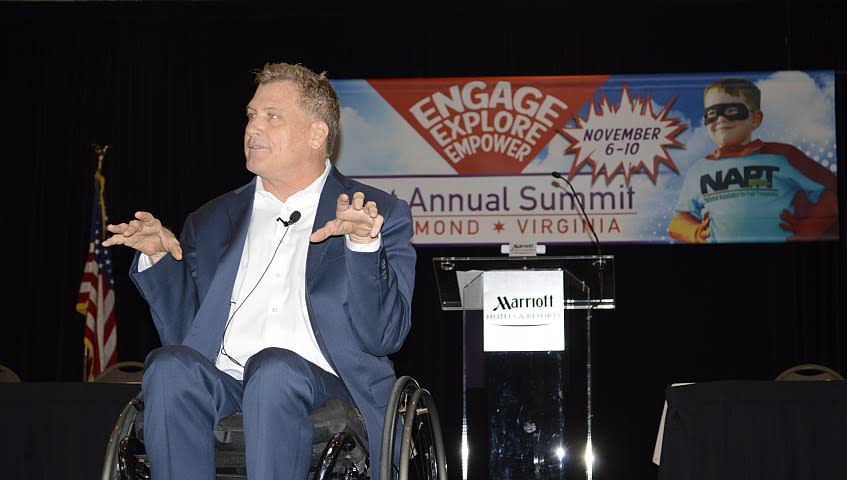
Scott Burrows told NAPT and NASDPTS members about the car accident that left him paralyzed from the chest down and how he worked hard to regain use of his limbs. “You can choose to be bitter, or you can choose to be better,” he said.
Scott Burrows told NAPT and NASDPTS members about the car accident that left him paralyzed from the chest down and how he worked hard to regain use of his limbs. “You can choose to be bitter, or you can choose to be better,” he said.
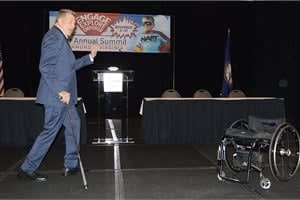
After speaking from his wheelchair for much of his presentation, Burrows surprised the audience by standing up and walking — which a doctor had told him he wouldn’t be able to do again after the accident. “Never let something that someone else believes paralyze you from achieving those things in your life that you might be able to achieve,” Burrows said.
Those steps will include further research into the issue — for example, studying jurisdictions that are currently using three-point belts on school buses — and trying to determine how to overcome the financial barriers — three-point belts currently add about $7,000 to $10,000 to the cost of a large school bus.
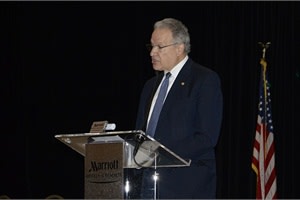
Mark Rosekind, administrator of the National Highway Traffic Safety Administration, made national headlines for his presentation, in which he said his agency’s new position is that “every child on every school bus should have a three-point seat belt.”
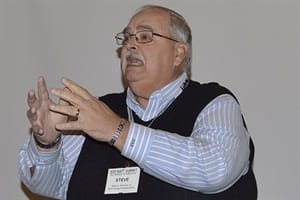
Steve Simmons, transportation director at Columbus (Ohio) City Schools, emphasizes to
an audience of many new
transportation directors
the importance of turning
school board members into allies.
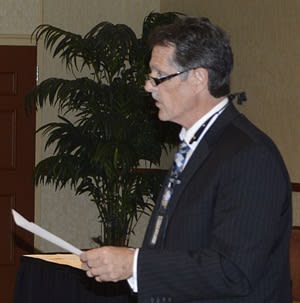
NASDPTS President Leon Langley said that his association is encouraged by NHTSA’s statement that school bus passengers should have three-point belts.
NASDPTS supports feds' new 3-point belt policy
State pupil transportation directors who convened in Richmond expressed support for the National Highway Traffic Safety Administration (NHTSA)’s new position on three-point seat belts for school buses.
NHTSA Administrator Mark Rosekind gave an address to industry groups gathered in Richmond on Nov. 8, saying that the agency now believes that “every child on every school bus should have a three-point seat belt.”
Rosekind also said that while school buses are still the safest form of student transportation, seat belts can make them safer. “The position of the National Highway Traffic Safety Administration is that seat belts save lives,” he said. “That is true whether in a passenger car or in a big, yellow bus.”
Leon Langley, president of the National Association of State Directors of Pupil Transportation Services (NASDPTS), responded to Rosekind’s remarks in a statement from NASDPTS during the association’s conference.
“We are encouraged by the administrator’s remarks about the agency’s position,” Langley said. “It supports our position paper, ‘The Equipping and Use of Passenger Lap/Shoulder Belts in School Buses, February 2014,’ and is consistent with it.”
In that position paper, NASDPTS endorsed three-point belts for school buses, saying that they “should be encouraged as an option when considering new bus original equipment specifications.”
In Richmond, NASDPTS also highlighted Rosekind’s pledge that “NHTSA will seek to use all the tools at our disposal to help achieve” the goal of three-point belts for all school bus passengers.
“We believe this support from NHTSA will trigger discussions by federal, state and local agencies about how resources can be allocated to begin putting three-point belts in new school buses throughout the nation,” Langley said.
The NASDPTS conference also offered presentations by other federal officials, including David Cooper from the Transportation Security Administration, Larry Minor from the Federal Motor Carrier Safety Administration, Jennifer Keller from the Environmental Protection Agency and Thomas Barth from the National Transportation Safety Board.
Also among the NASDPTS sessions were discussions on such safety topics as student dragging incidents, bus fires and stop-arm violations.
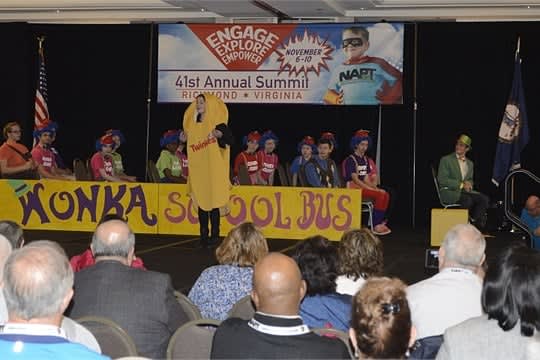
Theater students from Montgomery County (Va.) Public Schools present a Willy Wonka-themed school bus safety play that they performed as part of Love the Bus month in February.
See more conference highlights
To view more sights from the Richmond, Virginia, conferences, such as the Willy Wonka-themed school bus safety play presented by local high school theater students, shown left, go here.
More Management

EverDriven Launches Route Consolidation Calculator to Estimate Diesel Savings
As diesel prices hit record highs, the largest alternative transportation provider says a 10% route consolidation could save a 120-route district more than $78,000 a year in fuel alone.
Read More →
Zum Secures Continued Financing Support for School Bus Expansion
Generate Private Credit has financed approximately $75 million in school bus deployments across three states, supporting more than 500 buses as Zum expands across the county.
Read More →
Beyond Discipline: A Different Approach to Student Behavior on the Bus
After implementing a dean of students program in Oregon, North Clackamas is seeing positive improvements. Here’s how it worked. The Route is brought to you by IC Bus.
Read More →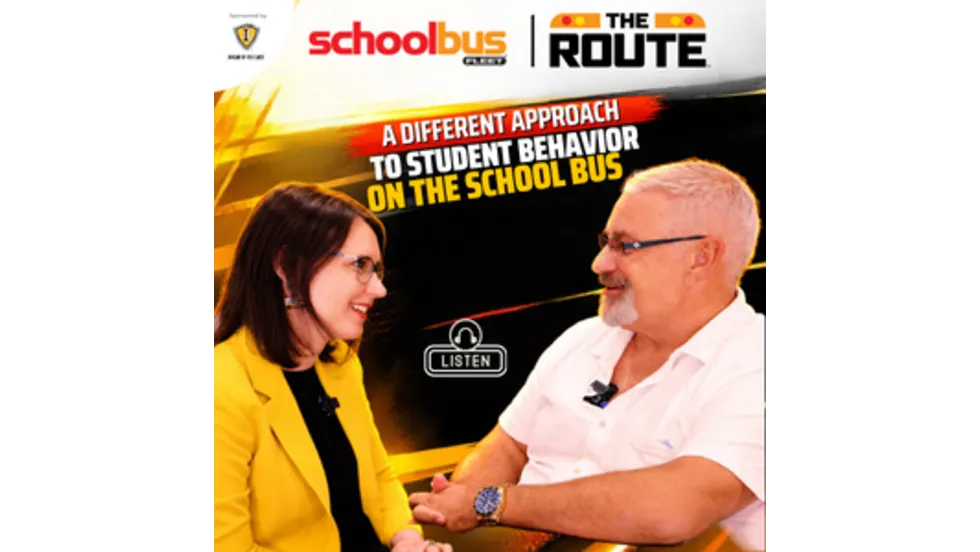
A Dean of Transportation's Different Approach to Student Behavior on the School Bus
After implementing a dean of students program in Oregon, North Clackamas is seeing positive improvements on the bus. Here’s how it worked.
Read More →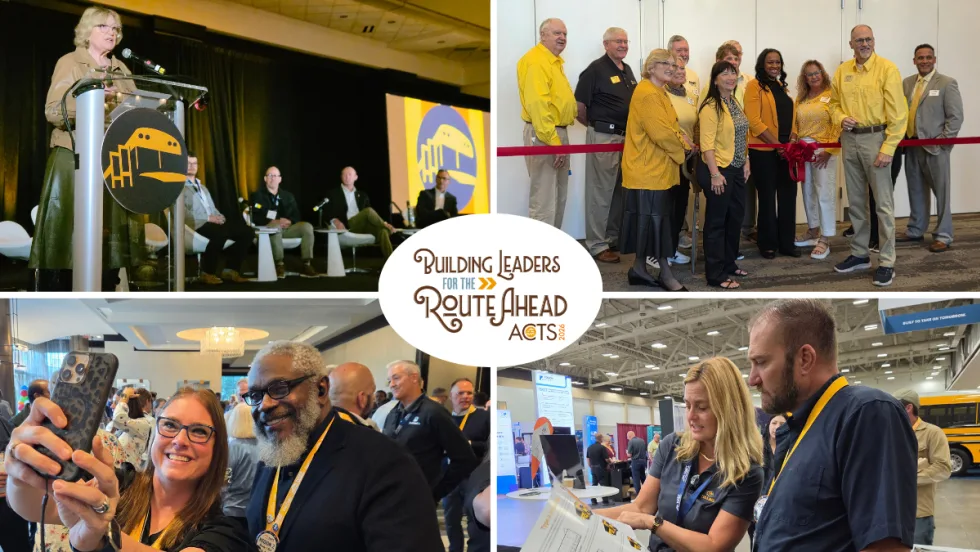
Inside NAPT ACTS 2026: Highlights from Louisville
From federal updates and student behavior strategies to new school bus technology and industry awards, see highlights from NAPT ACTS 2026 in Louisville.
Read More →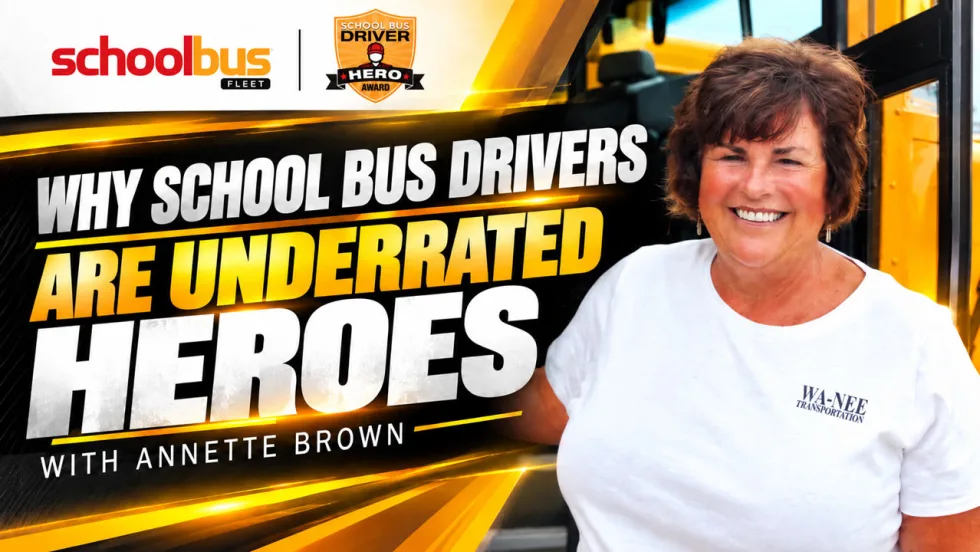
Meet the 2025 School Bus Driver Hero Winner: Annette Brown
We caught up with Wa-Nee Community Schools' Annette Brown on site at SBFX, where she was named the 2026 School Bus Driver Hero Award winner. Hear about her reaction, what she loves most about being a school bus driver, and more!
Read More →
Predictability Is Like Ketchup (According to 6-Year-Olds)
To students, a different school bus can feel like a full-blown crisis. One driver reflects on why familiar routines, showing up on time, and being reliably boring matter more than we think.
Read More →
Samsara Launches Free Driver Rewards Program
The new Driver Perks program gives eligible professional drivers access to discounts and offers without adding a cost for participating fleets.
Read More →
How Tax-Exempt Municipal Leases Can Help Finance School Buses
Let’s explore school bus financing options, including municipal leases, vendor payable accounts, and balloon payments, and how they can help stretch fleet budgets.
Read More →
Nominate Rising School Transportation Pros Under 40!
We’re searching for the next generation of leaders making an impact across the K-12 student transportation industry to recognize as SBF’s 2027 Trailblazers. Nominations are open now!
Read More →