




SBX Attendees Share Solutions for Driver Shortage, Student Discipline
The cost factors of alternative fuels and the transportation impact of school reform are also key topics at the 2018 edition of the event.

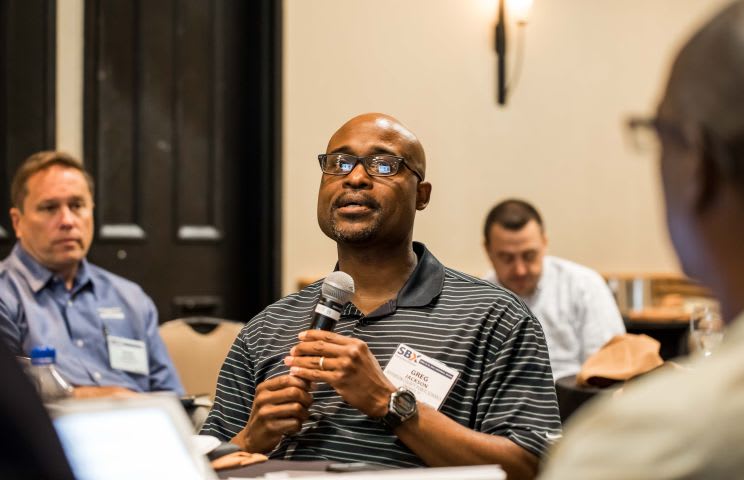
Greg Jackson of Jefferson County (Colo.) Public Schools discusses driver retention efforts.

Greg Jackson of Jefferson County (Colo.) Public Schools discusses driver retention efforts.
School bus driver shortage, alternative fuels, and student behavior on the bus were key topics of discussion at the 2018 School Bus eXchange (SBX).
The event, produced by the National Association for Pupil Transportation (NAPT) and School Bus Fleet, took place April 16 to 18 in Scottsdale, Arizona.
More than 30 public and private school bus operators and 25 supplier companies participated in the 2018 edition of SBX. The agenda included roundtable discussions, meetings between operators and suppliers, and a variety of networking functions.
Focus on School Reform
The event kicked off with a keynote address by Linda Bluth of the Maryland State Department of Education, a special-needs transportation expert and past NAPT president.
In a follow-up to her presentation at last year’s SBX, Bluth discussed the policies of U.S. Education Secretary Betsy DeVos, who is a proponent of school choice, charter schools, and vouchers to enable students to attend private schools with public funding.
Bluth noted that transportation has been found to be a barrier to school choice — for example, charter and magnet schools often don’t provide school bus service. If more parents choose to send their children to those types of nontraditional schools, one of the side effects could be that fewer students will ride school buses.
To illustrate the shifts in education that may have a significant impact on pupil transportation, Bluth cited a July 2017 article in the publication Reason:
“Luckily, school finance is becoming increasingly individualized, giving districts more flexibility when it comes to getting kids to school,” wrote author Tyler Koteskey, an education policy analyst at the Reason Foundation. “The conversation no longer needs to be centered on cities fixing the problem from the top down by buying and operating more school buses.”
Bluth said that stance undercuts the role of the school bus as the preferred method of getting students to and from school.
“For me, this alarming statement raises the issue of the future use of the yellow bus as we currently know it,” she said.
As she did last year, Bluth exhorted SBX attendees — and the industry in general — to find ways to contribute their expertise on safe transportation to the school reform efforts.
“Once again,” she said, “I want to reiterate how important it is for school transportation to establish itself as a respected contributor to school reform with a strong presence when discussions are occurring at national, state, and local community meetings.”
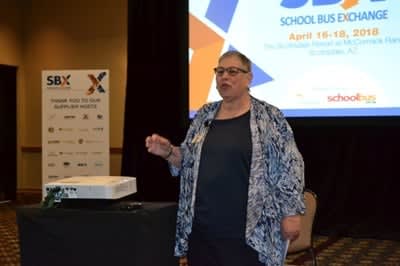
Linda Bluth of the Maryland State Department of Education gave a keynote presentation on school reform and led a session on student behavior.
Recruiting Solutions
In another SBX session, NAPT Executive Director Mike Martin led a discussion of school bus driver shortage, which remains a top challenge throughout the industry. Martin asked attendees what has been working for them when it comes to recruiting and retaining drivers.
Greg Jackson, executive director of transportation and fleet services for Jefferson County Public Schools in Colorado, said that one of his efforts related to driver retention has been aimed at improving student discipline. His department partnered with schools to implement a PBIS (positive behavioral intervention and supports)-type program. Jackson said that the program gives attention to good behavior rather than bad behavior, while recognizing that some students might need extra help in this area.
“We need to give them some support and put them in the right direction,” Jackson said.
Margarito Casillas, assistant director of transportation for Vail Unified School District in Arizona, said that he has worked to boost driver morale in his department by “doing some of the small things.” That has included attendance and retention bonuses, birthday cards signed by the whole administrative staff, and the formation of a committee called BUS (“Bring Us Solutions”) that is working to improve the culture of the department. Maintaining a strong relationship with the district’s HR team has also helped with driver recruitment and retention.
“We work well with the human resources department,” Casillas said. “I think that’s very key.”
Some SBX attendees noted the challenge of providing competitive pay. Tony Harris, transportation supervisor for Preston County Schools in West Virginia, said that the state Legislature sets salary levels for most districts’ bus drivers, which makes it tough to compete with employers that can offer higher wages.
“We’re losing drivers every day to the gas wells,” Harris said. “They’re starting out at $19 to $25 per hour. We’re starting just under $13 per hour [as of July].”
Michael Lowery, assistant safety director for Kobussen Buses Ltd. in Wisconsin, said that with unemployment as low as 2% in his county, the salary of a school bus driver isn’t going to be the major enticing factor that brings people to the job.
“We’re trying to find folks who want to make a difference,” Lowery said. “We’re encouraging drivers to develop their own stories about why they like to drive and stories about kids on their bus.”
For a recent school bus driver appreciation week, Kobussen gave their drivers pins. When worn out in the community, the pins can prompt conversations that may turn into recruiting opportunities.
“People see them with [the pins], and they share their stories,” Lowery said.
He noted that the company gives existing drivers a $500 bonus for recruiting new drivers after they’ve been employed for 60 days. Also, new hires get a $1,000 sign-on bonus after 60 days.
Maureen Heath, chief administrative officer for Southwestern Ontario Student Transportation Services in Canada, suggested that recruiting materials be developed at the state/province or national levels. The idea would be to provide resources that any operation could use to promote the value of being a school bus driver, so that “everyone’s not doing their own thing,” as Heath put it.
“There’s power in a broader voice,” she said.
“I agree with you wholeheartedly,” Martin said.

SBX attendees discuss challenges with student behavior on the bus during a roundtable session.
Assessing Alt-Fuels
Also at SBX, SBF General Manager James Blue led a panel session in which officials from Blue Bird, IC Bus, and Thomas Built Buses answered questions about alternative fuels, covering such issues as total cost of ownership, emissions, and fueling infrastructure.
Blue asked the panelists whether a business case can be made for investing in alt-fuel school buses even if grant funding can’t be obtained to support the purchase.
“That’s a difficult question,” said Jim Crowcroft, North American dealer and fleet sales manager for Thomas Built Buses. “Right now, if you do the math, it can be challenging to make the numbers work, but there are other intrinsic benefits of alternative fuels.”
Randy Ray, school bus sales director for IC Bus, said that the financial factor in alternative fuels depends on what happens with fuel prices, but so far propane is the best bet when it comes to recouping the extra investment in alt-fuel school buses.
“Generally, propane can pay for itself,” Ray said.
Rusty Mitchell, executive director of product marketing and planning for Blue Bird, said that there has been a “huge conversion rate over to propane” in recent years, with many fleets making the switch without any help from grants.
“You have many private contractors that have gone with propane,” Mitchell noted. “They have run the numbers, and it makes sense for them.”
On the funding front, the Volkswagen Environmental Mitigation Trust will provide states with a total of nearly $3 billion for projects to cut nitrogen oxide from large vehicles. During the SBX panel discussion, the OEM officials said that some states have been choosing to include school buses in their plans for the funds, while some are focusing on other types of vehicles, such as mass transit (in the case of Georgia) or off-road equipment (Illinois). California is doubling down on electric vehicles, with a proposed $130 million of its share of the funding to be used for acquiring electric school, transit, and shuttle buses.
“We’re losing drivers every day to the gas wells. They’re starting out at $19 to $25 per hour. We’re starting just under $13 per hour.” Tony Harris, transportation supervisorPreston County (W.Va.) Schools
Discussing Discipline
In another session, Linda Bluth engaged with SBX attendees on the subject of student behavior on the school bus. Bluth recommended that transportation directors promote the concept of the school bus being an extension of the classroom, with the same expectations for discipline and support from school administrators.
“Students need to know the consequences [of misbehavior],” she said. “Superintendents have to support that the principal is responsible for behavior on the bus.”
Meanwhile, transportation directors and managers should ride on buses a minimum of twice per year, Bluth said, and a show of hands indicated that most or all of the attendees in the room are doing so. Bluth also suggested having drivers regularly review surveillance footage “so that they see what’s happening on their bus.”
In many cases, more training is needed to equip school bus drivers and aides in dealing with behavioral challenges, Bluth noted, and the presence of surveillance systems doesn’t diminish that need.
“Too many school districts make this error,” she said. “They think when they have video cameras, that they can lessen the behavior training.”
SBX attendees also connected with school bus OEMs and suppliers during one-on-one meetings, group presentations, and networking functions. The annual event is free for the school bus operators who are selected to attend.
More Management
How to Build a Better Driver Training Program
Ready to boost up your school bus instructor training? Here’s how to pick the right talent and improve recruitment, retention, and safety.
Read More →
CALSTART and Forth Combine to Form Catalyst Mobility
The new name represents a renewed vision for the nonprofit focused on advancing clean, equitable, and affordable transportation solutions that move people and goods.
Read More →
What Makes a Great School Bus Driver Trainer?
Choosing the right school bus driver trainer takes more than experience. Learn six keys to selecting and developing trainers and evaluating program effectiveness.
Read More →


School Bus Contractors Expand Through New Deals, Acquisitions & Partnerships
STA's Canadian division acquires Ontario-based G&L Stevenson Transport while Durham School Services adds a new district contract in California, First Student adds a New Jersey contract, and Minnesota Coaches acquires Halo Transportation.
Read More →
Logan Bus Company Rolls Out AI Phone System for NYC School Bus Families
A summer pilot found that AI agents could handle most routine calls, freeing up time for customer service staff to focus on emergencies and complex family concerns.
Read More →
From Intent to Impact: What I Learned About Leadership from TAPT
A Texas transportation supervisor shares lessons on self-awareness, accountability, managing stress and building trust — and why investing in leadership development matters at every stage of your career.
Read More →
NAPT Names 2026 Award Recipients, Hall of Fame Inductee
Who earned national recognition for their work in student transportation? This year, NAPT named five recipients of its 2026 awards for service, safety, and leadership, plus its newest Hall of Famer.
Read More →
2026 State of Student Transportation Report
Driver shortages. Rising costs. Growing safety expectations. More data, but not enough time to act on it. The 2026 State of Student Transportation Report reveals what transportation leaders say is putting the most pressure on their operations—and where they’re investing next. See how your priorities compare.
Read More →
How to De-Escalate an Angry Person: 5 Steps for Handling Workplace Conflict
What makes emotions run high, and how should you handle an angry colleague or parent? Follow these steps for staying calm, listening, showing empathy, and resolving conflict.
Read More →
What Readiness Looks Like This School Year
Learn about the challenges shaping the 2026–2027 school year, from persistent driver shortages and budget pressure to technology and readiness gaps. See how school districts are responding and adapting in Zonar’s 2026 Back-to-School Readiness Report.
Read More →