




Reduced Engine Emissions, Higher Costs Looming
Bringing diesel engines into compliance with 2007 EPA standards will force manufacturers to charge a higher price. But the upside is that emissions will be significantly lower.
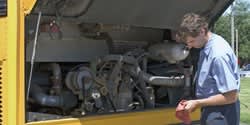
Among the many unknowns surrounding the upcoming changes in diesel emission regulations, there is one certainty: Buying and operating school bus engines built after Jan. 1, 2007, will cost more. How much more? Well, nobody’s sure just yet.
Every aspect of the transition to ‘07-compliant on-highway diesels comes with added expense. The new hardware — mainly exhaust-stream particulate traps and bigger cooling components — could bump bus prices by $1,900 (EPA estimate) or more (industry estimate). Whatever the figure, it will be fattened with princely sums charged for the reformulated fuels and oils needed to keep those engines running properly. If that weren’t enough, fuel economy is expected to take a slight hit — perhaps 1 to 2 percent — and oil drain intervals might be shortened somewhat, at least in the near term.
Pros outweigh cons
The upside is, of course, reduced exhaust emissions. The regulation — formally known as “the heavy-duty engine and vehicle standards and highway diesel fuel sulfur control requirement” — dramatically cuts two harmful components of spent fuel: particulate matter (PM) and oxides of nitrogen (NOx). Both pollutants will be reduced by about 90 percent. The new standards allow PM levels of just 0.01 g/bhp-hr and NOx levels of 0.20 g/bhp-hr. The NOx limit, however, is being phased in between 2007 and 2009, offering manufacturers a temporary reprieve before the next — and probably last — round of air-quality regs take effect in 2010.
Reaching the ‘07 mandated targets has been a sizable challenge for engineers across the heavy-automotive spectrum. Three or four years ago, trade publications were filled with dire predictions about the emissions-reducing methods being considered at the time — most of which seemed futuristic, overly complex and grandly unaffordable. Those worries have largely subsided now, though, because cooled exhaust gas recirculation, the primary NOx-cutting tool, has proven itself among North American fleet operators. Also, continuous refinements in combustion technology have enabled engine companies to meet the EPA’s next set of demands with a minimal amount of unfamiliar hardware, the sum of which is expected to add about 100 pounds to the weight of a medium-duty vehicle.
Trap will be key element
“A particulate trap accounts for about 90 percent of the new equipment we’ll be using,” says Steve Flammersfeld, a sales manager for Freightliner LLC. “The package also includes an intake throttle, hydrocarbon doser and some added software to control everything. There will be increased EGR, but it’s the same system we’ve had. The base engine [an MBE 900] is unchanged.”
Except for Caterpillar’s choice of ACERT instead of EGR, all manufacturers are taking roughly the same approach in this latest round of emissions compliance. They’re using ignition timing and EGR, or ACERT, to lower cylinder temperatures and suppress NOx formation, then routing the exhaust gasses through a filter, or “trap,” to strain off particulate matter.
When the accumulated PM reaches a certain volume, it’s converted to ash through a chemical process called “regeneration.” This is accomplished with either internal operating temperature or, lacking that, one of several mechanical maneuvers that will elevate heat to an appropriate level.
In developing the latest batch of diesel engine technology, designers considered two types of regenerating (self cleaning) particulate filters: passive and active. All chose the latter for heavy vehicles because it’s apparently more dependable across a wide range of environmental and operating conditions. Passive systems rely solely on an engine’s heat to perform the soot conversion, or oxidation, process; but active systems adjust internal temperature as needed to accomplish the task. Both types of devices, though, are sulfur intolerant.
[PAGEBREAK]
For that reason, the composition of on-highway fuel will change dramatically in the coming months, as the sulfur content — currently limited to 500 parts per million (ppm) — is nearly eliminated. By next September, 80 percent of the diesel refined for road-use must carry no more than 15 ppm sulfur. It is unclear whether the refiners can reach that percentage on schedule. However, ultra-low-sulfur fuel will be universally plentiful by the time the new engines are bolted into vehicles and in operation, which will happen sometime during the first quarter of 2007.
Fuel poses challenges
The new fuel, although cleaner than the current fare, poses two potential problems for users: less lubricity and less energy per gallon. The first could affect engine wear; the second will dampen performance and mileage. Eventually, petroleum companies should be able to resolve both issues with new additive mixtures, but the benefits of these might be offset by higher prices.
A similar scenario is occurring with engine lubricants. An entirely new category of lubes — temporarily known as PC-10 — is being developed to cope with the increased EGR-generated heat and soot inside the next generation of heavy diesels. As recently as two years ago, experts were warning that oil designed for ‘07 engines wouldn’t be “backward compatible” with older equipment, forcing fleet operators to stock two types of motor oil — and to hope that shop staff wouldn’t accidentally mix them during service routines.
It now seems that those early forecasts were overly pessimistic. Speaking at the Technology & Maintenance Council’s meeting in Tampa, Fla., last February, Mark Nelson, president of ChevronTexaco Global Lubricants, said the new oil would be suitable for all engines. He added that the current category of lubricants, CI-4, would even work in 2007 engines, although the particulate filters might need more frequent cleaning. The new oil’s certification process should start early next year, with products reaching the marketplace by the fourth quarter.
Already certifiable?
Most (if not all) of the new engines are ready to be certified now, but they probably won’t be submitted for formal government approval until much closer to the deadline. It’s a matter of economics, says Flammersfeld at Freightliner.
“The cost of certification is more than $100,000,” he says. “There’s no reason to get an engine certified any sooner than necessary because if we change something, we’d need to get the engine recertified. We have almost a year left to continue our engineering work. We’re planning to get our engines certified as close to Jan. 1, 2007, as possible.”
Once that date passes, bus buyers will notice little difference in the North American diesel engine landscape. The only model being discontinued is the Mercedes Benz MBE 904.
International Truck and Engine Corp. will introduce a larger, revamped version of its VT365 engine. “The engine isn’t exactly going away, but it is changing significantly,” says Greg Saele, International’s engine marketing manager. “The new model will be 6.4 liters instead of the current 6.0 liters. It will also have an entirely new fuel system.”
Limited pre-buy expected Apparently these changes — or their regulatory counterparts — aren’t causing widespread panic among buyers.
“We’re not expecting much pre-buying in the coming year,” Saele says. “We anticipate demand rising less than 4 percent.”
Flammersfeld at Freightliner agrees. “I haven’t seen any signs yet that people are out stocking up on school buses,” he says. “The operators I’ve spoken with know what’s coming, and they’re not intimidated. They know there will be a little more maintenance [with ‘07 equipment], but it’s not a big issue on their radar screens at this time.”
Roe East, general manager of bus business for Cummins, says one of the biggest challenges with the ‘07 engines will be to assure school bus operators that the changes will not be extreme. “There is some anxiety out there,” he says. “People shouldn’t have that anxiety level.”
Paul Hartley is a freelance writer and photographer in Northfield, Minn.
More Maintenance

The Evolution of DEF Header Technology: What School Bus Operations Should Know at Replacement Time
See what school bus fleets should consider when replacing DEF headers to improve reliability, reduce repeat repairs, and control maintenance costs.
Read More →
The Essential Guide to School Bus Maintenance and Student Safety
Your district's buses carry students to school every day. This guide shows how predictive maintenance powered by fleet data helps keep buses reliable, drivers accountable and students safer from the first bell to the last stop.
Read More →
Kerry Brothers Grows Michigan School Bus Repair Network
The acquisition of Downriver Truck and Bus expands Kerry Brothers’ school bus maintenance footprint across southeast Michigan, adding repair capacity, diagnostic resources, and state inspection support.
Read More →
Noregon Introduces CAN Bus Diagnostic Tool, Expands JPRO Features
CAN Mentor and the latest JPRO update aim to simplify vehicle network diagnostics and improve repair efficiency for technicians of all experience levels.
Read More →
Cummins on Smarter, Simpler Engine Innovation
Cummins discusses its first-ever gasoline engine for school buses, EPA 2027, and why bus fleets still want durable, simpler internal combustion options.
Read More →
Report: 72% of Diesel School Buses Now Use Advanced Low-Emission Engines
New data shows advanced low-emission diesel technology continues expanding across school bus fleets, even as electric bus adoption gains momentum.
Read More →
Vampire Tools' CAIMAN 7.5-Inch Multi-Purpose Screw Extractor Long-Nose Pliers with Crimper
Vampire Tools introduced the VAMPLIERS Caiman 7.5-inch multi-purpose pliers, combining screw extraction, cutting, crimping, and gripping functions into a single tool designed for fleet maintenance professionals.
Read More →
How Advanced Diagnostics Helps Bus Fleets Stay Ahead of Repairs
Chat with Noregon’s Kevin Smallhorn at ACT Expo about bus diagnostic tools, telematics integration, CNG maintenance support, and strategies to help reduce downtime and improve uptime.
Read More →
How School Bus Fleets are Getting Ahead of Breakdowns
Don’t let bus downtime wear you down. Here’s how bus operators are shifting from manual processes to AI-powered, data-driven maintenance systems for improved reliability and safety.
Read More →
Pennsylvania School Bus Maintenance Team Praised for Dedication to Safety
Matthews Bus Company’s West Jefferson received a letter of commendation from the Pennsylvania State Police for their fleet inspections.
Read More →