




Pupil Transporters Work to Meet Changes Aimed at Helping More Homeless Students
New legislation designed to support a growing number of homeless students leaves some transportation providers grappling with logistics and costs. More training and inter-staff communication are recommended.


iStock photo ©juliedeshaies
The number of homeless students in the U.S. is growing. From the 2006-07 school year to the 2013-14 school year, the number of children and youths in this situation nearly doubled, from 679,724 to 1,301,239, according to data published by the National Association for the Education of Homeless Children and Youth.
One state that is seeing this increase is Washington, where the number of homeless students nearly doubled from the 2007-08 school year (18,670) to the 2014-15 school year (35,511). Meanwhile, costs to transport them to and from school have followed that trajectory, says Glenn Gorton, director of student transportation and traffic safety education at the Washington Office of Superintendent of Public Instruction.
To better respond to the educational needs of these children, the U.S. Department of Education amended Title I, Part A, in the Every Student Succeeds Act of 2015 (ESSA) to require local education agencies (LEAs) that receive Title IA funds, which are education funds targeted to low-income districts and students, to coordinate transportation with state or local child welfare agencies for students in foster care. The amendment also made changes to the McKinney-Vento Homeless Assistance Act to include preschool age students and ensure transportation for students who obtain housing.
Generally, education agencies were required to begin implementing the new McKinney-Vento changes by Oct. 1, 2016, except for addressing the removal of the phrase “awaiting foster care placement” from the definition of homeless children and youth. That took effect on Dec. 10, 2016, in all states except for Arkansas, Delaware, and Nevada, where the phrase will be deleted from McKinney-Vento on Dec. 10, 2017.
The other new provisions go into effect with the 2017-18 school year, including one that states that the cost for transportation has to be divided between LEAs and the caring services center helping the student.
Homeless children and youths, as defined by McKinney-Vento, include those without a fixed, adequate nighttime residence, such as those who share housing with others due to loss of their family’s housing or economic hardship, or those living in hotels, trailer parks, camping facilities, emergency or transitional shelters, cars, parks, or substandard housing due to a lack of adequate accommodations.
Challenges such as identifying students in these situations, and coordinating with supporting agencies to establish transportation plans and obtain funds to cover the additional transportation costs, have some school transportation providers struggling to help these vulnerable students.
Foster care, preschool student changes
Children awaiting foster care placement are not considered homeless unless they meet other definitions provided under McKinney-Vento, and foster children weren’t always included in homeless numbers because they didn’t meet the definition of homelessness. Now, it’s explicit in the ESSA amendments that students in foster care are legally eligible for those services without question, says Jeff Ojeda, education specialist over McKinney-Vento for the Utah State Board of Education.
Students in foster care now also have their own advocate in schools. Before ESSA, under No Child Left Behind, whoever was in charge of McKinney-Vento at a school was also expected to oversee foster care situations. Under ESSA, these must now be two separate positions filled by two different people, Ojeda says.
Meanwhile, the amendments state that preschool-age homeless children are now entitled to transportation to a pre-K program. Data show that children in this group compose a major share of the overall homeless population; half of all people staying in shelters were reported as children ages 0 through 5, according to the 2012 Annual Homeless Assessment Report from the U.S Department of Housing and Urban Development.
Launi Schmutz-Harden, transportation director for Washington County (Utah) Schools, says her district expects to have about 100 new preschool-age homeless students who will need transportation starting next school year.
“Preschool is a huge focus right now for kids in poverty. [ESSA and McKinney-Vento] give them an opportunity to get an education and social skills [if they become] homeless,” Harden says. “Transportation is part of that. We need to provide stability.”
Carol Sicignano, transportation supervisor for Patchogue-Medford School District in Patchogue, New York, says that transporting preschool-age homeless students in her district will add considerations such as time restriction, car seats, and possibly a bus aide onboard, depending on the preschool.

Launi Schmutz-Harden, transportation director for Washington County (Utah) Schools, says her district expects to have about 100 new preschool-age homeless students who will need transportation starting next school year.
Ensuring stability
Another significant change from previous years is that transportation to the school of origin is required for the rest of the school year even if a student moves into permanent housing. This particular amendment stems from one main objective: to ensure stability for children, at least in one aspect of their lives.
“The view is that it isn’t in the best interest for the student [to change schools],” says Peter Mannella, executive director for the New York Association for Pupil Transportation (NYAPT). “The intent is to keep the student from having yet another move, and keep their school as a stable point.”
Additionally, if parents submit a dispute with the school district, transportation must still be provided until it is resolved, Mannella adds.
Logistics, cost hurdles
While they are intended to help a vulnerable population, the amendments present the challenge of planning transportation for these students, particularly those who leave the district, for the entire school year, even if they obtain permanent housing, Sicignano says. Her department at Patchogue-Medford currently transports 58 homeless students inside and outside the district.
“Before, some would come, some would go. It didn’t affect busing that much. Now, we’re not losing any [students], and they’re going in different directions, so it makes routing that much tougher.”
All the district’s routes are very tight, Sicignano says, but she has been able to share one bus, along with the cost, with a school district in which one homeless student is now located.
Transporting students outside the district also makes it tough to stay within the tax cap without adding buses, she says. (By state law, the district’s budget can only go up 2% annually.)
Cheryl Dalton, director of transportation for Saratoga Springs (N.Y.) City School District, says her district provides transportation for, on average, just under 100 homeless students every year, and one-third of them are located out of district.
“[That’s] where we run into the toughest problems: families that are out of our school district that live close to 50 miles away [from their school of origin],” she explains. She adds that children in a family can span a wide range in ages, and need to be transported to different schools with different bell times.
Bus rides for those students can be two hours a day, Dalton says.
“In some cases we’re watching the child. They are in a school building a good hour before school even starts.”
For example, one Saratoga Springs driver has to leave at 4:45 a.m. to bring a student back into district to start school at 7:30 a.m.
“We understand that typically school is the most consistent environment for the kids,” Dalton says. “But when you realize how much time it takes to get them to that destination, at what point does it impede their education? They’re exhausted.”
To accommodate the trips, Dalton often has to change routes and sometimes coordinate with other districts. When that has not been possible, she has to contract out trips.
Although the district gets reimbursed for transporting children who are placed by social services, many of the displaced students are actually going to different family members’ homes to live, Dalton adds.
Homeless students attending charter schools within 50 miles of the district now also must be transported, Sicignano says. A family who lived in her district before becoming homeless had not been eligible for transportation before, so there wasn’t a school psychologist or social worker checking on their status. If the family doesn’t report permanent housing next year, the district will be required to continue transporting them.
Another difficulty is that funding does not cover the cost of employees, Washington County’s Harden says. Her district is hiring more attendants and placing more students on buses, and will also see longer ride times, which will increase costs, she adds.
“The funding may only be for a portion of our services [and] obtaining it cannot delay enrollment or transportation. We have 24 hours [to make arrangements].”
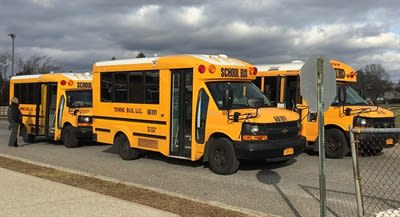
Patchogue-Medford (N.Y.) School District’s transportation department currently transports 58 homeless students inside and outside the district.
Training, shared communication
Transportation professionals are being asked to do a lot of work on this issue, which they don’t have any immediate grounding in, the way principals and social workers do, so more training and communication with other school officials is essential, Mannella says.
He notes in an NYAPT briefing that school bus drivers, as the first school employees to see homeless students at the beginning of the day and the last to see them at the end of the day, can provide insights about their emotional state and living situation that may affect their status, but training for identifying students in these situations is still needed.
In February, NYAPT will host a presentation from a local homeless advocacy group on homeless issues and the McKinney-Vento Act, and the discussion will address not only costs but the impacts of extended travel time to schools of origin on the student’s well-being, which is often ignored, Mannella adds.
“We need to offer the ramifications of each option. Make that a parent-and-child decision, not something we do because it’s easiest to say, ‘Just put them on a bus.’”
Additionally, transportation directors need to talk to the homeless liaison or superintendent about implementing a transportation plan so all parties involved are on the same page.
“We need to be trusted by other partners of the school community as part of the decision-making process,” Mannella says. “Too often transportation professionals, with all the knowledge they have, are left out of the conversation.”
More Management

How to Build a Better Driver Training Program
Ready to boost up your school bus instructor training? Here’s how to pick the right talent and improve recruitment, retention, and safety.
Read More →
CALSTART and Forth Combine to Form Catalyst Mobility
The new name represents a renewed vision for the nonprofit focused on advancing clean, equitable, and affordable transportation solutions that move people and goods.
Read More →
What Makes a Great School Bus Driver Trainer?
Choosing the right school bus driver trainer takes more than experience. Learn six keys to selecting and developing trainers and evaluating program effectiveness.
Read More →


School Bus Contractors Expand Through New Deals, Acquisitions & Partnerships
STA's Canadian division acquires Ontario-based G&L Stevenson Transport while Durham School Services adds a new district contract in California, First Student adds a New Jersey contract, and Minnesota Coaches acquires Halo Transportation.
Read More →
Logan Bus Company Rolls Out AI Phone System for NYC School Bus Families
A summer pilot found that AI agents could handle most routine calls, freeing up time for customer service staff to focus on emergencies and complex family concerns.
Read More →
From Intent to Impact: What I Learned About Leadership from TAPT
A Texas transportation supervisor shares lessons on self-awareness, accountability, managing stress and building trust — and why investing in leadership development matters at every stage of your career.
Read More →
NAPT Names 2026 Award Recipients, Hall of Fame Inductee
Who earned national recognition for their work in student transportation? This year, NAPT named five recipients of its 2026 awards for service, safety, and leadership, plus its newest Hall of Famer.
Read More →
2026 State of Student Transportation Report
Driver shortages. Rising costs. Growing safety expectations. More data, but not enough time to act on it. The 2026 State of Student Transportation Report reveals what transportation leaders say is putting the most pressure on their operations—and where they’re investing next. See how your priorities compare.
Read More →
How to De-Escalate an Angry Person: 5 Steps for Handling Workplace Conflict
What makes emotions run high, and how should you handle an angry colleague or parent? Follow these steps for staying calm, listening, showing empathy, and resolving conflict.
Read More →
What Readiness Looks Like This School Year
Learn about the challenges shaping the 2026–2027 school year, from persistent driver shortages and budget pressure to technology and readiness gaps. See how school districts are responding and adapting in Zonar’s 2026 Back-to-School Readiness Report.
Read More →