Pupil Transportation Experts Remain Open, Cautious as Autonomous Projects Advance
As projects and concepts for autonomous school vehicles move forward, they gather data on use and performance. Pupil transportation leaders see a long road with some hurdles, but remain open to potential benefits.
Nicole Schlosser・Former Executive Editor
October 15, 2018
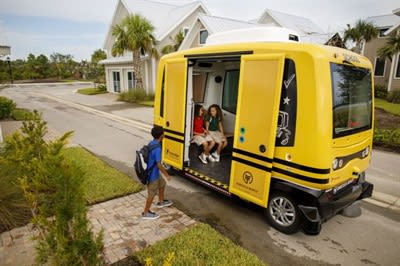
Mobility solution provider Transdev has started to run an autonomous school shuttle in Babcock Ranch, a new solar-powered community in Punta Gorda, Florida.
9 min to read
Mobility solution provider Transdev has started to run an autonomous school shuttle in Babcock Ranch, a new solar-powered community in Punta Gorda, Florida.
A handful of autonomous, or, self-driving, school transportation projects and concepts have emerged recently. They offer to further enhance pupil transportation by eliminating the need for a driver, potentially providing relief to the many pupil transporters struggling with driver shortage, and transporting smaller groups of students, sometimes on demand.
More generally, autonomous vehicles have grabbed their share of the spotlight in recent years, with the National Highway Transportation Safety Administration (NHTSA) establishing an advisory committee in 2017 to address them, and the tragic accident in Tempe, Arizona, in March, in which a self-driving car, operated by Uber, fatally struck a pedestrian. (It was widely reported that police said the driver was watching a TV show through a streaming service in the moments leading up to the crash.)
Understandably, there are safety concerns about the technology, and additional factors come into play when children are being transported. Ensuring safety through technology and laws, which need to catch up to the technology as it rapidly advances, is an essential next step.
The companies working on these projects and concepts are gathering data from them, as well as from schools, and one company is planning to share its data with regulatory entities as it debuts in a small new community.
Florida Pilot
Mobility solution provider Transdev has started running an autonomous school shuttle in a new solar-powered community in Punta Gorda, Florida.
Transdev is partnering with Babcock Ranch to provide autonomous vehicle transportation to the planned community, which focuses on environmentally responsible growth, and is the first solar-powered community in the country, according to Transdev. The company completed 14 months of testing with its electric-powered EasyMile EZ10 Gen II shuttle before it added school shuttle routes to the autonomous options it already provides.
During the pilot, which launched on Sept. 21, Transdev is evaluating rider behavior and demand by offering the service to students at Babcock Neighborhood School, a charter school in the community. Nearly 30 of the 316 students enrolled in grades K-7 at Babcock Neighborhood School this year will reside in the community by January. This fall, students and parents will be able to book on-demand rides on the shuttles using a custom mobile application.
Babcock Ranch and Transdev have been offering autonomous shuttle service since the town opened in January as part of the community’s devotion to reducing reliance on cars. EasyMile shuttles in Babcock Ranch have been taking future residents and visitors on a planned route around the community, which has given the company the confidence and knowledge to expand service into the first autonomous school shuttle operation, says Scott Hagen, communications manager at Transdev.
“We’re able to evaluate, scale, and grow alongside the community, which one day will be home to 50,000 residents,” Hagen adds.
Ad Loading...
Designers’ Concept
Meanwhile, designers in Seattle, Washington, are working on a concept vehicle that would offer a new approach to student transportation as autonomous vehicles advance.
Teague, a Seattle-based design consultancy for clients in automotive, personal mobility, smart cities, and other industries, asks the question on its website: “What will happen to the iconic yellow school bus when our vehicles become predominantly autonomous?”
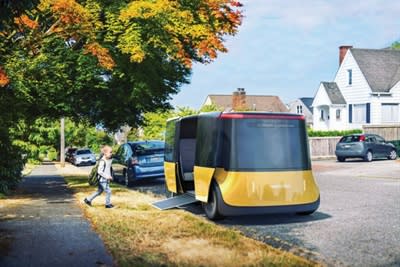
Hannah, Teague’s automated vehicle concept, is designed to operate point-to-point instead of hub-and-spoke routes, picking up every student at their residence instead of at bus stops. Hannah vehicles wouldn’t have a front or back “end,” because they are “palindromic,” hence the name, “Hannah,” allowing them to move forward and backward, with sliding doors and ramps on both sides, according to the consultancy’s website. That bidirectional feature would enable Hannah to travel down a street from either direction or run on either side of the street.
Devin Liddell, principal futurist at Teague and the lead on the Hannah concept, says the initial inspiration for the vehicle came in 2017 as the company noticed that amid all the discussion about how autonomous vehicles will work for adults, there wasn’t much being said about what the technology will mean for kids.
“Considering that school buses constitute the largest form of [public] transportation in the U.S., it seemed like a very worthwhile endeavor to imagine and prototype how school busing should work in the age of autonomy,” Liddell says.
Rather than designing the vehicle itself, Teague sees Hannah as a system created to work with a number of different approaches to vehicle design, he adds.
The next step for Hannah would be collaborating with an automotive or bus manufacturer, or a shipping or logistics company interested in breaking new ground, Liddell says.
Hannah, an autonomous school vehicle concept from design consultancy Teague, doesn’t have a front or back “end,” because it is “palindromic,” just like its name. It is equipped with sliding doors and ramps on both sides.
Safety Features
Transdev tested the 12-passenger shuttle with students and families before the pilot officially began. The company has been operating the shuttle since 2016, Hagen says, and has demonstrated the vehicle in multiple locations to increase the public’s comfort level with autonomous vehicles.
Babcock Ranch is the first place it has deployed the shuttles for more than a demonstration, providing service on weekends since January. Residents can ride on the shuttle at any time, allowing them to grow more familiar with its safety features, such as how it can stop and move around objects, Hagen says.
The shuttle currently reaches a standard cruising speed of 12 miles per hour, Hagen says, and points out that it will eventually be able to move faster as the community grows and adds more buildings. “Autonomous vehicles need reference points for their sensors to calculate where they are in relation to their path,” Hagen explains. “Once that infrastructure is in place, then [the vehicle] will be able to comfortably move faster.”
A safety attendant is on board to supervise students at least until autonomous vehicles become commonplace.
“Then, we’ll explore going to full autonomy, but at this point we understand that it’s still an unknown mode of mobility to a lot of people,” Hagen says.
Additionally, the shuttle can be stopped by pressing a button, and will also stop if it “senses” an obstruction in its way. The shuttle’s onboard computer allows it to stop 30 times faster than the typical reaction speed of the human brain, which is about .7 seconds, Hagen says.
It also has a safeguard against hacking: it can recognize a request to deviate from the set course and shut down.
Hagen emphasizes that the shuttle is not a school bus, and that Babcock Neighborhood Schools and the district it operates under are not involved with the pilot, meaning the shuttle is not required to meet the same state and federal specifications that school buses do.
“We’re very careful about not calling it a school bus, because of state government requirements [for school buses],” he adds.
The Florida Department of Education (FDOE) told School Bus Fleet that this project does not fall under its purview.
“The provision of student transportation by a private entity on private property is not within the department’s jurisdiction,” says Audrey Walden, press secretary for the FDOE.
Meanwhile, the Hannah concept could potentially eliminate the need for safety equipment such as stop arms, because students wouldn’t need to cross in front of or behind buses or other vehicles; the vehicle could pick up and drop off every student at the curb side of their home or school.
Gathering Data
Transdev will gather information from the Babcock Ranch pilot — such as how often students use the shuttle, whether they use it in good as well as bad weather — and share it with regulatory bodies in pupil transportation to show that it is safe and practical.
Currently, about five to 10 students live in Babcock Ranch, but that number is expected to increase to 30 or 40 by January.
Teague designers have conducted observations at several schools in the Seattle area and examined bus routes after student data was made anonymous to understand the complexities in bus use that they would need to address.
Industry Perspectives
Steve Simmons, president-elect of the National Association for Pupil Transportation (NAPT), says that the association is not opposed to the technology, but companies employing automated vehicle technologies will need to ensure it is foolproof before pupil transporters will jump onboard.
“It’s not necessarily the technology in the vehicle, but the vehicle itself,” he adds. “Does it meet construction and safety standards that [all other pupil transporters] in the country are bound by?”
However, he adds that he doesn’t see automated school transportation taking off even within the next 10 years, other than in small pilots to gather data.
Simmons adds that parents’ concerns about putting their child on a vehicle that has no driver is just one of many reasons that automated versions of school vehicles would likely be rolled out later than other vehicles.
School personnel should be involved in reviewing student management issues due to the lack of student supervision if adult monitors are not provided, says Charlie Hood, executive director for the National Association of State Directors of Pupil Transportation Services (NASDPTS).
“Although the lack of an adult presence on driverless vehicles is a huge hurdle, we remain open-minded to the potential of limited capacity, low speed automated school vehicles operating in a controlled traffic environment as one possible component of an array of available transportation options,” he adds.
Another factor is cost: people are willing to pay as much as a school bus costs on cars, so vehicle manufacturers may see the car as a more profitable product than the school bus, adds Dan Kobussen, vice president of Kobussen Buses Ltd. in Kaukauna, Wisconsin. However, autonomy could take off in the trucking industry before the car/bus market, he says, because it’s for profit and it is also dealing with driver shortage.
“[The trucking industry] has a shorter vehicle turnover rate that will allow them to implement autonomous technology faster than our industry,” he explains.
One challenge with the advancement of autonomous vehicles, Kobussen says, is that buses that are still in working order could be rendered obsolete before the end of their useful life, because they won’t be able to be retrofitted with the technology. It will then fall to the end user to replace them as customers demand more technology.
Kobussen adds that he sees autonomous bus technology emerging first as parking lot or university campus shuttles before coming to school bus transportation, in part due to legal issues.
“If you look at all the laws that need to be changed for autonomous vehicles in general, it’s going to take a long time, and there’s lots of hurdles there that need to be taken care of before we even get to the school bus,” he says. “I am excited for the day when the school bus driver can spend less time concentrating on driving and more time interacting with students.”
Hood says that now, states probably don’t have updated regulations regarding which vehicles are acceptable for use in student transportation to address options such as autonomous vehicles. However, he adds, most states have regulations that specify which modes of transportation are acceptable for student transportation and under what circumstances.
Hood recommends that state directors who are reviewing autonomous vehicle projects look at existing state laws and rules addressing allowable vehicle types and the potential safety issues created if driverless vehicles are stopping on public roadways without traffic controls, like flashing warning lights and stop arms, that are on conventional school buses. Law enforcement can help interpret whether autonomous vehicles create safety hazards for motorists or school vehicle passengers and design safety precautions.
As vehicle-to-vehicle and vehicle-to-infrastructure technology features, such as lane departure warnings and adaptive cruise control with low-speed follow, continue to become more available in cars, Simmons predicts that school buses will eventually be able to communicate warnings to cars not to pass them.
“Passing violations, we hope, will eventually go away, because the vehicles will talk to each other,” he says.
Generally opposing autonomous vehicle technology in student transportation unless the vehicles can identify school transportation vehicles and the multiple stops they need to make to pick up and drop off students while also complying with their warning lights and stop arms, the National School Transportation Association (NSTA) said in a letter to the Federal Motor Carrier Safety Administration (FMCSA) it “encourages caution in use of the technology.”
VW Makes Inroads Into Automated Pupil Transportation
The Volkswagen Group unveiled its new self-driving “school bus” concept earlier this year.
The vehicle manufacturer debuted SEDRIC (SElf DRIving Car) School Bus, an autonomous electric vehicle designed for a handful of passengers, at the International Geneva Motor Show on March 5. It is the latest version of SEDRIC, its mobility concept for fully autonomous multi-passenger driving, which was initially introduced at the International Geneva Motor Show in 2017.
Designed for on-demand travel, the SEDRIC School Bus includes the option of using a OneButton control element to call up one of the vehicles at the touch of a button and traveling door to door.
LED signage on SEDRIC’s exterior will tell motorists to stop and wait for students to cross, and provide other information to motorists, cyclists, and pedestrians, according to TechCrunch. The technology industry publication also noted the vehicle’s sliding glass doors, potentially making boarding and exiting easier.
The new name represents a renewed vision for the nonprofit focused on advancing clean, equitable, and affordable transportation solutions that move people and goods.
Choosing the right school bus driver trainer takes more than experience. Learn six keys to selecting and developing trainers and evaluating program effectiveness.
STA's Canadian division acquires Ontario-based G&L Stevenson Transport while Durham School Services adds a new district contract in California, First Student adds a New Jersey contract, and Minnesota Coaches acquires Halo Transportation.
A summer pilot found that AI agents could handle most routine calls, freeing up time for customer service staff to focus on emergencies and complex family concerns.
A Texas transportation supervisor shares lessons on self-awareness, accountability, managing stress and building trust — and why investing in leadership development matters at every stage of your career.
Who earned national recognition for their work in student transportation? This year, NAPT named five recipients of its 2026 awards for service, safety, and leadership, plus its newest Hall of Famer.
Driver shortages. Rising costs. Growing safety expectations. More data, but not enough time to act on it. The 2026 State of Student Transportation Report reveals what transportation leaders say is putting the most pressure on their operations—and where they’re investing next. See how your priorities compare.
What makes emotions run high, and how should you handle an angry colleague or parent? Follow these steps for staying calm, listening, showing empathy, and resolving conflict.
Learn about the challenges shaping the 2026–2027 school year, from persistent driver shortages and budget pressure to technology and readiness gaps. See how school districts are responding and adapting in Zonar’s 2026 Back-to-School Readiness Report.