




Product Focus: Emergency Equipment
School buses may be the safest vehicles on the road, but accidents do happen. In an emergency, certain types of equipment are vital in keeping preciou...
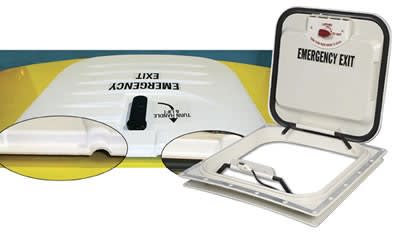
School buses may be the safest vehicles on the road, but accidents do happen. In an emergency, certain types of equipment are vital in keeping precious cargo safe.
One of those types of equipment is the roof hatch, which is offered in various incarnations by Pineville, N.C.-based SMI.
The company has been at the forefront of school bus safety for more than 40 years. During that time, it has produced a range of products that also includes crossing-control arms, stop arms and an LED warning sign.
Simple design
Douglas Campbell, director of North American sales at SMI, discussed with SBF the company’s products from design to execution.
SMI’s line of roof hatches is two-fold, including the recently purchased Transpec brand. “Its main purpose is as a safety vent, and the whole premise is that if there’s an accident or injury of any kind, a young child could quickly and easily open the hatch and get out of harm’s way,” Campbell says. “We’ve designed our hatches to give as fast an egress as possible by way of a simple operating handle, with no resistance to the hatch popping open.”
Campbell says that most of the focus during the design process is on ergonomics and intuitiveness. In a state of emergency, he says, there’s not a lot of time to figure out the workings of an escape hatch, so instant understanding is the top priority.
“Can someone visually recognize what to turn in case of an emergency? If a bus rolls over and there’s smoke and confusion, can passengers easily identify a bright red handle? Yes,” Campbell explains. “So we designed our handle to be noticeable and simple. It’s one quarter-turn, push and you’re out. It’s very intuitive.”
SMI’s engineers looked at design features that were common sense, practical and easily recognizable. Of course, the hatches had to have enough pressure to keep them closed, but not so much that a 5- or 6-year-old couldn’t grab the handle and push it out without too much force.
The testing came down to practical methodology, and the people at SMI brought in their own kids to put the products to the test.
“Our head engineer’s kids were some of the guinea pigs,” Campbell says. “We said, ‘Here are two different hatch designs. Without even thinking about, run to a hatch and open it up as fast as you can.’ It was easy to see which design a child could run to and open without having to read anything or think about it too much.”
The design that engineers arrived at for the Specialty wing of products, called the ProLo, was simple: a bright red handle that turns once and opens the hatch.
“We had other designs that were a little more complicated, and they took longer for the children in the test to open up and figure out,” Campbell says. “A child is not going to have time to do that, so we wanted to make something as simple and easy as possible.”
Brand awareness
SMI purchased Transpec, a noted rival, about a year ago, but the company still offers hatches from both brands to meet customers’ preferences.
“A lot of it is brand loyalty,” Campbell says. “There were a lot of people loyal to the brand, like people are to a Chevy, and we were the Ford. So now that Chevy and Ford have merged, more or less, they can still have their choice of either one.”
Campbell says that the Transpec line, for the most part, adheres to the same principle as the ProLo: escape out of the roof as fast as possible.
“They function the same, they serve the same purpose, but each has different design features,” Campbell says. “Part of it is price, part of it is features. The ProLo hatch, as an example, has a very low profile with the easy one-turn handle on the inside. The Transpec has a knob that you push and turn for release. Different handles, slightly different opening sizes, different look from the outside — it really is subtle.”
All of SMI’s hatches are equipped with alarm switches to let the driver know if the hatch has been opened.
“If a kid is goofing off and opens up the hatch while the bus is going down the road, the driver is going to know because the alarm will go off by the cockpit saying that the hatch is open though there is no emergency,” Campbell says.
Personal approach
As director of North American sales for SMI, Campbell has an obvious commitment to his customers, but being a parent is what really motivates him to champion his company’s products.
“My 7-year-old son rides a school bus every day,” Campbell says. “Every day, I’m looking at the cross arm, the stop arm and hatches and thinking, ‘Have we done the best design with them, and what can we do to improve on them?’ Also, ‘What other safety features can we design, to make sure that my kid gets home safely?’”
SMI offers a full line of school bus safety products that are all designed to keep kids safe.
Campbell is a strong proponent of SMI’s crossing-control arm.
“The intent of the crossing arm is to make sure the kids stay 6 feet-plus in front of the bus,” Campbell says. “They walk in front of the driver’s viewpoint the entire time they’re getting off the bus. As a result, there’s been a massive reduction in injuries with the crossing gate in place.”
SMI also offers stop arms, and a newer product is also showing promise. The Driver Alert, an LED sign mounted on the back of the bus, works in conjunction with the warning-light system on a school bus. When the bus activates its amber lights or emergency flashers, the Driver Alert alternately flashes the words “Caution” and “Stopping.” When the red lights and stop arm are activated, “Stop” and “Do Not Pass” flash.
Campbell says that the sign has been extremely effective in getting drivers to stop for buses. “It’s something that makes you feel good, especially as a parent, that you’ve done something to help ensure the safety of kids.”
The success stories of SMI’s products don’t tend to get back to Campbell. A car prevented from passing a stopped bus is hardly headline news, and when a roof hatch allows kids to safely escape in an emergency, it has simply served its purpose.
“The products quietly do their job effectively,” Campbell says. “Certainly there have been accidents where the hatches have been deployed, and certainly, we don’t hear about it. They serve their purpose, but there’s not a lot of sizzle that goes with them.”
Campbell says that when it comes to safety products, no news is good news.
In case of fire
One of the more critical emergencies that can arise on a school bus is a fire breaking out in the engine compartment.
On that front, Amerex Corp. offers automatic fire suppression technology. The company’s Small Vehicle System is designed for Type A buses and other small, front-engine vehicle applications.
In the event of a fire, the system automatically actuates, an audible alarm sounds, a fire LED illuminates and an internal relay is energized. Backup power is supplied by a standard 9-volt alkaline battery.
The system includes all hardware components required, is easy to install and low maintenance, and has a user-friendly interface.
More Safety
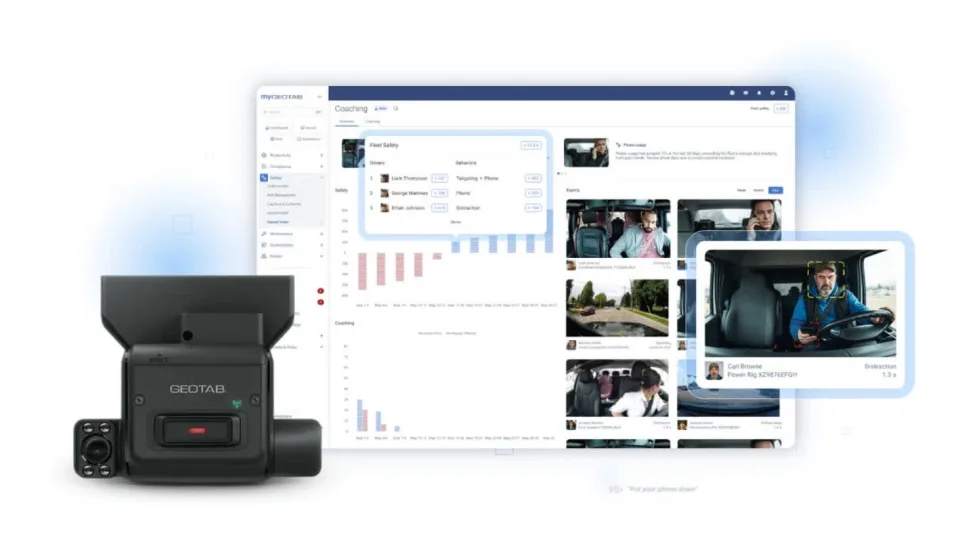
Geotab Expands Fleet Safety Tools With Video Coaching, Risk Insights
New safety and video capabilities aim to help fleet managers assess risk, support drivers, and take targeted action through video coaching, red-light violation detection, and more.
Read More →
How to Build a Better School Bus Driver Training Program
Is it time to strengthen your driver training? Here’s how to pick the right talent and improve recruitment, retention, and safety. This video is brought to you by IC Bus.
Read More →
Recent School Bus Accidents Leave 2 Dead, 2 Injured
Four school bus crashes in Florida, Illinois, and Georgia highlight risks in transportation lots, at bus stops, and during student loading and unloading.
Read More →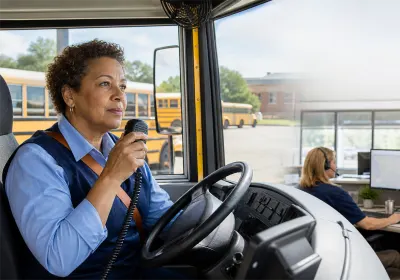

When Every Second Matters, Clarity Keeps Routes Moving
From routine delays to urgent incidents, strong communication practices help drivers, dispatchers, schools, and families respond with confidence.
Read More →
What Happens When a School Bus Catches Fire — and What Can Help
School bus fires are rare but can be devastating. Learn how advances in fire suppression and asset protection help fleets detect fires earlier, reduce damage, and improve safety.
Read More →
Geotab Launches Tool to Help Fleets Investigate Road Incidents
Geotab Investigations combines telematics data, video, documents, and other evidence to help fleets reconstruct incidents, resolve claims, and determine what happened.
Read More →
Texas Sixth Grader Wins 2026 National School Bus Safety Poster Contest
Sai Darshana Yekolu of Moseley Middle School in Prosper, Texas, was named the newest winner for her artwork, bringing the theme of “Safe Rides, Everyday Heroes” to life.
Read More →
Doing More With Less: How Transportation Directors Can Prioritize Safety Amid Budget Uncertainty
With diesel prices soaring and nearly one-third of transportation directors expecting budget cuts, maintaining student safety has never been more challenging. Download this guide to learn how leading districts are prioritizing risk, funding critical safety technology, and building stronger budget cases with data.
Read More →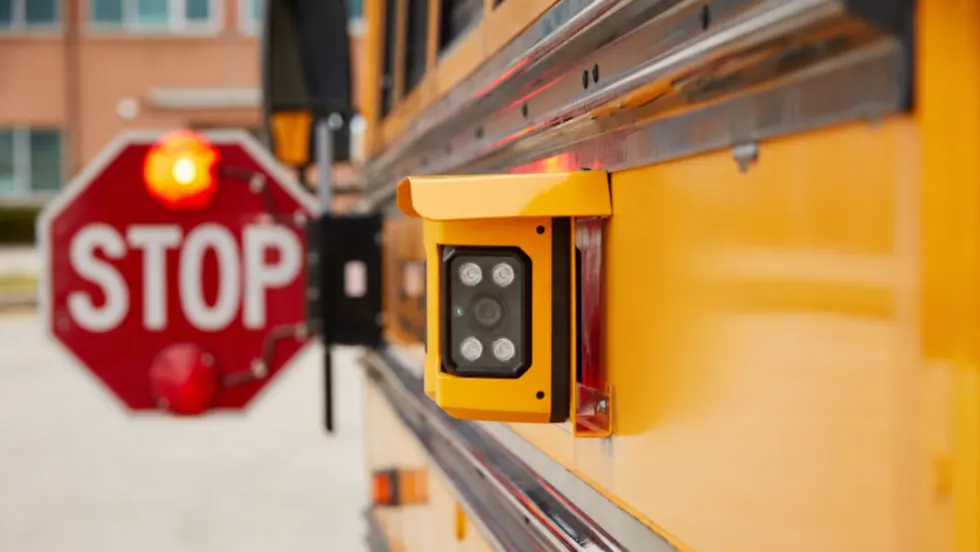
Walton County Schools Adds Gatekeeper Stop-Arm Enforcement System
The Florida district will deploy Gatekeeper’s updated Student Protector technology, which now incorporates AI to improve video evidence.
Read More →
How To Build a More Secure School Bus Yard During and After Hours
As thefts and overnight security threats continue, school transportation leaders are combining stronger operational practices with AI-enabled surveillance to better protect buses, facilities, and staff.
Read More →