




Oregon District Shuns Motorcoaches, Runs ‘Yellow Charters’
With the upgraded buses, Eugene School District is bolstering safety, saving money, and providing a comfortable ride for students on activity trips. An alarming crash sealed the district’s shift away from motorcoaches.

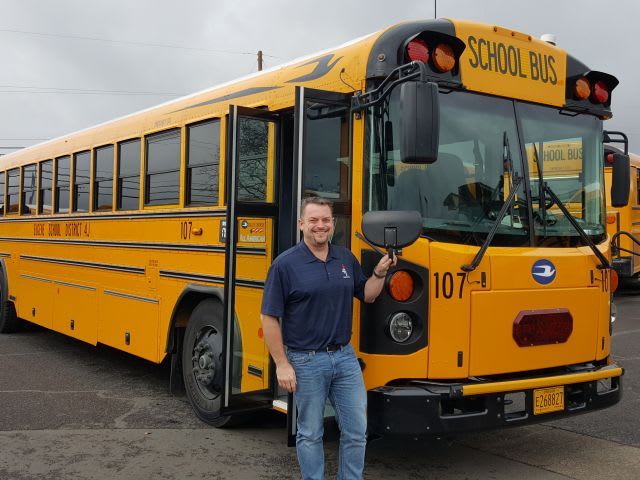
Transportation Manager Chris Ellison shows off an upgraded “yellow charter” school bus.

Transportation Manager Chris Ellison shows off an upgraded “yellow charter” school bus.
When Chris Ellison took over the transportation department at Eugene (Ore.) School District in 2013, the use of motorcoaches quickly came into his crosshairs.
“The first thing that caught my eye was how much we were spending on motorcoach rentals … almost half a million dollars a year,” Ellison recalls.
Apart from the financial aspect, Ellison saw a need to provide a safer ride — namely, yellow school buses — for students on activity trips. School bus construction standards and occupant protection are superior to those of motorcoaches, Ellison reasoned, and news of fatal motorcoach crashes in other states drove home the point.
“At that point, we were hearing frequently about horrific motorcoach crashes in New York and New Jersey,” Ellison says.
What the transportation manager didn’t know at the time was that a crash closer to home would solidify his push to end the district’s use of motorcoaches.
For the long haul
As Ellison knew, motorcoaches provided some advantages for passengers on long trips, particularly in the area of comfort. A typical coach could offer students more comfortable seats, a smoother ride, DVD monitors, a restroom, and other amenities that aren’t normally found on a yellow school bus.
The goal for Eugene School District was to replace motorcoach use with a safer vehicle that would still be comfortable for students on longer excursions. The solution, as envisioned by Ellison, was “yellow charters” — essentially modified school buses, built to the same construction standards but equipped with enhanced features. Those include charter-style seats, full air-ride suspension, air conditioning, overhead storage bins and lights, and flip-down DVD screens.
“It has all the amenities of a motorcoach bus, with the exception of a bathroom,” Ellison says. “Obviously, safety is No. 1. I pitched this to the athletic directors and school administrators, and they thought it was a great idea.”
The district initially ordered two of these yellow charter buses, with the expectation of buying more if they were a success.
“I don’t want to order four or six or eight and have them sitting,” Ellison told the directors who asked whether two would be enough. “We’ll see how it plays out.”
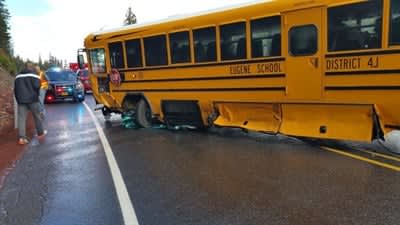
In September 2015, one of Eugene’s yellow charter buses was struck by a pickup truck. The truck driver was killed, but the students and bus driver suffered only minor injuries.
Crash test
Eugene School District’s first two yellow charter buses went into service in the fall of 2014. The district continued to use motorcoaches as well as regular school buses for some activity trips, but the new vehicles were in high demand.
“The two yellow charters were used pretty much every day,” Ellison says.
At the end of the 2014-15 school year, the district decided to order two more yellow charters. Then, a few weeks before those vehicles were to be delivered, the district experienced a crash that sealed the shift away from motorcoaches.
On Sept. 3, 2015, one of Eugene School District’s yellow charter buses was transporting high school soccer players through the Cascade Mountains to Bend.
As the bus made its way up a grade at about 49 mph, a green pickup truck coming down the grade at about 57 mph crossed the double yellow lines on a curve and hit the bus in the front left corner. The truck then scraped along the side of the bus, spun around, and came to rest in a ditch on the inside of the curve. The woman driving the truck died on impact.
“It was the most horrific thing I have ever seen,” says Ellison, who responded to the crash. “[The truck driver’s] mother was in the car ahead of her, and she saw the accident happen. It was absolutely heartbreaking to read the witness statements.”
On the yellow charter bus, the occupants fared better. After it was hit by the truck, the bus veered right and hit a guardrail, beyond which is about 6 feet of shoulder and then a drop of about 300 feet, according to Ellison. The bus deflected off of the guardrail and stayed upright.
There were 41 students on the bus at the time. One student was thrown from his seat on impact and scratched his leg on a seat post. Otherwise, there were some bumps and bruises, but no one on the bus was seriously injured.
“I will preach this to the day I die … that bus did its job,” Ellison says. “It did what it was designed to do.”
The soccer players would have been traveling on a motorcoach that day, Ellison noted, but the team had wanted to try out the yellow charter option. Investigators said that if the players had been on a motorcoach, the outcome most likely would have been worse.
According to Ellison, the Oregon State Police said that a motorcoach in the same situation would likely have either gone over the guardrail and into the ravine, or it would have deflected off of the rail and tipped over onto the road. Either of those scenarios could have resulted in student fatalities or severe injuries, the lead investigator said in a conversation with Ellison.
“I asked, in your expert opinion, would the outcome have been different if the students had been in a motorcoach,” Ellison recalls. “He said absolutely.”
“I will preach this to the day I die … that bus did its job. It did what it was designed to do.”Chris Ellison, transportation manager, Eugene School District
Decisive event
The September 2015 crash was “a huge wake-up call for us,” Ellison says.
The transportation manager convened a meeting with the district superintendent and other administrators. In light of the Oregon State Patrol’s analysis, Ellison recommended that the district eliminate the use of motorcoaches. The superintendent agreed.
At that point, Eugene School District rebooked all of its scheduled motorcoach trips onto a yellow charter or school bus. The yellow charter that was in the crash was totaled, which left just one available for the time being.
Two additional yellow charters were slated to be delivered within the next few weeks, and Ellison got the school board’s approval to order three more.
The district now has six yellow charter buses, which have a capacity of 46 passengers, or 40 for the one that is equipped with a wheelchair lift. The yellow charters each average about 19,000 miles per year as they transport students for athletic events, reward trips, and educational excursions.
“We’ve had students who go to the Oregon Coast Aquarium,” Ellison says. “They watch Finding Nemo on the way over. The comment from the drivers is that when the kids are watching a movie, it’s one of the best bus rides they have.”
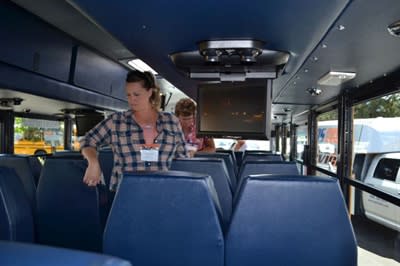
Eugene’s yellow charter buses boast such features as charter-style seats, overhead storage bins and lights, and flip-down DVD screens. The bus seen here was on display at the Oregon Pupil Transportation Association conference in Bend last summer.
New revenue
Beyond bolstering safety and providing a comfortable ride, the yellow charter buses have had a positive impact on Eugene School District’s transportation budget.
The district charges its schools for labor and mileage on any bus trips they take, and a premium is added when the yellow charter buses are used instead of regular school buses.
Because of their upgraded equipment, the yellow charter buses cost roughly $50,000 more than a regular school bus, but the district has been able to recoup that investment in about a year and a half.
Also, the money for all of the schools’ trips is now staying within the district rather than being paid out to motorcoach operators.
“Where we used to have an expenditure going out almost half a million dollars a year, now I have revenue coming in from the yellow charters,” Ellison says.
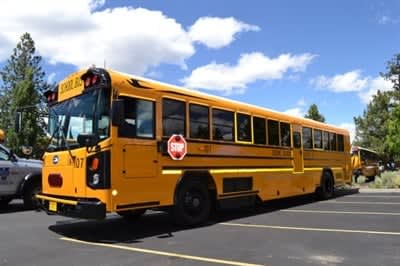
Eugene now has six of the yellow charter buses, which each average about 19,000 miles per year as they transport students for athletic events, reward trips, and educational excursions.
The initiative has also been a boon for the district’s drivers, because there are more opportunities for them to take on activity trips and earn more money.
Like school bus operations across the nation, Eugene School District has been hampered by driver shortage, but that hasn’t prevented the transportation department from covering the increased workload for activity trips.
“We do whatever it takes to make it work,” Ellison says. “If it means that I as the transportation director drive a route so a driver can take that trip, then that’s what we do.”
Ellison notes that his staff is also on board with the rationale for keeping students on yellow buses.
“Every one of my employees here knows,” he says, “you can’t put a price on student safety.”
More Safety

How to Build a Better School Bus Driver Training Program
Is it time to strengthen your driver training? Here’s how to pick the right talent and improve recruitment, retention, and safety. This video is brought to you by IC Bus.
Read More →
Recent School Bus Accidents Leave 2 Dead, 2 Injured
Four school bus crashes in Florida, Illinois, and Georgia highlight risks in transportation lots, at bus stops, and during student loading and unloading.
Read More →
When Every Second Matters, Clarity Keeps Routes Moving
From routine delays to urgent incidents, strong communication practices help drivers, dispatchers, schools, and families respond with confidence.
Read More →

What Happens When a School Bus Catches Fire — and What Can Help
School bus fires are rare but can be devastating. Learn how advances in fire suppression and asset protection help fleets detect fires earlier, reduce damage, and improve safety.
Read More →
Geotab Launches Tool to Help Fleets Investigate Road Incidents
Geotab Investigations combines telematics data, video, documents, and other evidence to help fleets reconstruct incidents, resolve claims, and determine what happened.
Read More →
Texas Sixth Grader Wins 2026 National School Bus Safety Poster Contest
Sai Darshana Yekolu of Moseley Middle School in Prosper, Texas, was named the newest winner for her artwork, bringing the theme of “Safe Rides, Everyday Heroes” to life.
Read More →
Doing More With Less: How Transportation Directors Can Prioritize Safety Amid Budget Uncertainty
With diesel prices soaring and nearly one-third of transportation directors expecting budget cuts, maintaining student safety has never been more challenging. Download this guide to learn how leading districts are prioritizing risk, funding critical safety technology, and building stronger budget cases with data.
Read More →
Walton County Schools Adds Gatekeeper Stop-Arm Enforcement System
The Florida district will deploy Gatekeeper’s updated Student Protector technology, which now incorporates AI to improve video evidence.
Read More →
How To Build a More Secure School Bus Yard During and After Hours
As thefts and overnight security threats continue, school transportation leaders are combining stronger operational practices with AI-enabled surveillance to better protect buses, facilities, and staff.
Read More →
FMCSA Names New Chief Safety Officer: What School Bus Operators Should Know
Steve Dowling is set to lead the federal agency's efforts to advance commercial motor vehicle safety and reduce crashes, fatalities, and injuries on the nation's roadways.
Read More →