




Options Abound for Student School Bus Safety Programs
Here are five examples of training programs that have been found to engage students while educating them on school bus safety.
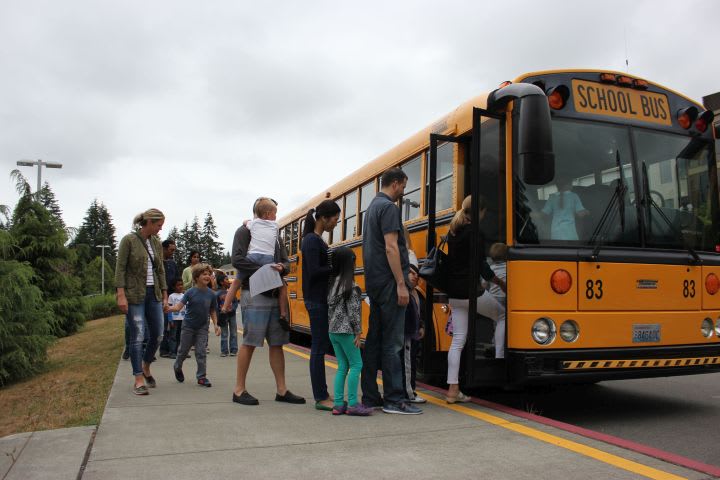
Families prepare to board buses for Issaquah (Wash.) School District’s annual ride-along for kindergartners and their families.
Families prepare to board buses for Issaquah (Wash.) School District’s annual ride-along for kindergartners and their families.
Whether they regularly ride the bus, walk, or catch a ride with mom and dad and only board a school bus for the occasional field trip, all students need to understand the dangers in and around buses and learn how to safely cross streets. For many students, safety instruction begins and ends with a bus evacuation drill and a pamphlet on bus rules.
However, very few school districts actually teach safety skills to students, according to Pete Meslin, director of transportation at Newport-Mesa (Calif.) Unified School District.
“By foregoing that opportunity, they are missing the chance to improve student behaviors and build safety habits,” he says.
Here are details on five programs and products that districts and school bus companies have found to be successful in engaging and educating students — and sometimes parents — on school bus safety.
1. Teaching Independence Skills
Bus in the Classroom (BIC), the program used at Newport-Mesa, teaches special-needs students independence as well as school bus safety.
BIC consists of five one-hour lessons taught by drivers and transportation staff. A list of skill-set objectives includes safe boarding of the bus and proper behavior, such as facing forward, putting feet on the floor, and using quiet voices. Interactive instruction models the behavior that is expected of students and engages them through role playing and activity coloring sheets.
While drivers receive pay for time spent teaching, the cost is offset by the independence skills they teach students.
“If you take a typical seventh grader with special needs who receives school bus service in front of their house and move that student to a corner stop, so he’s waiting for the bus rather than the bus waiting for him, the money you save in terms of driver time pays for the program for more than two years,” Meslin explains.
Teaching independence skills also helps special-needs students ride the general-education bus, he adds. That, in turn, enables them to build relationships with other students and provides skills that serve them well into adulthood.
More than 95% of students who complete the BIC program show significant improvement in safety skills. With such success, Meslin says, Newport-Mesa has expanded the program to include their general-education kindergartners.
To learn more about BIC, email bic@nmusd.us.
2. Involving Parents in Student Safety Training
Meanwhile, Issaquah (Wash.) School District looks to directly involve parents in safety education by hosting a ride-along for them and their children. When parents register their children for kindergarten, the transportation department invites them to ride the school bus with their incoming kindergartners, says Gayle Morgan, director of transportation for the district.
To maximize attendance, the district offers the ride-along on three days in early August, and parents sign up online. Families, including younger siblings, meet at one of the district’s high schools. Before the bus ride, staff members collect photos of each student and a parent release form that tells drivers who can receive a child at their bus stop. Drivers get these when school begins, along with a list of kindergartners on their bus.
During the ride-along, students learn to listen to the driver and watch their hand signals to safely cross the street. They are driven through the transportation department’s bus wash, which is exciting for the kids, then taken back to the school, Morgan says.
“Our real big thing is, bottoms to bottoms, backs to backs, hands to yourself, inside voice,” she adds. “That gives the idea that everyone needs their own space. It also keeps twisting, turning, and standing to a minimum.”
Having parents aboard to hear the instructions to the students gives them the opportunity to reinforce those expectations to their children, Morgan points out. Additionally, it helps ease anxiety for parents who have concerns about their young children riding the bus.
In 2016, the ride-along required 10 buses and drivers to transport 1,400 kindergartners, plus their parents and younger siblings. At least 4,000 people rode in the three-day event, and costs run between $1,500 and $2,000, Morgan says.
“It’s well worth it because a lot of these kids have never been on a bus before,” she explains. “So it’s good for kindergartners and a good education for parents.”
When beginning a program, there will be challenges, Morgan says. Some of Issaquah’s included finding a place large enough to accommodate the program, details like having sandwich boards directing parents where to park, gathering release forms and photos, and choosing dates that didn’t interfere with family vacations. After 10 years, “Ours has evolved to a place where we know what we’re doing,” she adds.
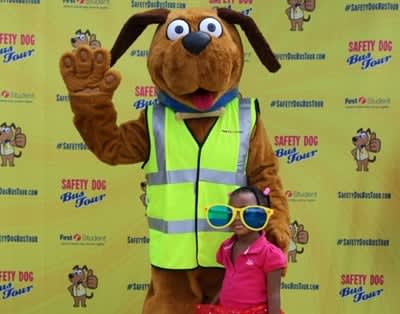
A student poses with First Student’s “Safety Dog” as part of the company’s safety event in Woodland Hills, Pennsylvania, in 2016.
3. Student Safety DVD Courses Tailored for Age
A cost-effective option that schools can use year after year is student safety DVD courses from the School Bus Safety Co. Jeff Cassell, president of the company, consulted educational experts to produce three courses to teach children about school bus safety.
A five-section course addresses the pre-K to grade 2 group. “Mrs. Mary” teaches children how to cross the street and safe practices inside the school bus, Cassell explains. To appeal to children of various learning styles, the production uses both real people and animation, featuring Hoppy Rabbit and Pengie Penguin. The pre-K to grade 2 course costs $275.
For grades 3 to 5, the company uses a “magic tent” to deliver its message, in which a brother is teaching his younger sister about safety. This three-part course costs $220. In 2013, the program won a Silver Telly Award in the safety category.
For the sixth grade and up course, which costs $150, “We just give them the facts,” Cassell says. “They already know everything, so you’ve got to present it to them with no gimmicks.”
For grades 3 and up, Cassell adds, “I involved experts to do an overview of what bullying is, why not to be a bully, why not to be a bystander, and what to do.”
All three courses can be purchased for $600 at schoolbussafetyco.com.
4. Creating a Fun Student Safety Event
In 2015, First Student introduced the Safety Dog program with a floppy-eared mascot to teach students simple but effective safety tips in a fun and memorable way, says Teresa Cole, First Student’s senior eastern safety director.
“Children get to walk a yellow carpet [and] pose for a photo, sort of like an Emmy event,” she adds.
Posing with Safety Dog, kids have the opportunity to wear fun costumes, sunglasses and feather boas.
“We encourage parents to attend the event with their children,” Cole says. “Children sign a safety pledge and leave with a bag of goodies.” Goodies include pens, bracelets, and sunglasses. Children also receive a coloring book created specifically for First Student, complete with safety tips taught during the program.
The Safety Dog program is free of charge to schools partnered with First Student.
5. Robot Teaches, Entertains
Since robots are a big hit with kids, schools might consider Buster the School Bus and Barney the School Bus, remote-controlled miniature school buses created by Robotronics Inc. Buster, which measures 24-by-36-by-36 inches, blinks his eyes, talks, and teaches students about school bus safety.
Although young kids can have short attention spans, “When Buster rolls into the classroom, kids can’t help but stay focused,” says Erik Larsen, western sales representative for Robotronics.
More than 50% of the robotic buses are purchased through federal and state grants or private funds, Larsen points out. Often schools ask a local company to sponsor a purchase of a bus. In return, the company receives federal tax write-offs, goodwill in the community, and advertising. School districts, bus companies, and sponsors can also purchase custom decals for their Buster or Barney with their logo on the side for an additional $250.
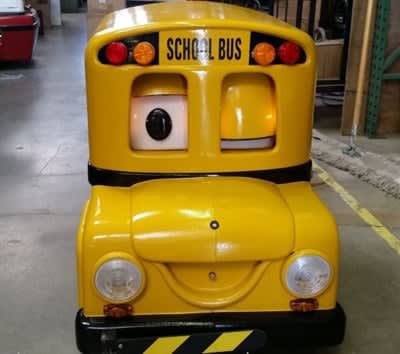
Robotronics’ remote-controlled school bus robots, Buster and Barney, capture the attention of young students to teach them safety lessons. Shown here is Buster the School Bus, ready to roll into classrooms.
Benefits of school bus safety programs
One doesn’t have to look far to see the benefits of student safety programs. Issaquah’s Morgan recalls an incident that could have had a tragic outcome were it not for the district’s safety training.
“Some kids got off the bus and were waiting for the driver to motion them across the street. The driver had her hand up and the kids had stopped, making sure she had control of the traffic, when a car zoomed past her [bus] into oncoming traffic. If the kids had stepped out without watching the driver, one of them could easily have been hit.”
Meslin recounts a story he heard from a teacher at Newport-Mesa: A child was about to squeeze between two buses parked at the curb because he spotted his mom at the far end of the parking lot. Standing next to him was a non-verbal third-grader who received the BIC safety training. He held out his arm and stopped his friend from crossing in front of the bus.
While the student wasn’t injured, he was in danger, Meslin says.
“That’s the way kids get hurt in the loading zone, darting out from behind a bus, being invisible to the driver.
“Those of us in pupil services recognize decreased liability is a cost savings,” Meslin adds. “Not just in doing what’s right for kids, but avoiding lawsuits because you taught kids how to be safe around school buses for the rest of their lives.”
More Safety
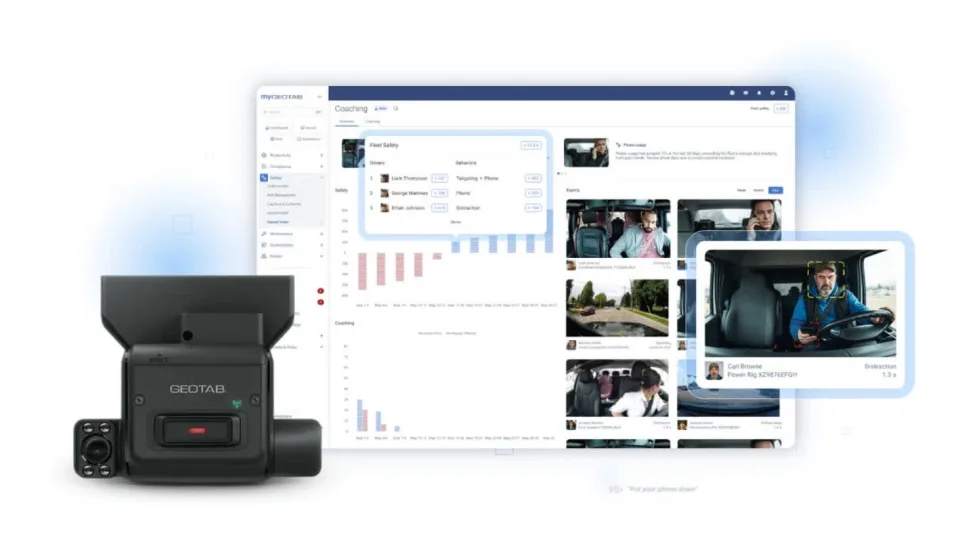
Geotab Expands Fleet Safety Tools With Video Coaching, Risk Insights
New safety and video capabilities aim to help fleet managers assess risk, support drivers, and take targeted action through video coaching, red-light violation detection, and more.
Read More →
How to Build a Better School Bus Driver Training Program
Is it time to strengthen your driver training? Here’s how to pick the right talent and improve recruitment, retention, and safety. This video is brought to you by IC Bus.
Read More →
Recent School Bus Accidents Leave 2 Dead, 2 Injured
Four school bus crashes in Florida, Illinois, and Georgia highlight risks in transportation lots, at bus stops, and during student loading and unloading.
Read More →

When Every Second Matters, Clarity Keeps Routes Moving
From routine delays to urgent incidents, strong communication practices help drivers, dispatchers, schools, and families respond with confidence.
Read More →
What Happens When a School Bus Catches Fire — and What Can Help
School bus fires are rare but can be devastating. Learn how advances in fire suppression and asset protection help fleets detect fires earlier, reduce damage, and improve safety.
Read More →
Geotab Launches Tool to Help Fleets Investigate Road Incidents
Geotab Investigations combines telematics data, video, documents, and other evidence to help fleets reconstruct incidents, resolve claims, and determine what happened.
Read More →
Texas Sixth Grader Wins 2026 National School Bus Safety Poster Contest
Sai Darshana Yekolu of Moseley Middle School in Prosper, Texas, was named the newest winner for her artwork, bringing the theme of “Safe Rides, Everyday Heroes” to life.
Read More →
Doing More With Less: How Transportation Directors Can Prioritize Safety Amid Budget Uncertainty
With diesel prices soaring and nearly one-third of transportation directors expecting budget cuts, maintaining student safety has never been more challenging. Download this guide to learn how leading districts are prioritizing risk, funding critical safety technology, and building stronger budget cases with data.
Read More →
Walton County Schools Adds Gatekeeper Stop-Arm Enforcement System
The Florida district will deploy Gatekeeper’s updated Student Protector technology, which now incorporates AI to improve video evidence.
Read More →
How To Build a More Secure School Bus Yard During and After Hours
As thefts and overnight security threats continue, school transportation leaders are combining stronger operational practices with AI-enabled surveillance to better protect buses, facilities, and staff.
Read More →