




NHTSA's David Strickland: school bus defender
On David Strickland’s watch, the National Highway Traffic Safety Administration has publicly supported the safety record of the yellow bus and has launched a campaign to promote ridership. In an exclusive interview with SBF, the administrator discusses these topics and reaffirms the agency’s decision to not mandate seat belts on large school buses.

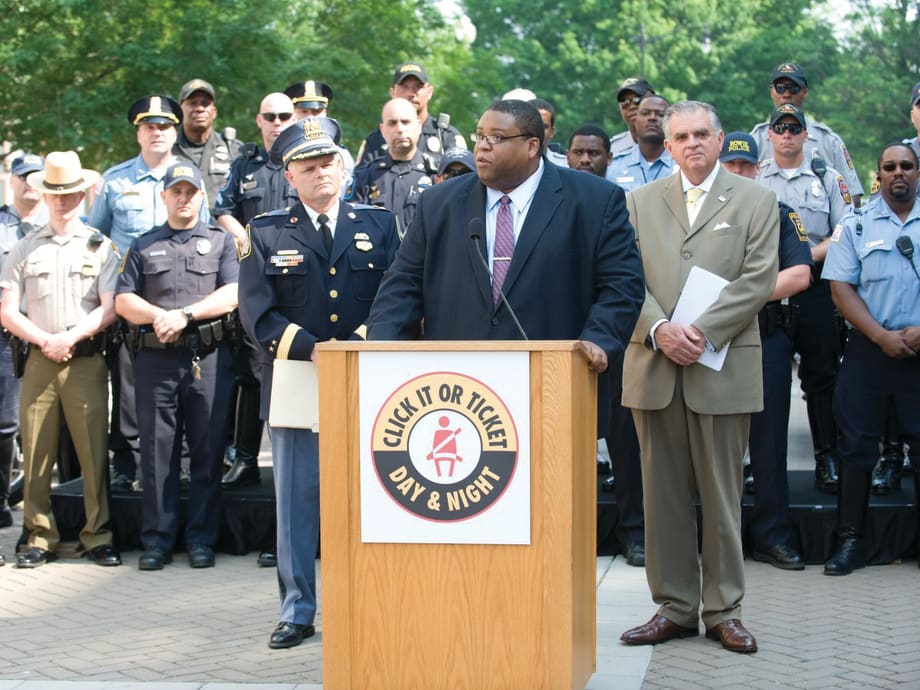
NHTSA Administrator David Strickland (at podium) speaks at a “Click It or Ticket” event last year. At right is U.S. Transportation Secretary Ray LaHood.
When David Strickland spoke to state pupil transportation directors at their conference last year, he used a term that seemed to resonate with the audience: “the humble yellow school bus.”
While the yellow bus may indeed be a modest and utilitarian form of transportation, Strickland, the 14th administrator of the National Highway Traffic Safety Administration (NHTSA), has made efforts to raise its profile and champion its successes.
On his watch, NHTSA has publicly supported the safety record of the school bus and has launched a campaign to promote school bus ridership.
Strickland discussed these and other pertinent topics in an exclusive interview with SBF Executive Editor Thomas McMahon.
Persuasive campaign
Last fall, NHTSA unveiled a series of posters that detail the benefits of school bus transportation.
The three posters (which are available here) show parents with their kids next to a school bus silhouette and the header “My choice … their ride.” Each one has an eye-catching chart and facts on why parents should choose the school bus over other modes of transportation for their kids.
“Students are about 50 times more likely to arrive at school alive if they take the bus than if they drive themselves or ride with friends,” one of the posters declares.
Another poster describes the many safety features of school buses, while the other focuses on the environmental and traffic benefits of opting for the yellow bus.
Strickland told SBF that the materials have been very effective in spreading their message.
“We’ve gotten a tremendous amount of press — almost 200 articles as of this past February, and a number of other radio impressions,” he said, noting that the goal is to make the impression on parents that the school bus is the safest way for their children to get to and from school.
Seat belt decision
NHTSA supported that safety contention last year when the Center for Auto Safety and other entities petitioned the agency to mandate three-point seat belts for all school buses. (They are federally required only on school buses weighing 10,000 pounds or less.)
NHTSA denied the petition, explaining that “for large school buses, we have determined there is not a safety problem warranting national action to require the addition of lap-shoulder belts to these vehicles. Large school buses are very safe due to their greater weight and higher seating height than most other vehicles, high visibility to motorists, and occupant protection through compartmentalization.”
Strickland said that NHTSA is constantly questioned about why it has not required belts on large school buses, but he reaffirmed that “the agency made the right decision in denying that petition.”

At last year’s conference of the National Association of State Directors of Pupil Transportation Services, Strickland touted the safety and environmental benefits of the “humble yellow school bus,” as he called it.
The administrator pointed to NHTSA’s analysis of the possible consequences of a national requirement for seat belts on large school buses. It found that such a requirement would increase the cost to purchase and operate the vehicles, which could reduce the overall availability and ridership of school buses.
Under those conditions, the agency estimated that the increased risk from students finding alternative, less-safe means of getting to and from school could result in an increase of 10 to 19 school transportation fatalities annually.
But Strickland noted that not all school districts and communities are equal — some do have the resources to equip their buses with belts without reducing service.
“If there is a community that can afford to maintain their school buses with belts, they are free to do so,” he said. “Because, ultimately, for us the question is safety. We want to keep the biggest number of buses on the road as possible. And we can talk about the margin of improvement after that.”
Congressional comments
In March, Strickland again publicly defended the yellow bus. In testimony during a House subcommittee hearing on motor vehicle safety provisions in House and Senate highway bills, the NHTSA administrator was questioned about school bus safety.
Rep. G.K. Butterfield of North Carolina mentioned an “awful, awful” bus crash that occurred in his district some 25 years ago in which all of the children on board were killed, he said.
Butterfield said he had just learned that school buses don’t fit within the definition of motorcoaches. NHTSA is developing a final rule that will require lap-shoulder belts on motorcoaches, and the congressman asked Strickland about whether such equipment should be included on school buses.
[PAGEBREAK]

Strickland says that riding the school bus as a kid fostered friendships and independence.
Strickland said that while states could mandate seat belts on large school buses in their jurisdictions, there is not a national mandate, nor would school buses be included in the rulemaking for motorcoaches.
“The reason is this,” Strickland told Butterfield in the hearing. “The safest form of transportation for children is a school bus. Period.”
The administrator went on to say that there are “a handful” of school bus rider deaths per year, most of which occur outside of the vehicle. He also cited the protection that compartmentalization provides for school bus occupants.
Going beyond safety
For all of his comments and focus on safety, Strickland identifies other benefits of the yellow bus — some not as easy to measure.
“I think there’s a number of things that the school bus provides; there are so many equities that are so valuable as we go into a modern era, especially of Generation Y younger kids living a digital lifestyle, being more and more separated,” he told SBF. “One nice thing about the school bus is it is sort of a notion of community for children that we can maintain, in addition to making sure that they get to school efficiently and safely every single day.”
The administrator also noted that riding the school bus can help children in forming “good transit habits and recognizing the fact that transit is a greener, capable way of getting yourself to places. I think it’s especially an important message these days as we go to a much more congested traffic environment.”
But Strickland’s admiration for the “humble yellow school bus” seems to reach beyond its benefits.
“Maybe it’s in my blood,” he acknowledged.
In fact, Strickland’s grandfather worked in pupil transportation.
“He was a farmer in Wrightsville, Ga., but he drove a school bus,” Strickland said. “In my digital picture frame, there’s a picture that rotates through of my grandparents’ front porch, looking over the plants that are on the ledge. But in the distance is my grandfather’s school bus.”
Safe student transportation is a tradition that Strickland aims to protect.
“We at NHTSA are doing anything we can to be supportive,” he said, “and really assist localities in how we can keep the yellow school bus going.”
Formative experience on the bus
Growing up and going to school in Atlanta, David Strickland had a long school bus ride. Strickland has said that he was bused across town about an hour and a half “because of the needs of diversity … to make sure that there were students of color across town.”
Despite those circumstances, he told SBF that riding the school bus fostered friendships and independence.
STRICKLAND: I took the bus from probably first grade all the way up through graduation. For me, the bus was something where I had time with my friends. It also gave me a sense of autonomy as a kid, too. You know, I had Mom dropping me off at the bus stop when I was a little kid in elementary school. But when you take the bus as a middle schooler and a teenager, you’re pretty much on your own schedule from your parents. You have to get yourself out to the bus every day — it’s your responsibility to get there.
For me as a school kid, I liked the bus. I thought it was a great opportunity to catch up with friends, to catch up with whatever video games were going on. It was a positive experience.
It’s also about the values not only from your parents about schooling, but the school itself. If the school puts priority on making sure the bus is a fun environment and a good environment, kids want to take the bus. I was blessed to have been at schools that really did want to make sure the bus environment was a very positive one.
School buses excluded from stability control proposal
Just before press time in mid-May, NHTSA proposed a new motor vehicle safety standard to require electronic stability control (ESC) systems on large commercial trucks, motorcoaches and some other large buses — but not school buses.
ESC systems have sensors that monitor vehicle movement and steering. They can help mitigate rollover incidents by using automatic computer-controlled braking, and they can aid the driver in addressing severe understeer or oversteer conditions that can lead to loss of control.
ESC technology has been mandated for cars and light-duty trucks, beginning with model year 2012.
NHTSA estimates that a standard requiring ESC on large trucks and large buses would prevent up to 2,329 crashes, eliminate an estimated 649 to 858 injuries, and prevent between 49 and 60 fatalities per year.
Along with school buses, transit buses are excluded from the proposed rule, which explains that in fatal crash data that were analyzed, “most of the transit bus and school bus crashes are not rollover or loss-of-control crashes that ESC systems are capable of preventing.”
However, the agency said that it “seek[s] comment on whether this proposal should be applied to the types of buses that are excluded from the proposed rule, such as school buses and transit buses.”
To view the proposal, click here.
More Management

How to Build a Better Driver Training Program
Ready to boost up your school bus instructor training? Here’s how to pick the right talent and improve recruitment, retention, and safety.
Read More →
CALSTART and Forth Combine to Form Catalyst Mobility
The new name represents a renewed vision for the nonprofit focused on advancing clean, equitable, and affordable transportation solutions that move people and goods.
Read More →
What Makes a Great School Bus Driver Trainer?
Choosing the right school bus driver trainer takes more than experience. Learn six keys to selecting and developing trainers and evaluating program effectiveness.
Read More →

School Bus Contractors Expand Through New Deals, Acquisitions & Partnerships
STA's Canadian division acquires Ontario-based G&L Stevenson Transport while Durham School Services adds a new district contract in California, First Student adds a New Jersey contract, and Minnesota Coaches acquires Halo Transportation.
Read More →
Logan Bus Company Rolls Out AI Phone System for NYC School Bus Families
A summer pilot found that AI agents could handle most routine calls, freeing up time for customer service staff to focus on emergencies and complex family concerns.
Read More →
From Intent to Impact: What I Learned About Leadership from TAPT
A Texas transportation supervisor shares lessons on self-awareness, accountability, managing stress and building trust — and why investing in leadership development matters at every stage of your career.
Read More →
NAPT Names 2026 Award Recipients, Hall of Fame Inductee
Who earned national recognition for their work in student transportation? This year, NAPT named five recipients of its 2026 awards for service, safety, and leadership, plus its newest Hall of Famer.
Read More →
2026 State of Student Transportation Report
Driver shortages. Rising costs. Growing safety expectations. More data, but not enough time to act on it. The 2026 State of Student Transportation Report reveals what transportation leaders say is putting the most pressure on their operations—and where they’re investing next. See how your priorities compare.
Read More →
How to De-Escalate an Angry Person: 5 Steps for Handling Workplace Conflict
What makes emotions run high, and how should you handle an angry colleague or parent? Follow these steps for staying calm, listening, showing empathy, and resolving conflict.
Read More →
What Readiness Looks Like This School Year
Learn about the challenges shaping the 2026–2027 school year, from persistent driver shortages and budget pressure to technology and readiness gaps. See how school districts are responding and adapting in Zonar’s 2026 Back-to-School Readiness Report.
Read More →