




News from the World of Pupil Transportation
Road rage precipitates death of school bus driver BOSTON — The Nov. 30 death of a veteran school bus driver in an apparent road rage i...

Road rage precipitates death of school bus driver
BOSTON — The Nov. 30 death of a veteran school bus driver in an apparent road rage incident has had an emotional impact on the pupil transportation industry. Paul Keith, area general manager for Laidlaw Education Services in Boston, said he received comments and expressions of sympathy from drivers across the country following the death of Sandra Thomas, who drove a school bus for 27 years. Thomas was involved in an apparent altercation with another motorist, Dana Lombardi, on Nov. 30 while returning to the bus compound in the early evening. Witnesses say Lombardi drove off with Thomas clinging to the hood of his Volkswagen Beetle and then ran over her. He fled the accident scene but later turned himself in to police. Meanwhile, Thomas suffered fatal injuries. Through his attorney, Lombardi, who has been charged with manslaughter, accused Thomas of instigating the event by throwing herself in front of his car. Keith said his drivers are warned against leaving their buses in a traffic dispute, but said they are allowed to get out of the bus to exchange insurance information in the event of an accident. He said it’s possible that Thomas and Lombardi had been involved in a minor fender-bender, based on paint smudges discovered on the side of Thomas’ 14-passenger bus. Following the incident, grief counselors were dispatched to Laidlaw’s Boston terminal, which covers 621 routes for Boston Public Schools. Some of the drivers, Keith said, were devastated by the news. “I sat outside this building for more than a half hour with one driver, just holding her,” he said. “It was a real tough thing.” In the wake of the incident, Keith said some drivers have voiced concerns about leaving their buses, even after a minor traffic accident. “I told them they could call a dispatcher for assistance and stay in their vehicles until a safety supervisor arrived,” he said. Although Laidlaw has been holding road rage training sessions for its drivers for a couple of years, Keith said the next meeting likely will be an emotional one. “It has a lot more reality now,” he said. “We probably will have some school counselors in attendance.”
Kindergartner killed in bus stop accident
MARTINEZ, Ga. — A 5-year-old girl was run over and killed by her school bus on the afternoon of Tuesday, Jan. 9. Aleana Johnson, a kindergartner at Westmont Elementary School, apparently tripped over her shoestrings as she was crossing in front of the bus and wasn’t able to get out of the way as the vehicle pulled away. The bus driver, 22-year-old Robert Matthews, was placed on leave pending the results of an investigation. Johnson reportedly was struck by the front left fender and then the rear left tires. According to published reports, the crossing gate was extended. Her mother, Christy Johnson, told the Augusta Chronicle that Aleana was “beautiful, bubbly and full of life.”
Teen wins contest, initiates safety program
MULDROW, Okla. — Kyle Alderson, a ninth-grader at Muldrow High School in Oklahoma, not only won a state speech contest on school bus safety, he also convinced school officials to implement a district-wide school bus safety program. As winner of the second annual Oklahoma School Bus Safety Speech Contest, Kyle received a $1,000 college scholarship. The contest awards $3,000 in scholarships to finalists each year. An expansion to a national speech contest is in the works. Kyle’s winning speech, “Saving Timmy: School Bus Safety Awareness,” opened with a story about a 5-year-old boy named Timmy who is killed getting off the bus on his first day of school — because no one instructed him on school bus safety. At the end of his speech, Kyle revealed that Timmy was a fictional character invented to emphasize the importance of school bus safety programs. In researching his speech, Kyle discovered that the large majority of children killed in school bus accidents die while boarding or exiting the bus, not as passengers. This surprising fact prompted Kyle to campaign for a school bus safety program in his school district. “To think that something that simple kills so many kids each year,” Kyle said. “I thought something needs to be done about that.” With the help of Roger Sharp, superintendent of Muldrow Public Schools, and transportation director Phillip Davis, the district will implement a school bus safety program early this year. All students will receive at least one hour of instruction on bus safety from the Muldrow police safety officer, and safety information will be given to faculty and staff. “My goal was simply to make children, parents, staff, school officials, and all of the community aware of the dangers of riding the school bus,” Kyle said. He hopes the program he started will do just that, and that other communities will see the benefits of safety education and implement a similar program to save children’s lives. “I’m excited that children are being able to become educated and to be safer riding the school bus,” Kyle said.
Alabama billboard campaign targets stop-arm runners
MONTGOMERY, Ala. — The Alabama State Department of Education (SDE), in cooperation with the Alabama Department of Transportation and the Governor’s Office, has initiated a school bus safety campaign aimed at informing all motorists that Alabama law requires them to stop for school buses that are loading or unloading students. The first step in the campaign, unveiled at the State Board of Education meeting in December, is a public effort consisting of 90 billboards to be placed near interstate highways in six major metropolitan areas. The SDE spent more than $50,000 on the creation and installation of the billboards. As the next step in the battle, Alabama Gov. Don Siegelman proposed raising the fine for stop-arm runners to a minimum of $500. “We’ll push it as high as I can get it,” he told the Atlanta Journal-Constitution. The increased minimum fine, if approved, would cost a guilty motorist slightly less than the average weekly salary in Alabama. Siegelman said that the state has a serious problem with motorists passing stopped school buses. Two Alabama children were killed in loading and unloading accidents in the past three years. “I hope and expect the school bus safety campaign will increase awareness about this critical safety issue,” he said.
Fanciful wall art created by bus technicians
LIVONIA, Mich. — The fleet maintenance building at Livonia School District is unremarkable in many ways — except perhaps for the fully lighted school bus protruding from its brick exterior. This unusual “wall art,” which acts as a sign for the fleet maintenance department, is an exact replica of the front section of a Thomas MVP model bus, according to its architect, Fred Krueger, the district’s fleet maintenance supervisor. Krueger said he wanted to create a unique and eye-catching sign for his department. The idea had been percolating for a couple of years before he proposed it to operations director David Watson, who approved. “I thought it was clever,” said Watson. After receiving the green light from Watson, Krueger and six fellow mechanics started the project during the summer and finished it in September. Krueger said the sign is based on the dimensions of a real bus, 8 feet wide and 10 feet high. The maintenance team used donated scrap parts, painted them “national school bus yellow” and wired the completed unit so it had functional lights. Response to the sign, which Krueger said symbolizes the pride he and his coworkers feel toward their department, has been positive. The greatest satisfaction, Krueger added, comes from seeing how the sign makes people smile. “People could be having a bad day, but when they see the bus up there, they get a kick out of it,” he said.
Superintendent communicates on the bus
KUNA, Idaho — Doug Rutan has a professional mission statement: to serve, to care, to empower and to make a difference. As superintendent of Kuna Joint School District No. 3, Rutan achieves just that — every time he climbs behind the wheel of a school bus. By driving students to their activities, Rutan has been able to combine his affinity for school buses with staying in touch with his district. A few times during the month, Rutan drives students to their sports, drama, choir or band functions. The idea to drive a school bus evolved from his fascination with the vehicles. Presently, Rutan is leading a restoration of a 1937 International school bus and continues to add to his collection of more than 75 toy school buses. Rutan said that driving the students is “a great opportunity to get to know them better.” He hopes the students view him as a good role model and as someone who cares and acknowledges their potential. What Rutan gains from his experiences of driving the students is a perspective on life, particularly when dealing with job stress. “It brings it down to such a simple level of just individual kids, and making a difference in their lives,” said Rutan. The transportation department and the bus drivers themselves also see benefits from Rutan’s additional role as bus driver. “Doug really understands the needs of the transportation department because he also is a part of our organization,” says Linda Braswell, driver trainer for the district. One need that Rutan has addressed is making sure that accommodations for overnight trips are located in good areas of communities. Also, if there is a shortage of drivers, Rutan will always fill in. Rutan said he is enjoying his second career more as the years pass because he gets to know a greater number of students, and it is his way of showing appreciation for other bus drivers.
Description of 1999-2000 'danger zone' fatalities
TOPEKA, Kan. — Twenty-two children were killed in school bus loading/unloading accidents during the 1999-2000 school year, according to an annual survey performed by the Kansas State Department of Education’s School Bus Safety Education Unit. That’s a 22 percent increase over the previous year, in which 18 fatalities were reported. The following are summaries of the circumstances of the fatal incidents.
A 5-year-old girl exited the bus and walked away from the danger zone. While climbing over the newly plowed snow, she fell under the right rear wheels of the bus and was struck and killed.
A 5-year-old girl exited the bus and waited a few minutes before walking in front of it. The driver pulled ahead, hitting the girl as she attempted to cross in front of the bus, causing her to lose balance. She regained her balance and tried to hurry across the road again and was struck and killed by the front of her bus.
A 5-year-old boy exited the bus. As he crossed in front of it, he apparently came back to pick up some papers that he had dropped and was struck and killed. The bus driver said he checked everything, but then felt a bump from the rear wheels.
A 5-year-old girl was struck and killed by a passing motorist while attempting to cross the road to catch her bus.
*A 5-year-old girl exited the bus and walked around to the front of it to cross the street when the driver pulled forward and struck and killed her.
A 5-year-old boy was running to catch his bus. He ran in front of the bus and was struck and killed.
A 6-year-old girl exited the bus, walked in front of it and was struck and killed.
*A 6-year-old girl exited the bus and was struck and killed by the front of the bus, which had stopped directly in front of her home.
A 6-year-old boy exited the school bus. The driver did not see the student, and the boy was struck and killed by the front of the bus.
A 6-year-old girl exited the bus, crossed in front of it and was struck and killed by a passing motorist. The driver of the approaching vehicle said she did not recall observing any signals that would indicate the bus was unloading passengers.
A 6-year-old girl exited the bus and was struck and killed by a vehicle that was passing on the right shoulder of the road.
A 6-year-old boy exited the bus and was struck and killed by a passing vehicle.
A 7-year-old girl was struck and killed by the front of her bus outside her elementary school. Officials are not sure what happened, but they think she was running along side the bus when she fell under the right front wheels.
A 9-year-old boy exited the bus, crossed in front of it and was struck and killed by a passing motorist who had failed to stop for a group of children exiting the bus.
A 9-year-old boy was waiting at the bus stop when, in an unexplainable manner, he was struck and killed by the right rear wheels of the school bus. Officials stated that they are not sure whether he was running for the bus or whether he slipped on some wet grass and fell under the wheels.
A 9-year-old girl exited the bus and was struck and killed by a passing motorist. The driver had activated the red flashing lights.
A 9-year-old boy and his sister were waiting for their bus. A passing motorist attempted to stop, but his vehicle apparently experienced mechanical brake failure. The driver swerved left and drove in front of the bus where the boy was waiting, striking and killing him.
*A 10-year-old boy was struck and killed by a vehicle while crossing the road to wait for the school bus.
*A 10-year-old girl was exiting the bus to go to school when her clothing got caught in the school bus door. She was dragged about 10 feet.
An 11-year-old boy exited the bus, ran to the back of the bus and slapped a passenger’s hand. The student then attempted to cross the roadway behind the school bus, possibly to a mailbox, and was struck and killed by a passing motorist.
A 13-year-old girl was struck and killed by a fast moving vehicle that whipped around two other vehicles, striking and killing her as she crossed the road to board her bus.
A 14-year-old girl and her brother were waiting for their bus. A passing motorist attempted to stop, but his vehicle apparently experienced mechanical brake failure. The driver swerved left and drove in front of the bus where the girl was standing. The motorist struck and killed the girl. *Michigan responded with four fatalities and no detail. The accident summaries were obtained from newspaper articles.
How much are school bus drivers really worth?
If they could be paid for 40 hours per week, 52 weeks per year, what should drivers’ annual salary be?
This was a recent Question of the Month in the Forum. Here are some of the responses: Pay drivers like professionals
Bus drivers are worth as much money as any professional in a school system. However, there is an attitude that if you don’t teach in a classroom, you are less valuable to the organization. True value is usually determined after an accident. If you want a professional driving team, you have to pay and treat your employees as professionals and not just as warm bodies that happen to have CDLs. Barry Brooks
Supervisor, purchasing and transportation
Minot (N.D.) Public Schools Drivers need to negotiate pay
In our organization, we have begun getting together and discussing what we want to ask for from the school board. We meet with the superintendent and with the school board secretary to let them know what type of raise we would like and what we would like for benefits. We put it in writing and walk it around to the other drivers. Everyone gets a say and we put it all together as best we can. Then — we ask. We always get something that we want, though no one is ever going to get rich driving a school bus. In negotiating insurance coverage, we figured out how much a 40 hour-a-week employee contributes toward it and asked for an amount based on the hours we work. We also included in that the hours for extra runs — athletic events, field trips, etc. — because many employees drive 30 to 40 hours a week. I work in the school, too, but my bus driver’s pay is just as important (maybe more so). Administration has been pretty receptive to us asking for what we want. Don’t get me wrong, if we asked for $40 an hour, we wouldn’t get it, but asking for a reasonable increase and reasonable benefits works. Try that. Don’t go off mad, like children with a temper, but put it in writing. Call around to other districts in the area or in your athletic conference and compare. That is how you will get what you need to make it as a bus driver. Jackie R. Webster
School Bus Driver
Nevada (Iowa) Community School District Mechanics deserve more, too
In my area of the country, wages range from $6-and-something per hour to $15 per hour and some even higher. Is the job worth a living wage? You bet! Unions don’t seem to be an answer either, as some of the lower paid positions are union represented. Go figure! While I’m on my soapbox, how about this — bus mechanics, the seldom seen, always present group of people who work their tails off to keep buses on the road and safe, don’t always earn a living wage either. For instance, a bus mechanic in the private sector will earn approximately 25 percent more in any given year than one who works for a contractor or a school district. Besides that, he or she doesn’t get called out at night or have to show up hours before route time to get buses started to warm them up. Curt Swanson
Williamsville (Ill.) County
Unified School District 15Simulator expected to sharpen driver skills
RALEIGH, N.C. — A state-of-the-art driving simulator specially adapted for school buses is being used to screen and train drivers at Wake County Public Schools. The goal is to improve their response to road distractions and to heighten their observational abilities. “I’m very excited about it,” said Wyatt Currin, the district’s transportation director. “I think it will really help our safety program.” Currin said the most likely candidates for the simulator will be new drivers and those who have been involved in accidents as well as veterans who simply need to sharpen their skills. The simulator combines 3-D graphics with a curved projection screen that provides a 180-degree peripheral display. Attached to the base of the dome screen is a platform with a seating position, steering wheel and foot pedals. The simulation consists of a series of levels, beginning with a practice level to get the driver accustomed to the simulation. The four subsequent levels increase in difficulty as the driver encounters more distractions, such as swerving vehicles, traffic signals, animal crossings and pedestrians. A narrator gives directions throughout the test, and drivers are directed to click a paddle when a stop sign or red light appears and to press and release the brake pedal when brake lights of a car are visible. The test lasts about 15 minutes and concludes with an evaluation of the driver’s performance. Scoring is based on a percentile ranking for particular areas of skill such as steering, braking and decision-making. Software called Profiler assesses the driver’s weaknesses and strengths and provides recommendations for areas of improvement. The Profiler software, which was originally developed for use by the state police, was donated to Wake County Schools in December by the SAS Institute. According to SAS Institute spokeswoman Polly Guthrie, the software was given to the district as a gesture of good will on the part of Andre Boisvert, the company’s president. She said the company has no plans to market the software to the school bus industry. The simulator’s curved projection screen, called a VisionStation, was developed by the Elumens Corp., which worked in conjunction with the SAS Institute. The screen is nearly five-feet high and envelopes the user in 3-D graphics. The cost of the VisionStation alone is approximately $23,000. Jonathan Serxner, a 12-year driver for Wake County, was the first bus driver to test the Profiler system. “It has a lot of potential,” he said, noting that driving a school bus can be comparable to driving a law enforcement or emergency vehicle. “School bus driving can be a high-stress occupation.”
FirstGroup enters Canadian market
REGINA, Saskatchewan — British-based FirstGroup, parent of the second-largest school bus operator in the United States (First Student Inc.), has purchased Saskatchewan’s Hertz Group of school bus companies for $24.5 million. With 735 school buses and paratransit vehicles, the Hertz Group was the third-largest school bus operator in Canada. FirstGroup’s new Canadian operations, First Bus Canada, will be based in Regina and headed by Brad Hertz, president and CEO of the Hertz Group. “We’ll take the best practices that FirstGroup has and the additional depth they have in resources and overlay them on our existing structure,” said Hertz. All Hertz Group employees will be retained and new staff may be added for further expansion in the Canadian marketplace, said Hertz. “FirstGroup is a stable, profitable company with a lot of resources. They have seven or eight people in their IT department, whereas before, as a private owner, I was the IT department,” explained Hertz. Hertz said the purchase, which includes the Hertz Group’s subsidiary companies such as Wayne Bus, has been in the works for almost a year. “There was a lengthy negotiation process. In the end, FirstGroup and the Hertz family both came out of it feeling they got an adequate deal,” he said. FirstGroup is the United Kingdom’s largest bus operator and one of its largest train operators. The acquisition of the Hertz Group represents its first venture into the Canadian school bus market.
More Management

EverDriven Launches Route Consolidation Calculator to Estimate Diesel Savings
As diesel prices hit record highs, the largest alternative transportation provider says a 10% route consolidation could save a 120-route district more than $78,000 a year in fuel alone.
Read More →
Zum Secures Continued Financing Support for School Bus Expansion
Generate Private Credit has financed approximately $75 million in school bus deployments across three states, supporting more than 500 buses as Zum expands across the county.
Read More →
Beyond Discipline: A Different Approach to Student Behavior on the Bus
After implementing a dean of students program in Oregon, North Clackamas is seeing positive improvements. Here’s how it worked. The Route is brought to you by IC Bus.
Read More →
A Dean of Transportation's Different Approach to Student Behavior on the School Bus
After implementing a dean of students program in Oregon, North Clackamas is seeing positive improvements on the bus. Here’s how it worked.
Read More →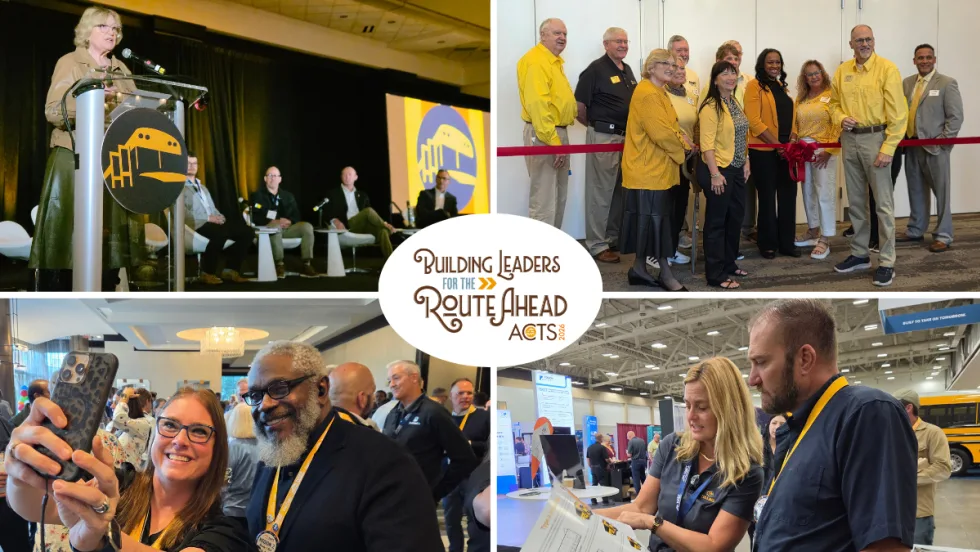
Inside NAPT ACTS 2026: Highlights from Louisville
From federal updates and student behavior strategies to new school bus technology and industry awards, see highlights from NAPT ACTS 2026 in Louisville.
Read More →
Meet the 2025 School Bus Driver Hero Winner: Annette Brown
We caught up with Wa-Nee Community Schools' Annette Brown on site at SBFX, where she was named the 2026 School Bus Driver Hero Award winner. Hear about her reaction, what she loves most about being a school bus driver, and more!
Read More →
Predictability Is Like Ketchup (According to 6-Year-Olds)
To students, a different school bus can feel like a full-blown crisis. One driver reflects on why familiar routines, showing up on time, and being reliably boring matter more than we think.
Read More →
Samsara Launches Free Driver Rewards Program
The new Driver Perks program gives eligible professional drivers access to discounts and offers without adding a cost for participating fleets.
Read More →
How Tax-Exempt Municipal Leases Can Help Finance School Buses
Let’s explore school bus financing options, including municipal leases, vendor payable accounts, and balloon payments, and how they can help stretch fleet budgets.
Read More →
Nominate Rising School Transportation Pros Under 40!
We’re searching for the next generation of leaders making an impact across the K-12 student transportation industry to recognize as SBF’s 2027 Trailblazers. Nominations are open now!
Read More →