




New Jersey district embraces new ideas and saves big
Medford Township Public Schools continually seeks out opportunities to grow its sustainability practices, reduce transportation costs and generate revenue, which have been accomplished through such initiatives as a solar project, shared bus service and running vehicles on biodiesel. From the solar project alone, the district has realized savings of $300,000 annually.


Medford Township Public Schools has solar roof and ground arrays at seven locations, including its transportation facility. Pictured is the district’s Chairville Elementary School and the transportation center.
As Medford Township (N.J.) Public Schools’ transportation department focuses on safely transporting students to and from school each day, there is also considerable effort among officials to reduce the district’s carbon footprint and save money or generate revenue.
The district has accomplished all of this under several initiatives, including a solar project, running all of its school buses and other vehicles with diesel engines on B20 biodiesel and sharing transportation services with a neighboring district.
Joe Biluck Jr., director of operations and technology for Medford Township Public Schools, has spearheaded many of these projects with his colleagues in the district’s business office.
Most recently, the district has begun working to partner with the New Jersey Sustainable Schools Project to develop a best practices model for districts to identify cost savings in recycling, resource use, energy conservation, etc.
“It provides a benchmark for school districts to review against their operations,” Biluck explains. “For example, if a K-8 district’s utility costs are $400,000 a year, we can compare those costs against a high-performing school district and what it’s paying for its utility costs and share the various measures a school district could implement to achieve those costs, and you can develop a strategy based on those practices.”
Biluck adds that this partnership is designed to spread the word about what his district has done, which could help others.
“What we’re finding is that there’s not a lot of awareness about these practices, how they can be implemented and the benefits that are associated with them,” he explains. “We feel as though it’s our responsibility, since we’ve been successful, to share this information with folks.”
Solar project, sustainability practices
Two years ago, Medford Township Public Schools energized its solar electric generation panel system, which comprises panels at seven locations, including schools and the transportation center. Biluck says it is the largest solar array project for a K-8 school district in the state. The system generates just under 3 megawatts of power annually, which reduces the district’s utility costs by about $300,000.
To fund the $22 million project, the district developed a power purchase agreement, allowing it to enter a private-public partnership with an investment group that would pay for system installation, maintenance and operation. The district partnered with Nautilus Solar, which owns the system.
“We provided all of the assets on which to construct the ground arrays, the roof arrays and the parking canopies, and we entered into a long-term agreement to buy the power that’s generated,” Biluck explains. “So although the district does not own the system, where we benefit is that the kilowatts that are generated from those arrays are sold back to us at a fixed price with a fixed escalator; we’ve created a predictable rate for our power.”
Medford Township Public Schools has also adopted an aggressive resource and energy conservation program.
As an example, geothermal heating and cooling systems were incorporated into the construction of some of its schools. Biluck says that the initial costs were higher than non-geothermal systems, but incentive programs are offered through the state of New Jersey to help offset the costs. The district received approximately $400,000 for the geothermal systems from the state’s Department of Public Utilities after submitting an application for funding.
Biodiesel vehicles reduce operating costs
The district has also achieved cost savings by fueling its vehicles with B20 biodiesel for the last 15 years. Medford Township began running its first school bus — bus No. 74 — on the alternative fuel as part of a demonstration project in conjunction with the New Jersey Clean Energy Program and the U.S. Department of Energy (DOE). Biluck says the bus was the first in the state to run on the fuel.
“We purchased a fuel tank using funding provided by the U.S. DOE and started to do emission testing on some of the vehicles that were going to run on biodiesel so that we could develop an emissions profile prior to introducing the fuel,” he explains.
After the demonstration project ended, the district decided to run all of its vehicles with diesel engines on biodiesel.
“We continued to monitor the emissions program, and a report was released from the New Jersey Clean Energy Program — they found that the units running on B20 had a 2 cent per mile lower operating expense compared to the units running on diesel,” Biluck says. “The reduction is attributed to reduction in particulate matter, which extended the life of the exhaust systems, and increased lubricity in the biodiesel compared to the diesel, so the injection systems last longer. We weren’t replacing certain bus components on the biodiesel buses as frequently as we were on the diesel buses. That equated to about $10,000 a year, so over the last 15 years, we’ve saved $130,000 to $150,000.”
(Bus No. 74 was retired in 2011 after more than 13 years of service because of New Jersey’s mandatory retirement age for school buses.)
[PAGEBREAK]
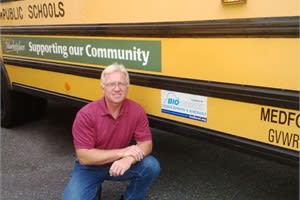
Earlier this year, Medford Township Public Schools began an advertising agreement with Murphy’s Marketplace, which Director of Operations and Technology Joe Biluck Jr. says will generate $48,000.
Shared service saves on bus purchases
Medford Township is not immune to the challenges that other districts face. Several years ago, four of the district’s buses were required to be retired due to their age, but funding for new buses was not available.
This prompted officials to reach out to a nearby vocational and technical high school district that serves high school students and adult learners; that district did not have enough bus drivers to satisfy the routes.
Under a shared service agreement that was drafted, Medford Township Public Schools provides the drivers to operate the other district’s routes, and in return, the latter district allows Medford Township to use its fleet of vehicles.
“That eliminated our need to buy school buses, and they pay us to maintain those buses and to provide the drivers to satisfy their routes,” Biluck says, adding that the districts are in their third year of shared service. Under the initial agreement, Medford Township saved around $250,000.
Bus advertising to generate revenue
In addition to cost-saving measures, Medford Township Public Schools has taken steps to generate revenue through school bus advertising. Earlier this year, the district secured a four-year sponsorship agreement with a local food marketing firm — Murphy’s Marketplace — and they worked together to develop ads for the district’s buses.
Under New Jersey law, ads for tobacco or alcohol products or for political advocacy are prohibited, as are any other advertisements for products or services or by sponsors that the commissioner of education deems inappropriate.
Fifty percent of any revenue generated by the sale of advertising space must be used by the local board of education to offset the cost of fuel for providing pupil transportation services. The remaining 50% of the revenue can be used to support any programs and services the board deems appropriate.
Biluck says the discussion to advertise on school buses began in 2007-08, when state aid for districts was significantly reduced. The agreement with Murphy’s Marketplace will generate a total of $48,000 for the district.
Biluck acknowledges the concern that some in the pupil transportation community have regarding the potential for advertisements to cause a distraction for motorists.
“That definitely came up during our correspondence with state legislators and as we were providing testimony as the legislation made it through the subcommittees,” he says. “The law is sensitive to that concern, and that’s why there are areas on the exterior of the bus that are off-limits for ads, including the back of the bus, so that as motorists are approaching the bus as kids are loading or off-loading, their attention’s not drawn to an ad. The advertisers have to put their decals on the sides of the buses at a point that’s below the line of sight.”
School board support is essential
Biluck says the success of the projects and partnerships that Medford Township Public Schools has developed has been contingent upon support from the district’s school board.
“The board gives us the necessary freedom to go out and investigate potential opportunities and bring those recommendations to them for review, providing justification for the opportunities, the positive impacts to the district, etc.,” he explains. “The board acknowledges that this is part of our responsibility and we have the best interests of the district at heart.”
Biluck notes that it is not always easy to gain support from a school board for new ideas, and he says that Medford Township Public Schools’ board has not always given the green light to his proposals.
However, the board has been largely supportive, and Biluck says he’s been able to achieve this positive working relationship by getting an understanding of the board’s priorities and coming up with ways that those priorities can “merge” with the opportunities that he believes would benefit the district.
“Once you understand their concerns and look at things from their perspective, you can develop a workable game plan,” Biluck says.
Fleet Facts
School buses: 52
Transportation staff: 75
Students transported: 3,500
Schools served: 7
Area of service: 42 square miles
More Management

How to Build a Better Driver Training Program
Ready to boost up your school bus instructor training? Here’s how to pick the right talent and improve recruitment, retention, and safety.
Read More →
CALSTART and Forth Combine to Form Catalyst Mobility
The new name represents a renewed vision for the nonprofit focused on advancing clean, equitable, and affordable transportation solutions that move people and goods.
Read More →
What Makes a Great School Bus Driver Trainer?
Choosing the right school bus driver trainer takes more than experience. Learn six keys to selecting and developing trainers and evaluating program effectiveness.
Read More →


School Bus Contractors Expand Through New Deals, Acquisitions & Partnerships
STA's Canadian division acquires Ontario-based G&L Stevenson Transport while Durham School Services adds a new district contract in California, First Student adds a New Jersey contract, and Minnesota Coaches acquires Halo Transportation.
Read More →
Logan Bus Company Rolls Out AI Phone System for NYC School Bus Families
A summer pilot found that AI agents could handle most routine calls, freeing up time for customer service staff to focus on emergencies and complex family concerns.
Read More →
From Intent to Impact: What I Learned About Leadership from TAPT
A Texas transportation supervisor shares lessons on self-awareness, accountability, managing stress and building trust — and why investing in leadership development matters at every stage of your career.
Read More →
NAPT Names 2026 Award Recipients, Hall of Fame Inductee
Who earned national recognition for their work in student transportation? This year, NAPT named five recipients of its 2026 awards for service, safety, and leadership, plus its newest Hall of Famer.
Read More →
2026 State of Student Transportation Report
Driver shortages. Rising costs. Growing safety expectations. More data, but not enough time to act on it. The 2026 State of Student Transportation Report reveals what transportation leaders say is putting the most pressure on their operations—and where they’re investing next. See how your priorities compare.
Read More →
How to De-Escalate an Angry Person: 5 Steps for Handling Workplace Conflict
What makes emotions run high, and how should you handle an angry colleague or parent? Follow these steps for staying calm, listening, showing empathy, and resolving conflict.
Read More →
What Readiness Looks Like This School Year
Learn about the challenges shaping the 2026–2027 school year, from persistent driver shortages and budget pressure to technology and readiness gaps. See how school districts are responding and adapting in Zonar’s 2026 Back-to-School Readiness Report.
Read More →