




NAPT News & Views — Seat belts on buses? You decide
NAPT and NSTA were informed that NHTSA’s best advice on the matter is in a single document: the 2011 denial of a petition that the agency mandate seat belts in large school buses.
Editor's note: This article, by NAPT President Don Carnahan and NSTA President Tim Flood, was published in the October issue of School Bus Fleet, before Carnahan died suddenly on Oct. 3. For more information, go here.
The call for belts on buses seems to ebb and flow each year, with the tide rising each fall when a new group of children begin riding the school bus. Their parents wonder why the children are required to buckle up in the family car but not in their school bus.
While this view has strong common-sense appeal, the National School Transportation Association (NSTA) and the National Association for Pupil Transportation (NAPT) — unlike others — have been and remain unwilling to embrace the mainly emotional rationale it embodies. Instead, we have held the position throughout our participation in federal rulemaking regarding seat belts and discussions with federal officials that the National Highway Traffic Safety Administration (NHTSA) should conduct research, evaluate the results and then clearly explain the information so everyone can understand it.
NAPT even formally petitioned NHTSA several years ago to do research and make recommendations that would enhance or even replace the current standards for school bus occupant crash protection and perhaps even lead to the next evolution in school bus occupant safety. They denied our request.
In the wake of recent recommendations from the National Transportation Safety Board (NTSB), NSTA and NAPT met recently with NHTSA officials, asking again for clarity on their perspective, and for additional crash testing to document benefits/unintended consequences of belt use.
NHTSA made it clear they are not planning to do additional crash testing of school buses using anthropomorphic test dummies (ATDs) and said, “NHTSA believes that both ATD test data and real world crash data of occupant kinematics and associated injuries, if available, are important to obtain a better understanding of restraint performance.” NHTSA also said, “Where human response and injury outcome in a crash environment are available, we consider both sources of information (ATD test data and real world crash data) when evaluating restraint performance.”
In addition, NAPT and NSTA were informed that the agency’s best advice on the matter of seat belts in large school buses — superseding all other guidance — is contained in a single document: the Aug. 25, 2011, denial of a petition from the Center for Auto Safety (CAS) and others requesting that NHTSA mandate seat belts in large school buses.
We urge you to read the entire petition denial notice carefully; it can be found via this link: schoolbusfleet.com/PetitionDenial.
From this point forward, the NHTSA petition denial is, and will remain unless it is superseded, the document NSTA and NAPT will reference whenever we are asked for our “position” on belts in school buses. And we believe the following are statements from that document that stand out:
• “NHTSA has considered the question of whether seat belts should be required on large school buses from the inception of compartmentalization and the school bus safety standards and has reassessed its decisions repeatedly. Each time, after analyzing the implications of a seat belt requirement and all available information, we have concluded that a seat belt requirement for large school buses has not been shown to be warranted.”
• “In large school buses, fatal rollover crashes are rare (approximately 1 crash per year, resulting in 2 fatalities annually), as are fatal side impact crashes in which seat belts would have prevented death or serious injury. Fatal non-rollover frontal crashes in large school buses are uncommon (less than 1 crash per year). Large school buses are already very safe vehicles. More important ... requiring seat belts on large school buses is likely to have the effect of increasing fatalities related to school transportation.”
• “After considering all views [including a recommendation by the NTSB — H-99-46], we could not agree with those asking us to propose to require seat belts on large school buses. We assessed the safety need for seat belts. Since school buses are already very safe and are the safest mode of school transportation, a seat belt mandate would result in very few benefits.”
• “We determined that it would be inappropriate for NHTSA to require seat belts given the low safety need for the belts, when such a decision has a direct bearing on the ability of the local decision-makers to allocate and spend limited pupil transportation resources on other school transportation safety needs that are likely to garner greater benefits, perhaps at lower cost.”
• “It is true that seat belts have been proven beneficial in rollover crashes. However, real world data show that school bus passenger fatalities and injuries in rollover events are rare. The CAS petition cites two school bus accidents in support of its position that there is a safety need for seat belts on large school buses. We cannot agree that citing these rare instances of fatal rollover crashes forms the basis for a finding of a problem of national significance that warrants trumping local policymaking on this matter.”
• “We believe that it is most appropriate if the decision to order seat belts on large school buses were left to the States and local jurisdictions rather than to NHTSA. States and local school districts are better able to recognize and analyze school transportation risks particular to their areas and identify approaches to best manage and reduce those safety risks. Local officials are in the best position to decide whether to purchase seat belts, since the officials must weigh a multitude of unique considerations bearing on purchasing decisions, especially when faced with budgetary constraints.”
NAPT and NSTA understand that these statements don’t bring perfect resolution to this long-standing issue, and some ambiguity remains. We regret this and will continue to try earnestly to seek clarity for you from federal regulators.
Moreover, we want to replace with unequivocal science-based information the emotional arguments and personal opinions that sometimes dominate the conversation on this subject. Until such time, however, NSTA and NAPT are confident that states, communities and local school transportation service providers will continue to make decisions that keep yellow school buses as the absolutely safest way for children to get to and from school, and indispensable to our public education system.
More Safety
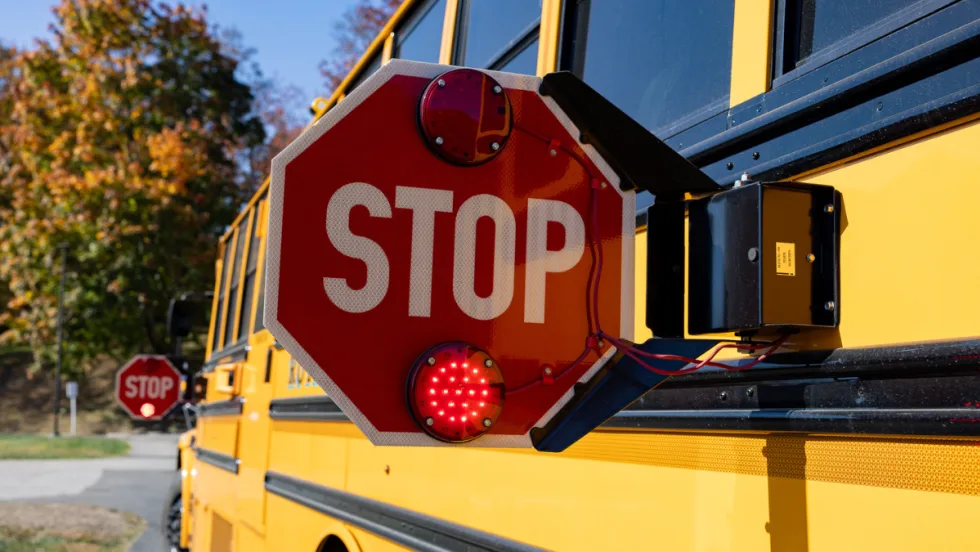
Illegal School Bus Passing Drops 24% in New York Districts
With fewer than 5% of citations involving repeat offenders, Westchester County officials said enforcement, education, and community partnerships are helping change driver behavior.
Read More →
School's Back. Here's What Happened to Traffic, Speeding & Distraction
What happens to traffic when school resumes? New data analysis examines changes in distracted driving, congestion, and speeding around schools.
Read More →
Geotab Expands Fleet Safety Tools With Video Coaching, Risk Insights
New safety and video capabilities aim to help fleet managers assess risk, support drivers, and take targeted action through video coaching, red-light violation detection, and more.
Read More →

How to Build a Better School Bus Driver Training Program
Is it time to strengthen your driver training? Here’s how to pick the right talent and improve recruitment, retention, and safety. This video is brought to you by IC Bus.
Read More →
Recent School Bus Accidents Leave 2 Dead, 2 Injured
Four school bus crashes in Florida, Illinois, and Georgia highlight risks in transportation lots, at bus stops, and during student loading and unloading.
Read More →
When Every Second Matters, Clarity Keeps Routes Moving
From routine delays to urgent incidents, strong communication practices help drivers, dispatchers, schools, and families respond with confidence.
Read More →
What Happens When a School Bus Catches Fire — and What Can Help
School bus fires are rare but can be devastating. Learn how advances in fire suppression and asset protection help fleets detect fires earlier, reduce damage, and improve safety.
Read More →
Geotab Launches Tool to Help Fleets Investigate Road Incidents
Geotab Investigations combines telematics data, video, documents, and other evidence to help fleets reconstruct incidents, resolve claims, and determine what happened.
Read More →
Texas Sixth Grader Wins 2026 National School Bus Safety Poster Contest
Sai Darshana Yekolu of Moseley Middle School in Prosper, Texas, was named the newest winner for her artwork, bringing the theme of “Safe Rides, Everyday Heroes” to life.
Read More →
Doing More With Less: How Transportation Directors Can Prioritize Safety Amid Budget Uncertainty
With diesel prices soaring and nearly one-third of transportation directors expecting budget cuts, maintaining student safety has never been more challenging. Download this guide to learn how leading districts are prioritizing risk, funding critical safety technology, and building stronger budget cases with data.
Read More →