




NAPT News & Views
I now live far from the Washington, D.C., pressure cooker of my working years. Folks here are not as immersed in the minutia of public policy as those in and around the nation's capital.
The troubling political climate
I now live far from the Washington, D.C., pressure cooker of my working years. Folks here are not as immersed in the minutia of public policy as those in and around the nation's capital.
That's not to say that folks out in the hinterlands aren't informed. With cable TV, talk radio and the Internet, Facebook, Twitter and more, news and information travels like greased lightning. Even if they don't understand the gobbledygook, they get the big picture and quickly filter it through their tried and true compass — common sense.
Therein lies the problem. They don't see much sense, common or otherwise, coming out of Washington, D.C., anymore. Instead, many see a blender full of acrimony and policies that don't sit well with them.
Populist frustration turned to anger is now reaching a crescendo. It's palpable — you can feel it. Just ask Scott Brown. He's the new junior senator from Massachusetts who understood the anger and won against all odds because he campaigned on common sense approaches that appealed to people of all political stripes, even in a state where there is mostly just one political stripe.
The natives — reasonable Democrats, Republicans (both have factions that are not reasonable) and independents alike — are not just restless anymore, they're disgusted and frightened.
My view: We have a leadership crisis in both political parties. Washington, D.C., is mostly out of touch. It's doing too many things that it shouldn't be doing and not a good job with core responsibilities. The Leviathan government is trying to expand and continue to eat in great quantities at a time when resources are scarce and most Americans are just trying to survive.
But the overriding concern is that our mind-boggling debt is unsustainable.
According to Sen. Judd Greg (R-N.H.), the debt and deficits will lead to "the financial meltdown of our nation." He ought to know — he sits on the committees on Appropriations; Banking, Housing and Urban Affairs; and Budget.
Speaking about a pending $410-billion spending bill, Sen. Evan Bayh (D-Ind.) said the bill "...requires sacrifice from no one, least of all the government. It only exacerbates the problem and hastens the day of reckoning."
Added to the frightening prospect of all the spending, every new revelation about more astronomical deficit spending, a tsunami of mortgage defaults, political corruption scandals and big bonuses for bank executives who needed federal bailouts serve to erode what little confidence is left in the system.
Never have I seen it as poisonous as it has become in the last year. The current health care legislative debate (if you can call it that) may be the straw that breaks the back of what microscopic civility is left.
A recent CNN/Opinion Research poll found that 73 percent of Americans said they were opposed to any health care legislation or that they wanted Congress to start over again. Just 25 percent wanted the legislation to pass. Even Warren Buffett, a strong supporter of the president, said the bill needed to be redrafted to reduce the cost and get rid of "nonsense." Yet, at this writing, the game plan by the White House and its majority in Congress was to press ahead, to use parliamentary procedures in Congress to force passage.
The political aftermath will make ugly look beautiful.
[PAGEBREAK]
We have reached the stage in our civilization where all the easy governing has come and gone. Today, as a mature civilization in a world of mind-boggling complexity, the issues are very daunting, the solutions neither clearcut nor painless, and passions on both sides of every one of them running at fever pitch.
Compromise historically has been at the heart of all good politics. We hear constant cries for bipartisanship. Bipartisanship in the abstract is undeniably desirable. Everyone says they want their members of Congress to practice it. But it amounts to just a lofty notion in a nation so balkanized. Because when you ask the next question, "Are you willing to compromise your position?" the answer often is not just "no," but "hell no."
We are a nation of Hatfields and McCoys when it comes to the difficult social and moral issues of our time. Bipartisan cooperation and solutions are very elusive. Credible research bears this out.
A recent Rasmussen poll found that just 25 percent of U.S. voters believe the country is headed in the right direction, the lowest level of confidence since early January 2009. A corresponding national telephone survey also by Rasmussen found 69 percent believe the nation is "heading down the wrong track," the highest number measured in 14 months.
As the noted political scholar Pogo once opined, "We have met the enemy and he is us." If we are unhappy with our government, we have a peaceful, Constitutional means of redirecting things every two, four and six years. Yet fewer than half of us vote. Let's all do our part next time to make sure more among us don't just sound off, but show up at the polls to do something constructive about our sentiments.
Barry McCahill is communications consultant for the National Association for Pupil Transportation.
More Safety
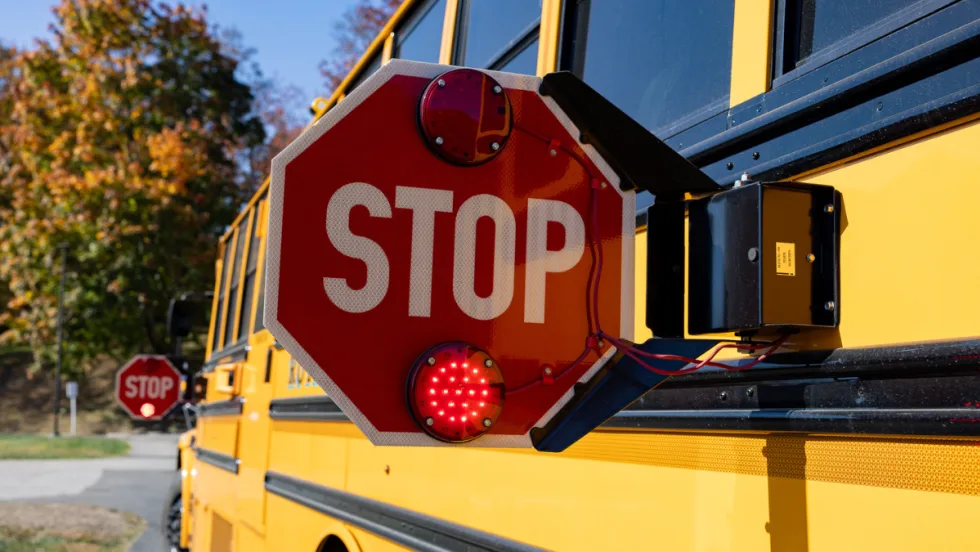
Illegal School Bus Passing Drops 24% in New York Districts
With fewer than 5% of citations involving repeat offenders, Westchester County officials said enforcement, education, and community partnerships are helping change driver behavior.
Read More →
School's Back. Here's What Happened to Traffic, Speeding & Distraction
What happens to traffic when school resumes? New data analysis examines changes in distracted driving, congestion, and speeding around schools.
Read More →
Geotab Expands Fleet Safety Tools With Video Coaching, Risk Insights
New safety and video capabilities aim to help fleet managers assess risk, support drivers, and take targeted action through video coaching, red-light violation detection, and more.
Read More →

How to Build a Better School Bus Driver Training Program
Is it time to strengthen your driver training? Here’s how to pick the right talent and improve recruitment, retention, and safety. This video is brought to you by IC Bus.
Read More →
Recent School Bus Accidents Leave 2 Dead, 2 Injured
Four school bus crashes in Florida, Illinois, and Georgia highlight risks in transportation lots, at bus stops, and during student loading and unloading.
Read More →
When Every Second Matters, Clarity Keeps Routes Moving
From routine delays to urgent incidents, strong communication practices help drivers, dispatchers, schools, and families respond with confidence.
Read More →
What Happens When a School Bus Catches Fire — and What Can Help
School bus fires are rare but can be devastating. Learn how advances in fire suppression and asset protection help fleets detect fires earlier, reduce damage, and improve safety.
Read More →
Geotab Launches Tool to Help Fleets Investigate Road Incidents
Geotab Investigations combines telematics data, video, documents, and other evidence to help fleets reconstruct incidents, resolve claims, and determine what happened.
Read More →
Texas Sixth Grader Wins 2026 National School Bus Safety Poster Contest
Sai Darshana Yekolu of Moseley Middle School in Prosper, Texas, was named the newest winner for her artwork, bringing the theme of “Safe Rides, Everyday Heroes” to life.
Read More →
Doing More With Less: How Transportation Directors Can Prioritize Safety Amid Budget Uncertainty
With diesel prices soaring and nearly one-third of transportation directors expecting budget cuts, maintaining student safety has never been more challenging. Download this guide to learn how leading districts are prioritizing risk, funding critical safety technology, and building stronger budget cases with data.
Read More →