




Max Christensen Brings Key Changes With Positive Leadership
At the Iowa Department of Education, Christensen has streamlined driver training. His involvement in professional organizations has also enhanced pupil transportation safety.

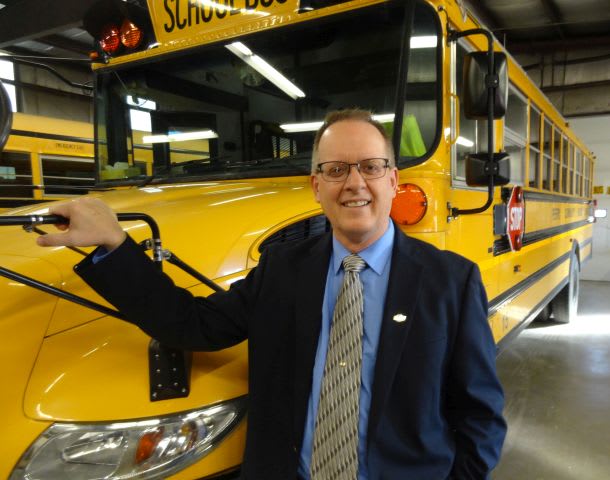
Max Christensen is executive officer at the Iowa Department of Education.
More than three decades ago, after Max Christensen literally helped a man out of a hole, he received a job offer in return.
“I was renting some farmland, and there was another gentleman [renting land] at this farm,” he recalled. “One day I was farming and he was out checking his cows, and had gotten stuck in a mud hole. I took my tractor down, hooked the chain on, and pulled him out.”
Christensen turned down payment from the man for his services, instead encouraging him to pay the favor forward. As it turned out, that favor seems to have been paid back to him.
His fellow farmer was also the transportation director at the nearby Anita School District at the time. About a year later, that man resigned and recommended Christensen as a replacement. Christensen agreed to an interview with the superintendent even though, he told him, he hadn’t been on a school bus since he was in high school.
“By the time I left his office, I had the position,” he says. “That’s how I got started in the profession.”
In his more than 30 years of work in pupil transportation, Max Christensen has applied his forward-thinking attitude to help grapple with major issues in the industry, such as driver shortage and using technology to increase efficiency, as well as to update training to keep his state and pupil transporters across the U.S. current on important issues.
Christensen also has exemplary communication skills that enable him to cultivate successful partnerships not only for the Iowa Department of Education, where he works as an executive officer, but with industry associations as well.
“He is a gifted communicator,” says Tom Cooley, bureau chief at the Iowa Department of Education, and Christensen’s supervisor. “Watching how he interacts with people, Max is very friendly and knowledgeable, and has a good sense of humor.”
Christensen has managed in the 16 years that he has worked for the department to improve efficiency and enhance safety for students by bringing the state’s driver training and school bus inspection systems online, and by spearheading projects that test technology such as supplemental warning lights on buses.
Cooley says that Christensen’s accomplishments include ensuring that the department, in particular the Bureau of Finance, Facilities, Operation and Transportation Services, is always apprised of transportation trends.
Beyond his work for the state department, Christensen’s efforts have been effective on a national level. He is deeply involved in professional organizations, having bolstered the efforts of the National Association of State Directors of Pupil Transportation Services (NASDPTS) by serving as a board member, president, and past president over the last several years, and helping to clarify important positions, such as the association’s stance on seat belts. Moreover, he has helped NASDPTS continue to support the National Congress on School Transportation (NCST) by taking the lead in coordinating a new location for the Congress in 2015.
For his dedication not only to school transportation safety in Iowa but across the U.S. for the last three
decades, School Bus Fleet named Max Christensen its 2018 Administrator of the Year.
Forward-Thinking Mindset
After three years as a school bus driver and over a dozen years of working as a transportation director for a couple different school districts in the state, Christensen joined the Iowa Department of Education in 2003. He immediately worked to transition the state’s school bus inspection system as well as its bus driver and vehicle records from a paper-based to an electronic system.
In 2005, Christensen used information on an online training system he learned about at the National Association for Pupil Transportation conference that year to develop a similar system for new school bus drivers that has been in place since 2010.
The previous 12 hour in-person-only training for an average of about 1,000 new school bus drivers every year often proved too daunting for many would-be drivers to schedule.
“It was getting more difficult for drivers to schedule their time for this training — it was broken up into six hours on two Saturdays or a few hours at a time on four weekdays — because many of them had a second job, and we all have busy lives,” he says.
By moving to 14 hours of online training, followed by three hours of face-to-face training, candidates can train at any time in any location with an internet connection. That’s not only more convenient for the prospective drivers; it also helps schools hire them faster, Christensen adds.
“My goal has always been to be progressive in our ideas in regard to training drivers, making it easier for schools to communicate with the Department of Education, and do their jobs,” he says.
“He is a gifted communicator ... Max is very friendly and knowledgeable, and has a good sense of humor.”
Tom Cooley, bureau chief
Iowa Department of Education
Testing New Tech
Christensen often moves different projects forward at the state level, such as putting studies together, and has a knack for coordinating with local districts, Cooley says.
The department conducts on average at least one pilot project per year, Christensen says. One of its most successful was completed in 2014 with supplemental warning lights mounted at the bumper level on the front and the back of school buses in an effort to reduce illegal passing incidents.
“Buses have gotten taller over the years, and the warning lights are higher up,” Christensen says. “With cars getting smaller and shorter, it seems that drivers are distracted and don’t see the warning lights.”
The pilot project found that lights at the bumper level, closer to a driver’s eye level, reduced pass-bys by over 50%.
“If we can reduce pass-bys, then we can reduce the chance for kids getting hit, injured, or killed in the process of loading or unloading the school bus,” Christensen says.
The department also partnered on a seat belt study in 2016 with Des Moines Public Schools, SynTec Seating Solutions, and Thomas Bus Sales. The district equipped two school buses with lap-shoulder belts. After seeing positive results, particularly to student behavior, the district recently ordered nine new school buses equipped with lap-shoulder belts for the 2019-20 school year.
“I like to think of myself as being pretty progressive and trying to move not just the state forward but hopefully the nation as well,” he says.
Additionally, while pedestrian detection systems are now becoming more available industry-wide, Iowa tested and approved some of the earliest models five years ago, he adds.
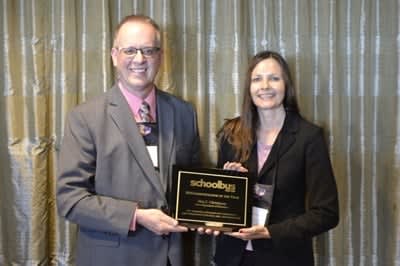
For his dedication not only to school transportation safety in Iowa but across the U.S. for the last three decades, School Bus Fleet named Max Christensen its 2018 Administrator of the Year.
Successful Teamwork
With his keen communication skills and team-building talents, Christensen has helped pupil transportation establishments progress.
Throughout his career, he has emphasized the importance of teamwork, having found that it is rare for one person to effect change on their own.
“One person might be the catalyst for an idea, but it takes a team to make things happen,” he says.
In one instance he took an important stance on a sensitive issue. In another, he helped crucial work on updating and maintaining industry standards continue through the 2015 NCST.
Attending a school bus crash demonstration with lap-shoulder belts in 2013 solidified for Christensen his position that school buses be equipped with them. However, that was a challenging and even contentious issue at times.
“It’s certainly not going to be a very popular position to take,” he says of his concerns at the time.
As the president of NASDPTS, he knew that the organization’s position was that it supported lap-shoulder belts — if there was funding for them. He worked with the then-executive director of NASDPTS on a presentation on the topic for the association’s board of directors. The presentation convinced the board, and NASDPTS moved forward with its current position paper, which states its support of lap-shoulder belts in school buses, regardless of funding.
“It reignited the conversation, [which] has moved toward the fact that school buses should have lap-shoulder belts,” Christensen says. “That was a huge team effort.”
The following year, he worked with NASDPTS and the NCST Steering Committee to quickly find a new location for the conference after it lost its long-held venue in Warrensburg, Missouri, enabling the Congress’s important work to continue.
Derek Graham, a consultant, the former state director for North Carolina, and a colleague of Christensen, says that when that conference needed to be relocated, Christensen was there to serve the Congress as its onsite coordinator, taking a personal interest in making it a positive experience for the entire industry.
Graham also said that Christensen “exhibited outstanding leadership for [NASDPTS], and always with a joyful attitude.”
Due to the NCST 2015’s success in Des Moines, it will be held there once again in 2020, Christensen says.
More Management
How to Build a Better Driver Training Program
Ready to boost up your school bus instructor training? Here’s how to pick the right talent and improve recruitment, retention, and safety.
Read More →
CALSTART and Forth Combine to Form Catalyst Mobility
The new name represents a renewed vision for the nonprofit focused on advancing clean, equitable, and affordable transportation solutions that move people and goods.
Read More →
What Makes a Great School Bus Driver Trainer?
Choosing the right school bus driver trainer takes more than experience. Learn six keys to selecting and developing trainers and evaluating program effectiveness.
Read More →

School Bus Contractors Expand Through New Deals, Acquisitions & Partnerships
STA's Canadian division acquires Ontario-based G&L Stevenson Transport while Durham School Services adds a new district contract in California, First Student adds a New Jersey contract, and Minnesota Coaches acquires Halo Transportation.
Read More →
Logan Bus Company Rolls Out AI Phone System for NYC School Bus Families
A summer pilot found that AI agents could handle most routine calls, freeing up time for customer service staff to focus on emergencies and complex family concerns.
Read More →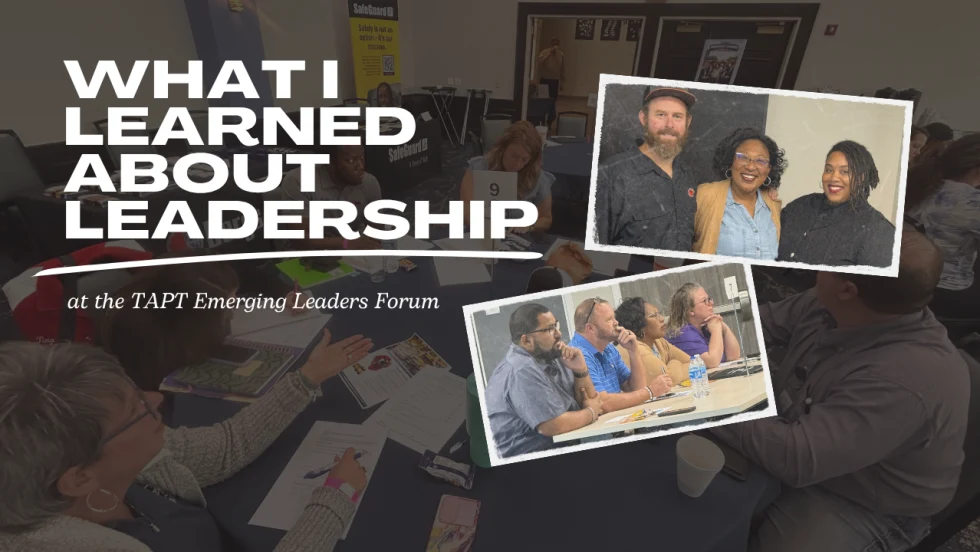
From Intent to Impact: What I Learned About Leadership from TAPT
A Texas transportation supervisor shares lessons on self-awareness, accountability, managing stress and building trust — and why investing in leadership development matters at every stage of your career.
Read More →
NAPT Names 2026 Award Recipients, Hall of Fame Inductee
Who earned national recognition for their work in student transportation? This year, NAPT named five recipients of its 2026 awards for service, safety, and leadership, plus its newest Hall of Famer.
Read More →
2026 State of Student Transportation Report
Driver shortages. Rising costs. Growing safety expectations. More data, but not enough time to act on it. The 2026 State of Student Transportation Report reveals what transportation leaders say is putting the most pressure on their operations—and where they’re investing next. See how your priorities compare.
Read More →
How to De-Escalate an Angry Person: 5 Steps for Handling Workplace Conflict
What makes emotions run high, and how should you handle an angry colleague or parent? Follow these steps for staying calm, listening, showing empathy, and resolving conflict.
Read More →
What Readiness Looks Like This School Year
Learn about the challenges shaping the 2026–2027 school year, from persistent driver shortages and budget pressure to technology and readiness gaps. See how school districts are responding and adapting in Zonar’s 2026 Back-to-School Readiness Report.
Read More →