




Legislators Need Education on School Buses
James Blue, School Bus Fleet's general manager and publisher, weighs in on recent bills across the U.S. that have taken aim at school bus safety.

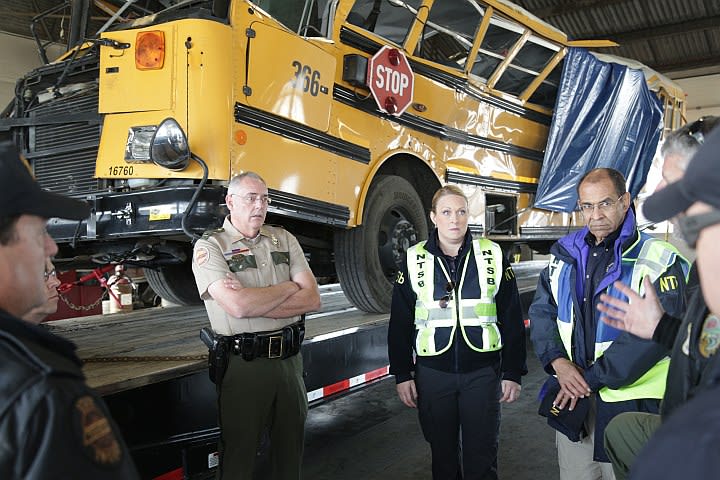
Bills targeting school bus safety were likely spurred by recent high-profile school bus crashes, such as the one in Chattanooga, Tennessee. National Transportation Safety Board photo by Nicholas Worrell
Bills targeting school bus safety were likely spurred by recent high-profile school bus crashes, such as the one in Chattanooga, Tennessee. National Transportation Safety Board photo by Nicholas Worrell
State legislatures across the country are in full swing, and many of them have school transportation in their crosshairs.
It’s not unusual for yellow buses to be the subject of legislative proposals, but this year there seems to be an influx of bills that specifically take aim at school bus safety. This was likely spurred by recent high-profile school bus crashes, particularly the Nov. 21 crash in Chattanooga, Tennessee, in which six students were killed.
In the wake of that tragedy, lawmakers in Tennessee have introduced several proposals that target pupil transportation safety. Some seek to raise the state’s minimum age for obtaining a school bus endorsement. (The driver in the Chattanooga crash, Johnthony Walker, was 24.)
Another piece of legislation in Tennessee would increase training requirements for drivers as well as managers and would mandate formal policies for responding to school bus safety complaints. The latter issue also ties in with the Chattanooga crash: Concerns had previously been raised about Walker’s driving.
Then there are the predictable proposals to mandate seat belts on school buses, and not just in Tennessee — at least 16 other state legislatures have recently introduced school bus seat belt bills, according to The Associated Press.
In Tennessee, one of two bills filed by state Rep. JoAnne Favors of Chattanooga would require Tennessee school buses bought after July 1, 2018, to be equipped with “a restraint system” for passengers. Five years later, all school buses in the state would have to be equipped with the restraints.
It would be to no one’s benefit to pass another mandate that goes unfunded and falls by the wayside.
Naturally, Favors wants to improve school bus safety in response to the tragedy that took place in her own city. However, there’s a glaring ambiguity in her bill, at least as originally written: It does not specify a type of restraint. Should those be lap-shoulder belts? Lap belts? Straitjackets?
The text of the legislation only stipulates that the restraint systems would have to be “approved by the national transportation safety board [sic].” But the National Transportation Safety Board (NTSB) doesn’t have regulatory authority over school buses — the agency, which is still investigating the Chattanooga crash, makes nonbinding recommendations.
We do know that NTSB has endorsed lap-shoulder belts as a way to enhance occupant protection for school bus passengers, but the agency has also said that lap belts can provide a benefit when worn properly. That doesn’t sit well (no pun intended) with some pupil transportation officials who worry that lap belts could be used as a weapon or that they could cause abdominal injuries in a crash.
Legislation that’s vague about restraint types has also cropped up in Louisiana. Last year, a state legislator filed a bill that would have required undefined “restraints” on school buses. The bill was later withdrawn and replaced by the commissioning of a task force to study school bus safety issues, including seat belts.
As we previously reported, the Louisiana task force ultimately recommended that seat belts not be mandated for the state’s school buses. But if they are mandated, the panel said that the Legislature should provide funding for three-point belts — and for employing an attendant for every bus that is equipped with them.
The funding issue has been another stumbling block in Louisiana. The state actually already passed a school bus seat belt bill (which also used the term “restraints”) in 1999, but it was contingent on funding being appropriated to pay for the restraints. Since the mandate remains unfunded, it has not become effective. The same thing happened with a seat belt bill that was passed in Texas.
My point here is not to chide legislators, but rather to show that many of them need to be more informed about the various factors involved in school bus safety, the different types of restraints, the costs of adding those restraints, and the funding challenges that already exist for pupil transportation.
After all, it would be to no one’s benefit to pass another mandate that goes unfunded and falls by the wayside.
More Management

The Right Ride for Every Student: Navigating the New Student Transportation Ecosystem
How should districts blend school buses with small-vehicle transportation and other options? EverDriven CEO Mitch Bowling discusses safety, costs, partnerships, and strategy.
Read More →
Annette Brown Always Takes the Extra Time: Meet Our 2026 School Bus Driver Hero
For more than 30 years, the Wa-Nee Community Schools driver has treated students like family, combining safety, compassion, and servant leadership to make a lasting difference on and beyond the school bus.
Read More →
How to Build a Better Driver Training Program
Ready to boost up your school bus instructor training? Here’s how to pick the right talent and improve recruitment, retention, and safety.
Read More →


CALSTART and Forth Combine to Form Catalyst Mobility
The new name represents a renewed vision for the nonprofit focused on advancing clean, equitable, and affordable transportation solutions that move people and goods.
Read More →
What Makes a Great School Bus Driver Trainer?
Choosing the right school bus driver trainer takes more than experience. Learn six keys to selecting and developing trainers and evaluating program effectiveness.
Read More →
School Bus Contractors Expand Through New Deals, Acquisitions & Partnerships
STA's Canadian division acquires Ontario-based G&L Stevenson Transport; Durham School Services adds a new district in California; First Student expands in New Jersey; and Minnesota Coaches rebrands and acquires Halo Transportation.
Read More →
Logan Bus Company Rolls Out AI Phone System for NYC School Bus Families
A summer pilot found that AI agents could handle most routine calls, freeing up time for customer service staff to focus on emergencies and complex family concerns.
Read More →
From Intent to Impact: What I Learned About Leadership from TAPT
A Texas transportation supervisor shares lessons on self-awareness, accountability, managing stress and building trust — and why investing in leadership development matters at every stage of your career.
Read More →
NAPT Names 2026 Award Recipients, Hall of Fame Inductee
Who earned national recognition for their work in student transportation? This year, NAPT named five recipients of its 2026 awards for service, safety, and leadership, plus its newest Hall of Famer.
Read More →
2026 State of Student Transportation Report
Driver shortages. Rising costs. Growing safety expectations. More data, but not enough time to act on it. The 2026 State of Student Transportation Report reveals what transportation leaders say is putting the most pressure on their operations—and where they’re investing next. See how your priorities compare.
Read More →