




LED Unit Bolsters 'Stop' Message
What part of the word S-T-O-P don't they understand? To someone on the inside of the pupil transportation industry, the problem of illegal passbys...
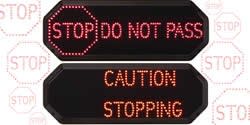
What part of the word S-T-O-P don't they understand?
To someone on the inside of the pupil transportation industry, the problem of illegal passbys can be bewildering. How could anyone drive by a school bus that's loading or unloading pupils when red lights are flashing and a sign that reads "STOP" protrudes from the large, yellow vessel?
The fact that thousands of these incidents — some with tragic results — occur across the nation each school day indicates that some motorists aren't getting the message.
To help in eliminating this dangerous and persistent problem, Transpec Worldwide, based in Sterling Heights, Mich., developed an LED display called Driver Alert.
The unit, which measures about 9 by 24 inches, works in conjunction with the warning-light system on a school bus. When the bus activates its amber lights or emergency flashers, the Driver Alert alternately flashes the words "Caution" and "Stopping." When the red lights and stop arm are activated, "Stop" and "Do Not Pass" flash. Can it get any clearer than that?
Root of the problem
A fundamental part of reducing stop-arm violations is understanding why they happen. Ron Lamparter, CEO and founder of Transpec, identifies three basic types of offenders:
1. The "scofflaws" — those who are aware of the law on passing school buses but choose to disobey it.
2. Those who are ignorant of or just don't understand the law.
3. Those who miss the "stop" message because of obscured visibility.
With the creation of Driver Alert, Transpec took aim at the latter two. "The only thing that can deal with the scofflaws is law enforcement," Lamparter says.
Regarding the second category, Lamparter says that many people learned in driver education that when you see a flashing red light, it means, "Stop and proceed with caution." Therefore, some motorists stop behind loading or unloading school buses and then drive slowly past.
Transpec addressed this confusion by endowing the Driver Alert with an unmistakable message. "Instead of just saying, "Stop," the Driver Alert says, "Stop — Do Not Pass," Lamparter says.
{+PAGEBREAK+} Regarding the third category of offenders, the obscured visibility is largely due to low light and inclement weather. However, research performed by Transpec found that the two-light arrangements on many stop arms can add to the problem.
Lamparter says that when a bright light is shining off a stop arm, the sign itself becomes obscured.
"Our research indicates that the brighter you make these lights, the more counterproductive they become," he says.
The cautionary words on the Driver Alert sign are spelled out in high-visibility LEDs, which is key to the effectiveness and reliability of the product.
Along these lines, Transpec also developed a stop arm that spells out "STOP" in red LEDs to maximize visibility.
"When you arrange LEDs to form letters, you can see them from incredible distances," says Lamparter. "Because they're almost laser-like, they can penetrate rain, fog, snow and dusk conditions."
Put to the test
To measure the results of using Driver Alert, Transpec initiated a thorough test program, installing 42 units on school buses in 23 states and provinces.
Each location selected a bus, driver and route for the study. The driver compiled data during 30 days before installation of Driver Alert and 30 days afterward. In most cases, the signs were placed on the rear of buses, but some were placed on the front.
The outcome was largely positive. According to Transpec's statistics, illegal passbys were cut by at least half in more than 80 percent of the studies. Bus drivers said traffic was reacting sooner and stopping farther from the bus. In five cases, drivers reported a total elimination of passbys.
Mandatory matter
At least two states — Alabama and Georgia — have implemented mandates related to Driver Alert for new school buses, and others may soon follow suit. Lamparter says that several states and provinces are considering requiring the device, while many have approved it as an option but haven't mandated it yet.
Joe Lightsey, pupil transportation administrator in Alabama, says his state was looking for a way to increase the visibility of school buses to reduce illegal passbys as well as rear-ending accidents. On a statewide survey day last year, 1,746 passby incidents were reported.
Driver Alert was adopted in Alabama's 2005 minimum specifications. "The LED configuration and the message it flashes are what we believe will have an impact on our illegal passings," Lightsey says.
More Safety
Geotab Expands Fleet Safety Tools With Video Coaching, Risk Insights
New safety and video capabilities aim to help fleet managers assess risk, support drivers, and take targeted action through video coaching, red-light violation detection, and more.
Read More →
How to Build a Better School Bus Driver Training Program
Is it time to strengthen your driver training? Here’s how to pick the right talent and improve recruitment, retention, and safety. This video is brought to you by IC Bus.
Read More →
Recent School Bus Accidents Leave 2 Dead, 2 Injured
Four school bus crashes in Florida, Illinois, and Georgia highlight risks in transportation lots, at bus stops, and during student loading and unloading.
Read More →

When Every Second Matters, Clarity Keeps Routes Moving
From routine delays to urgent incidents, strong communication practices help drivers, dispatchers, schools, and families respond with confidence.
Read More →
What Happens When a School Bus Catches Fire — and What Can Help
School bus fires are rare but can be devastating. Learn how advances in fire suppression and asset protection help fleets detect fires earlier, reduce damage, and improve safety.
Read More →
Geotab Launches Tool to Help Fleets Investigate Road Incidents
Geotab Investigations combines telematics data, video, documents, and other evidence to help fleets reconstruct incidents, resolve claims, and determine what happened.
Read More →
Texas Sixth Grader Wins 2026 National School Bus Safety Poster Contest
Sai Darshana Yekolu of Moseley Middle School in Prosper, Texas, was named the newest winner for her artwork, bringing the theme of “Safe Rides, Everyday Heroes” to life.
Read More →
Doing More With Less: How Transportation Directors Can Prioritize Safety Amid Budget Uncertainty
With diesel prices soaring and nearly one-third of transportation directors expecting budget cuts, maintaining student safety has never been more challenging. Download this guide to learn how leading districts are prioritizing risk, funding critical safety technology, and building stronger budget cases with data.
Read More →
Walton County Schools Adds Gatekeeper Stop-Arm Enforcement System
The Florida district will deploy Gatekeeper’s updated Student Protector technology, which now incorporates AI to improve video evidence.
Read More →
How To Build a More Secure School Bus Yard During and After Hours
As thefts and overnight security threats continue, school transportation leaders are combining stronger operational practices with AI-enabled surveillance to better protect buses, facilities, and staff.
Read More →