




LED Lighting Continues to Win Converts
Over the past 10 years, light-emitting diodes have made inroads into the school bus market. In another 10 years, they could be standard equipment. Here’s why...
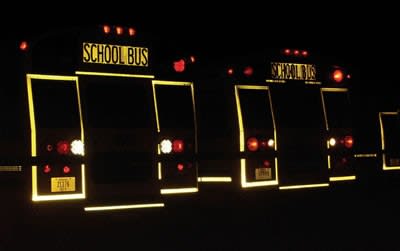
It’s been almost a decade since light-emitting diodes, or LEDs, were first installed on school buses. In that time they’ve moved from the domain of brave and/or well-funded fleets into the mainstream of the pupil transportation industry. Technological advances have lowered the cost and raised the performance of LEDs.
Despite these changes, the majority of school buses on the road don’t have LED lighting, and most new school buses are still being delivered with incandescent lights. Many school bus operators aren’t aware of the differences between incandescent lights and LEDs, and there are still some operators who have never even heard of them. They don’t realize that new options in lighting could prevent maintenance headaches down the road.
A different light
LEDs are a different kind of light bulb. In a regular incandescent bulb, wires inside a glass housing hold up a filament. When electricity runs through the filament, it heats up and gives off light. An LED has no filament or glass bulb. It’s a solid piece of clear plastic with a semiconductor inside. When electricity is run through the semiconductor, it is converted directly to light. Because the process is very efficient, it gives off very little heat and requires only a fraction of the energy of an incandescent bulb. The LED is also more durable because there is no glass or fragile filament to break or burn out.
An LED light is usually made up of multiple individual light-emitting diodes. That’s because each diode doesn’t put out as much light as a single incandescent bulb. LED manufacturers place multiple diodes in a single light to make up the difference. Working together, these diodes produce light that is as bright or brighter than an incandescent bulb.
LEDs first appeared on school buses in brake and tail lights, but they’ve since expanded their use. Warning lights, turn signals and stop-arm lights are all available as LED lighting systems. The only major exterior lights that can’t currently be LED are bus headlamps.
Brighter, faster, safer
Although the minimum legal requirements are the same for both types of lights, LED lights have been found to increase safety margins.
CRS Electronics in Welland, Ontario, which offers a complete line of LEDs and has been manufacturing an LED warning light system since 2000, asks its school bus customers to track illegal pass-bys before and after the warning light systems are installed.
CRS President Scott Riesebosch says the before-and-after difference is a reduction of 70 to 90 percent. “And this is not a flash in the pan,” he says. “It’s a sustainable figure.”
The reason that the company’s LED warning lights are so effective, Riesebosch says, is the flash pattern. It’s designed to stimulate the part of the brain that instinctively senses danger. “Our brains have no choice but to pay attention,” he says, adding that people who illegally pass school buses often are daydreaming or distracted and are not intentionally violating the law.
Wanda Kerns, transportation coordinator at Manassas Park (Va.) City Schools, has only a few buses with LED lights in her fleet. But she is a great admirer. “I love them,” she says. “You can see them for what seems like a mile, even in inclement weather. They’re great.”
When it comes to brake lights, LEDs are actually faster to light than incandescent bulbs. When a driver steps on the brakes, electricity shoots through the lighting system. With an incandescent bulb, the filament has to heat up before it produces light. The delay on an incandescent bulb is approximately 250 milliseconds, and while that may not seem like much time, for a car traveling 65 mph, it equates to an extra 24 feet of stopping distance.
[PAGEBREAK]
The instant-on feature of LEDs also makes them easier to see in flashing applications like turn signals and warning lights. Flashing incandescent lights slowly reach full brightness then dim off. The ability of LEDs to turn instantly on, stay on at full brightness and then instantly turn off creates a light pattern that is far easier for the human eye to recognize.
Justin Wilczynski, assistant transportation director at Clark-Pleasant Community School Corp. in Whiteland, Ind., believes the enhanced safety of LED lights should be factored in to spec’ing decisions. “Why would any supervisor in transportation pass up the opportunity to make their buses that much safer?” he asks.
Lights that last
The appeal of LEDs from a maintenance point of view is undeniable. A high-quality LED lighting system should last the life of the bus. Maintenance costs with LED lights should be virtually nil.
Most incandescent lights have an expected lifetime of 1,000 to 2,000 hours. They need to be replaced every few years or so, depending on usage. Most LEDs have a life of 100,000 hours — far longer than any school bus would be in operation through its lifetime.
Clark County School District in Las Vegas was one of the first school districts to install LEDs in their buses, primarily because of their long-term ease of maintenance. Frank Giordano, vehicle maintenance coordinator, says the annoyance of replacing, say, a burned-out clearance light is becoming a distant memory. “Since we’ve gone to the LED lights, I don’t have guys out there balancing on a ladder having to change those things,” he says.
Says Wilczynski, “I have about 30 buses equipped with SoundOff Signal lights and have had to replace only two lights. And that was because a strand of LEDs was out. We probably could have run the lights in the condition they were in, but our warranty allowed us to have a replacement.”
This sturdiness and reliability of LEDs are an obvious benefit. Says Terry Applegate of Weldon Technologies: “If you make the right choice, on the right LED, you don't have to worry about it. That’s assuming that you don’t back into something.”
A matter of economics
The primary reason many operators cite for not switching over to LEDs is cost. The price of LED lights is usually six times, or more, than that of incandescent lights. The cost to retrofit a bus equipped with incandescent lights to LEDs can be even higher. It’s no wonder that sticker shock has scared away some school bus operators from the new technology. Many bus operators simply have a hard time justifying to superiors the higher cost of LEDs.
But the higher initial cost is more than compensated by the reduction of vehicle downtime and labor costs. “If you add the cost of the maintenance — actually pulling off the lens and replacing the bulb two or more times — you’ve pretty much paid for an LED light,” Applegate says.
Fact and fiction
Because the maintenance cost benefits of LEDs only arise if they don’t need to be replaced, it is important to choose the right LED lighting system. And because LEDs are relatively new to the market, information about them is sometimes scarce, and sometimes wrong.
One popular myth advises to always pick the light with the most LEDs. The belief is the more LEDs a light has, the more light it puts out. This used to be true, when LEDs first hit the market. But since then, a new generation of LEDs has been developed, and these new diodes put out more light than older models.
“Just because you have a lot of LEDs doesn’t mean that the LED light is brighter,” says Scott Comisar, general manager of Doran Mfg. “People think more is better, but LED lights are going to get where instead of having five or six LEDs, there may be one or two.”
As with any new technology, it pays to research before you buy. Be sure to get information about third-party testing of any lighting system you’re considering, and compare the warranties of several manufacturers.
The future of lighting
Prices for LED products have been dropping since they were introduced in school buses, and all indications are that prices will continue to go down. Lower costs should allow even the most budget-conscious fleets to be equipped with LED lighting systems.
Recent advances in technology have allowed LEDs to expand their color range from red and yellow to white light. As more and more are produced, their cost will fall, making them economically feasible for use all over school buses, from dome lights to stepwell lights to exterior flood lighting.
Lower costs and increased versatility mean that in the next few years, LEDs will move from an expensive option to the primary choice in school bus lighting.
Travis Kott, national account manager for SoundOff Signal, has a prediction: “I would say in the course of the next seven to 10 years, you’re probably going to have to ask for incandescent lights, because LED will more than likely be standard.”
Rob Slusser is a freelance writer in Manhattan Beach, Calif.
More Management

The Back-to-School Checklist Every Director Should Complete Before the First Bell
Help your transportation team start the school year strong with these tips for contingency planning, communication, fleet visibility, technology, and trip management.
Read More →
How a New York District Cut Nearly $1M in Transportation Costs While Expanding Bus Access
A data-driven overhaul with BusRight reduced Poughkeepsie City School District's planned routes from 26 to 17 while extending school bus service to about 1,200 additional students.
Read More →
Budgets Down, Enrollment Shifting: What the Data Says Districts Should Watch
School transportation departments face two converging challenges this year: tightening budgets and shifting enrollment. Most districts still address these issues separately, but the assumption that either trend will simplify operations is proving incorrect.
Read More →
These 8 School Transportation Companies Made the 2026 Inc. 5000 List
Find out which school transportation contractors, technology providers, and suppliers ranked among America’s fastest-growing private companies.
Read More →
The Link Between Emotional Intelligence and School Bus Safety
How can emotional intelligence help transportation pros navigate stress, manage change, and build stronger relationships? Listen to find out.
Read More →
What Emotional Intelligence Has to Do With School Bus Safety
In this video, discover how emotional intelligence can help transportation leaders and drivers navigate stress, manage change, and build stronger relationships. The Route is sponsored by IC Bus.
Read More →
Beyond Two-Way Radios: School Bus Communications Evolve With Push-to-Talk Over Cellular
PRYME Radio and PositionPTT join forces to advance hands-free radio use and reduce distracted driving. See how PoC compares with traditional radios on range, cost, safety, and connectivity.
Read More →
Have School Districts Adapted to Bus Driver Shortages or Simply Accepted Less Service?
According to a recent report from HopSkipDrive, many districts appear to have recalibrated what "normal" transportation service looks like.
Read More →
Reliable Transportation Linked to Better Student Outcomes, New EverDriven Study Finds
See why new research suggests transportation consistency improves student outcomes while influencing attendance, funding, IEP compliance, and family trust.
Read More →
Switzer-CARTY Enters the U.S. with New Acquisition
The Canadian contractor’s acquisition of Minnesota-based Agnes Corporation marks its first cross-border expansion into the United States and adds 350 vehicles.
Read More →